GMBC ep43 - Magic, Mayhem, and Betrayal: The Spellslinger Experience Unpacked
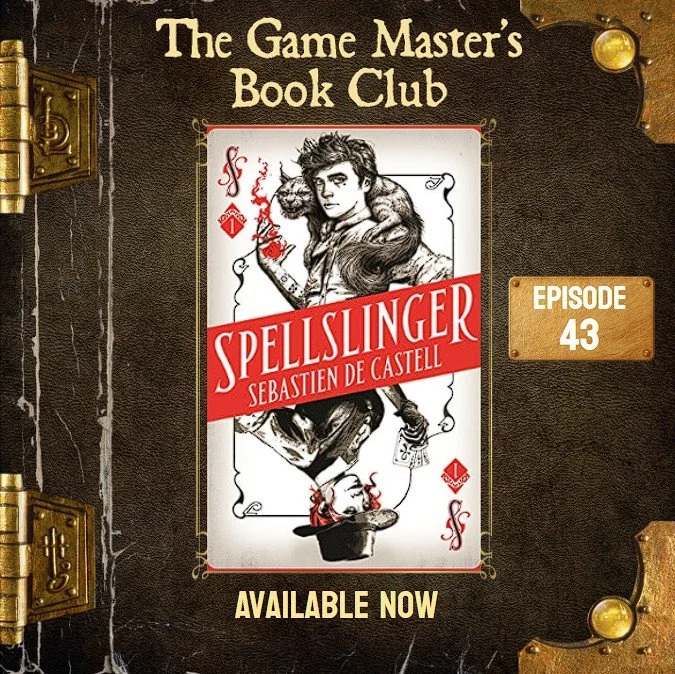
Sebastian De Castell
Spellslinger
Speaker A
00:00:02.480 - 00:00:13.400
Welcome to the Game Masters Book Club, where great fiction becomes your next great tabletop roleplaying experience. Kellan wants to be a mage, but he has no magic to speak of. Being a mage is everything to his people, the Jantep.
Speaker B
00:00:13.400 - 00:00:18.160
So Kellan decides to cheat his way through his trials. But Kellan isn't the only one keeping secrets.
Speaker A
00:00:18.160 - 00:00:21.960
And all of his fluffing and scrabbling unravels the web of plots that holds.
Speaker B
00:00:21.960 - 00:00:25.360
His friendships, family, and the whole of Jantep society together.
Speaker A
00:00:25.600 - 00:01:32.780
How will he survive? George Krupsky, Marshall Smith and Eric Drix will take us through Sebastian de Castell Spellslinger, the first book in the Spellslinger series.
They will introduce us to fabulously complicated NPCs, explore interesting magic systems, and discuss bringing back level titles from first edition D& D. Let's get into the conversation and welcome to the Game Masters Book Club. Here we are again to talk to you about another amazing book. This time, Sebastian de Castell's Spellslinger series.
Six novels, a bunch of short stories, and but for us, just the first book. And today I have three amazing game masters here who have all read the book and are all super talk about it. But why listen to me tell you about them?
Why don't I just have them tell you? Perhaps because I'm planning a betrayal. And that is in fact the question we have for our Game Masters tonight.
How do you handle betrayals in your game? And that should definitely bias you. If you're going to be looking at the Spellslinger, be ready for some betrayals.
We're going to start off with George Krupsky. George, you want to tell the people a little bit about yourself and about an experience of betrayal in your tabletop roleplay game?
Speaker C
00:01:34.140 - 00:01:53.100
Sure. I mean, I've been gaming for four decades or so. I'm the GM more often than not.
And you know, if you're going to keep it fresh and interesting, everyone can't be friends. So you have to have different factions and different angles and have it all come together in the end.
Speaker A
00:01:53.260 - 00:02:00.220
The betrayal as a necessary part of the game. Marshal, tell the people who you are and about betrayal in your game.
Speaker D
00:02:01.010 - 00:02:01.330
All right.
Speaker E
00:02:01.650 - 00:03:00.440
My name is Marshall Smith. Been a DM for a long time and I've got a few writing credits for RPGs. I've done other podcasts. I've been around for quite a while.
I don't think that I have ever, as a dm, done a major betrayal of the party. However, there was an incident where I was the player and the dm, we found an orphan girl in the marketplace.
And we immediately went, hey, we are going to take care of her. And we hired her to be our maid.
And it turned out that she had been working for the bad guys from the very beginning, passing them all the information on all of us. And then at the conclusion of it, she opened up the doors and let all the bad guys into our house. And it was a. It was pretty awful. Yeah.
Speaker A
00:03:01.000 - 00:03:03.560
So don't trust those rescued orphans.
Speaker E
00:03:04.440 - 00:03:18.040
I do currently have a plan to. Since the DM from that game is a player in my current game, I do have a plan in place to take revenge.
Speaker A
00:03:18.360 - 00:03:24.840
Oh, well, goodness. But since he obviously is a listener of the podcast, we better not say anything out loud.
Speaker E
00:03:24.840 - 00:03:25.020
So.
Speaker A
00:03:25.090 - 00:03:30.770
So, yes, absolutely. So, Eric, do you want to talk about portrayal in your game?
Speaker D
00:03:31.010 - 00:05:13.490
Yeah. Hi, my name's Eric. I'm in from the Philadelphia area. Longtime gamer, longtime gm.
I've both experienced betrayal from a GM that worked with a player that was falling to the dark side. And basically when the player switched characters, he just flat out betrayed us.
So he used that sort of, hey, players should always trust each other, and we're all players working towards the same goal. But the GM DM actually betrayed us. And the player ended up stepping out and bringing in a different character, which was tricky.
But from how I use betrayal, it's.
There are things I little things I keep in mind first before the betrayal happens, create value with that betrayal and then have the betrayal take or limit it. So, for instance, the example of a child is a fantastic one.
You know, the value was the players felt good, they saved this child, they did that, and then the child betrayed them.
Or a healer who the party constantly is tending to, the party who eventually falls to the dark path was they lost something, they couldn't save somebody, and they went to the dark path without doing that. So. And taking that from the players really sets that moment for the betrayal to really matter. And the only other warning is don't do it all the time.
If you over betray, over betray, over betray, you will have jaded or overly suspicious characters. Players that don't want to get involved, they don't want to help people anymore. Because if you do it too much, it causes a backlash.
Speaker A
00:05:13.490 - 00:05:19.250
Yeah, I could see where betrayal within the party leads to lack of heroism.
Speaker D
00:05:19.410 - 00:05:19.730
Right.
Speaker A
00:05:19.730 - 00:06:29.750
The idea that you're not going to put yourself out there for somebody because every time you do, somebody's going to. Orphans are going to let villains into your house. I mean, that's just crazy. I am the other Eric. I'm Eric Jackson.
And I am in Lowell, Massachusetts and I have been playing since the Pleistocene and this is my podcast and I'm not really good at betrayal as a general rule.
It's not something I, I do, but I think maybe because I have used it so sparingly the couple of times that I have used it, it's worked out really well.
The last time that I specifically remember running one, the party of people who came in to run a game, I was running a game for them and they just didn't have a cleric and they had to find any cleric they could find and they found a cleric of the God of Thieves.
And unsurprisingly, when they finally made it to the final, sort of the final place where the big treasure hoard was, the cleric took the money and left.
So the party was all of a sudden in front of this, their big bad evil guy and, and there was just a little note and I think, I think I left like two healing potions and said, thanks guys, appreciate your help. And off he went. And those players still speak that thieves name with great vehemence.
Speaker E
00:06:29.830 - 00:06:39.920
So that reminds me of the critical role moment where Joe I can never. Mangiello, whatever, however you pronounce his last name, took the hand of Vecna.
Speaker A
00:06:39.920 - 00:07:55.320
Oh yeah, right out. Excuse me. Chop click, buy. Oh.
So today we're going to go into some of that betrayal and we're going to talk a little bit about the Spellslinger series where spoilers. For those of you if you are listening to this podcast and youth would like to read this book, please stop now.
There's a betrayal in it and we're going to talk about it and that will definitely change your listening and or reading pleasure. So you are forewarned. I'm going to give a little summary of the book and then you guys can tell me what I missed. Here we go.
A society that treats non wizards as second class citizens. A young wizard who is hiding that he has no magic. A wizard duel that goes horribly wrong. A rescue by a fast talking stranger from the desert.
A familiar who is an ancient enemy of the wizards. Okay, he's more of a business partner, but still a conspiracy of huge historical and cultural significance and prejudice, power and pride.
All met with the desire to be a good person. This is Spellslinger, the first book in the eponymous six book YA fantasy series by Sebastian De Castell.
Yes, that's the author of the Grim Dark Musketeer series. He also has a YA series, so enjoy. And that's what I have to say.
Speaker D
00:07:55.320 - 00:08:04.960
About that Throw In a dash of political manipulation and back dealing. And I think that was an excellent, excellent summary.
Speaker A
00:08:05.200 - 00:08:05.920
There we go.
Speaker E
00:08:06.320 - 00:08:26.930
Marshall, I was just sitting here trying to count the number of betrayals, starting with his sister, his parents. I don't think the dowager ever actually betrayed him. Just manipulated him, his uncle, his friends, multiple friends on multiple occasions.
Yeah, there was a lot of betrayal in this book.
Speaker A
00:08:26.930 - 00:08:28.450
Kellen could not catch a break.
Speaker D
00:08:28.610 - 00:08:35.050
To be perfectly honest, it was really interesting how each character had their own justifications for their betrayal.
Speaker A
00:08:35.050 - 00:08:55.940
Oh, yeah, yeah, yeah. Absolutely. No, they absolutely had. There was definitely. Like I said, there's pride, there's prejudice, there's greed, there's agreed for power.
It's all over the place. And it does seem like there isn't in this. You've read the book more than once. So what's the name of the people? The Jetet.
Speaker D
00:08:56.180 - 00:08:56.700
The Jan.
Speaker A
00:08:56.700 - 00:09:01.780
The Jan Thep. Yes, the Jan Thep. Being a good person doesn't seem to be high on the list.
Speaker C
00:09:01.940 - 00:09:09.300
Yeah, I think what your summary missed, Eric, is that the Jantep Society is just terrible, which makes sense.
Speaker A
00:09:09.300 - 00:09:36.510
While I was writing that, I found out that Sebastian De Castel wrote the Greatcoat series, which has been described as a grim, dark Three musketeer series. So I'm like, okay, this is somebody who's done palace intrigue and terrible people, right?
Because even can easily interpret this Three Musketeers into something very grim, dark. And it's like, I'm impressed that he's as hopeful, or at least his main character is as hopeful as he is based on knowing what else he's written.
Speaker E
00:09:36.510 - 00:09:40.670
It's still book one. There's. There's plenty of time to. To rub that off, I suppose.
Speaker A
00:09:40.670 - 00:10:37.510
So, yes, I. We'll have to see.
I may come back and make a comment about that at some point in the future and be like, hey, guys, I read the second and third book of the Spellslinger series and remember when I said it wasn't too grim, dark? Oh, boy. Anyway. Well, we'll see. The Internet will obviously prove me wrong once this comes out.
But anyway, let's talk a little bit about this first book and about how we as game masters might like to put a world like this together. Not only the betrayals, but this was a really well layered world. It had a lot of great things happening in it.
There are a lot of really cool cultural bits. There was a lot of great historical context, so. And it's obviously a fantasy with spell casting and all kinds of other neat stuff.
So if you were going to Run spellslinger. And you wanted to put it into a tabletop. What's the mechanic that you would want to use? Marshall, do you want to start us off with that?
Speaker E
00:10:37.590 - 00:11:03.680
So the one part is not so much a mechanic, but the Dowager Queen Mara San is immortal as long as she does not leave the room that she is in. She is layered in a series of spells that keep her alive as long as she stays there.
And I just thought that was such a really clever trick to pull there. I thought it was fantastic.
Speaker A
00:11:03.680 - 00:11:04.320
Agreed.
Speaker E
00:11:04.560 - 00:11:06.120
I definitely want to steal that as an npc.
Speaker D
00:11:06.120 - 00:11:07.360
It's a great character.
Speaker A
00:11:07.520 - 00:11:09.440
Yeah, it's a great character. Absolutely.
Speaker D
00:11:09.520 - 00:11:47.570
Mechanics for me, I love that the physical representation of sort of their strength and their.
Their magic powers as the characters who are the mages have these bands that they call sparking their bands when they connect with a certain type of magic. I love that physical representation because it does a bunch of things. It helps with the cultural significance of magic. I love.
And I would totally take a world where.
Where mages consider themselves the primary power and how that domino falls and creates problems in the rest of your world, I think would be fascinating.
Speaker A
00:11:47.650 - 00:12:47.020
Agreed. I'm going to jump in just because you mentioned, like the cultural magic that was there and that my choice for this would be.
Or, excuse me, 7C current version. We'll talk a little bit about that later. The second edition.
I find that all of the magic and a lot of the things that you can do are very culturally based. And so you can get these very typical characters that can come out of their pseudo Italian group or their.
They have a desert one that's like, got a bunch of cool Egyptian stuff, but also has some really cool Jewish and Israeli kind of things that are in there. It's just fantastic.
They do a really great job of looking into a lot of those mythologies and putting them into a gamified kind of area that you can play in.
And I think it would be really easy to take the structures that they have for a lot of those cultures and then go, okay, let's do this for the spellslinger cultures. And there's a couple of them in there, so that would make. I. I think it's really set up well for that.
George, do you want to wrap us up on the mechanics?
Speaker C
00:12:47.020 - 00:12:54.140
I also like the dowager as. As a concept to steal, but for different reason. You said we could go for spoilers.
Speaker A
00:12:54.300 - 00:12:55.340
I absolutely did.
Speaker C
00:12:55.580 - 00:13:29.290
In the book she's keeping.
She has a bunch of information that the main character needs, but because of magic, she cannot tell him Directly, so he's got to sort of tease it out. And it's even a cat and mouse game early on for him to realize that she has that information.
And I love the idea of an NPC who has information that they want to share but they cannot. And the protagonist or players would have to sort of figure out how to get at that information in a non conventional way.
Speaker A
00:13:29.290 - 00:13:59.990
Yeah, when we did Nettle and Bone here on the podcast, I think it was like our third episode. There's a character who also has a curse that doesn't allow. Allow her to say outright what the curse is that's there.
It actually has another really clever way of getting around that spell as well. Read the book if you want to know what the answer is, or listen to the podcast, because we did talk about it there.
But George, you had mentioned when we were in the pregame that if you were going to run this game, you would run it as like a superhero game.
Speaker C
00:14:00.070 - 00:14:40.910
Yes.
You know, I like old school stuff and I used to love the villains and vigilantes game, which is very good mechanic for balancing skilled characters versus superpowered characters. And what we really have in this book, to me, is skilled characters versus super powered characters in some cases secondarily.
I also like the idea in one of the key mechanics governing superpowers in villains and vigilantes is that you have certain, certain amount of points of power and you can sort of run out of steam. So I think that's a good way to govern and balance the magic. I'd probably go back to my old V and V books and adapt.
Speaker B
00:14:40.990 - 00:14:41.550
Not bad.
Speaker A
00:14:41.710 - 00:14:44.830
Eric, I think you had said something about mutants and masterminds.
Speaker D
00:14:44.990 - 00:15:25.900
Yeah, for a lot of the same reasons that was just said about villains and vigilantes. Each character, whether you're skill based or have magic powers, is there's a power level with points, so everyone's built with the same points.
There's also a whole section of advantages and disadvantages.
So if for some reason something would happen to your character and you want to have a disadvantage on your magic power, where you can only use, let's say shadow magic, you could do that. And that's very easy to apply along the way, as well as grow and change if necessary.
The other mechanic I use is lean into the Buffy rpg just because it's very quick, it's light and fast paced.
Speaker A
00:15:26.250 - 00:15:37.130
And it's got that main protagonist slot to fill, which Khalid does. He's really occupying that in a pretty big way. Marshall, I think you said you were looking at doing A homebrew on this one.
Speaker E
00:15:37.370 - 00:16:36.100
Yeah. There are enough unique elements to this that I would really want to capture that I would want to do a ground up homebrew.
I would probably use Fate as my base system.
Both because I just really like Fate and because I feel like there's an awful lot that goes on in the book that is about sort of a trade off between the player Kellan and the DM in a way that favors some of those narratively mechanic systems.
I also realized as I was thinking that this book plays out like building a fake character and that you can see him picking each of his different aspects as he goes along of failed apprentice and or failed mage and counter banded and argosy and just picking up all of these things that build him as a really classic kind of fake character. So that's what I would go with.
Speaker A
00:16:36.100 - 00:17:29.139
Yeah, no, I think that's a great idea.
I'd also like to point out that if folks are really interested in taking a look at these mechanical kinds of things where you've got your spell slinger, there's a spell slinger class that you can purchase over at Drive Thru rpg. It's used in conjunction with the Gunslinger Marshall Archetype for Fighters by Jack Gregory.
If you get a chance to take a look at that, that looked pretty cool. Also to go in the Wayback Machine, if you wanted to look at another system for that, you can look at Castle Falkenstein.
They have a book called Six Guns and Sorcery and they do have spell slingers in that book though that's more of a gunslinger that shoots spells though that's kind of close. Close to what Kellen does. So hopefully those things will help. Will help folks with some mechanics if they're looking into that.
The only thing I didn't get the chance to talk about how much I liked the naming system.
Speaker E
00:17:29.219 - 00:17:29.619
Right.
Speaker A
00:17:29.699 - 00:18:00.350
I love the idea that when you came to a certain level of understanding like you once you sparked your band, you had the opportunity to take on this new name, which I thought was really cool.
I think the idea that when characters move into a different level, if you look at this from a fifth edition sort of thing, you could talk, there's that intro and then there's a sort of intermediate and then there's the epic level like you cast into the thing or when you choose your subclass. I think that'd be really awesome thoughts.
Speaker D
00:18:00.350 - 00:18:15.690
No, I agree and I. If you're creating a society where you're judged by your power, I think that a.
That makes perfect sense And B, there's has to be ways of judging that and qualifying somebody who. For those different sort of rankings.
Speaker A
00:18:15.770 - 00:19:17.120
Absolutely. I think it was during the pregame.
Marshall pointed out that this is not a new idea because if you go back to your first edition handbooks for AD and D, all the different classes had. For every level had a different name. And actually this brings up the game that I'm in.
We just faced a bunch of Druids and they had the head of their circle and that sort of thing. And that brought back up the idea that you. And this is something that they bring up in the book.
In order to sort of achieve the top level of being a mage, either the guy has to die or you need to kill him. And that was. That was in the rules originally with the Druids. Like, if you wanted to become a name level, you had to defeat the person ahead of you.
Same thing with the monks in the original game, you had to like, if you wanted to become the Grandmaster of Dragons, which was seventh level, you had to go out and find the existing Grandmaster of Dragons and go defeat him before you could level. That's kind of interesting, but. And I'm not sure I'd want to bring it back, but there it is.
Speaker D
00:19:17.360 - 00:19:35.760
It's a great thing to use.
Like from a cultural or other type of reward standpoint, if someone wants to be the head of this organization, they have to defeat the current head of the organization. So they're not losing value that they feel like, oh, I can't progress. But it's a social reward, a social treasure.
Speaker A
00:19:35.840 - 00:19:59.930
And one of the cool things, actually, I think that is neat about this book as well.
And we'll talk about other media that's like this, I think, is that this character and this book really takes time to take a character out of that culture. There's a very straight line from, hi, my name is Kellen and I'm a wizard, to hi, my name is Kellan and I am no longer a wizard.
Speaker D
00:20:00.160 - 00:20:00.480
Yeah.
Speaker A
00:20:00.480 - 00:20:25.160
And that's that whole hero's journey. Right. You have to leave the home and go out and do the thing in order to become the heroes.
So it's really interesting to see how a character moves from this interior inside the culture to outside the culture. And I think that's what a lot of stories are about.
And it definitely took a bunch of betrayals for him to get there, which of course is what we were talking about before. George, you wanted to say something about that.
Speaker C
00:20:25.160 - 00:21:27.430
You guys all talked a little about betrayals in your game. I Sort of glossed over it. One of the things that can be a lot of fun with a betrayal is if you can involve one or more of the players in it.
I ran a long term game, long term Star wars game. So of course there's going to be secrets and revelations.
One of the players had conspired with me that her character was the half sister of one of the other characters. So it was Ed and Korra, married couple. Cora conspired with me. I guess not really betrayal, but kind of.
Ed did not know that their characters were related. Cora did through the whole. We did like a whole season. We did like 20 sessions. In the finale, the master villain reveals, you know, he's.
She's like, okay, go on, you know, tell Ed's character the secret you've been keeping. And Cora wouldn't do it.
So the villain says it and she goes, two characters share a father and I can see Cora's delight that the secret is coming out. And then the villain continues and looks at Cora's character and goes, just as you and I share a mother.
Speaker A
00:21:27.430 - 00:21:27.870
Nice.
Speaker C
00:21:28.430 - 00:21:37.749
So Cora was not only the betrayer but the betrayed. And it was a very delightful moment for me and ultimately for Ed and Korra.
Speaker D
00:21:37.749 - 00:21:39.230
Nice. That's awesome.
Speaker A
00:21:39.230 - 00:21:41.390
Betrayals always work so much better with couples.
Speaker C
00:21:41.470 - 00:21:57.210
One of my GM ticks is the redeemed villain. So any bad guy that the players like winds up being on their side eventually.
So I have to reverse it a lot of the time and be like, ok, well you like that bad guy. He's a good guy. Now you like that good guy.
Speaker A
00:21:57.210 - 00:21:57.930
Guess what?
Speaker C
00:21:58.410 - 00:21:59.530
On the wrong side.
Speaker A
00:21:59.610 - 00:22:52.110
I just read a book called Good Bad Witch and spoilers.
If you haven't read that book, her best friend in the town where she was setting up her witch shop and was, you know, sort of the her equal perky sunshine self turned out to be the villain who like cast dark magic and like wanted to kill her. It was just, it was like, what? Oh my God. So that was a nice little betrayal as well. Speaking of books, let's talk about media.
If you read Spellslinger and you guys all did and you wanted to read something else, I know when we talked about this in the pre game that everybody was like, this is fairly unique. And I agree it's a pretty unique story.
But if you had to pick something that had similar vibes or at least similar vibes to part of it, where do you go for that inspiration? What media would you watch? I'm going to start with you, Eric. What you think vibes with this book.
Speaker D
00:22:52.110 - 00:23:52.800
I started thinking about the different themes of the book and everything and went all the way back to Piers Anthony's Zangth novels, which started with a spell for Chameleon, which was a young man in a society who didn't think he had magic powers and a society where everyone had magic powers and where a lot of thing is more played for more comedic. In that series, there's still that real world focus of, you know, how would this society happen and what would this person's role be.
The other book, and this is more just from a general feel, was Tress of the Emerald Sea by Brandon Sanderson. It has that sort of swashbuckly quality. They have a lot of curses which people who are cursed can't tell people about their curses and they can't.
So communication has to be roundabout as well as alchemical sort of tech that they're dealing with. So those would probably be the two books that like you said, Eric, I had trouble figuring that out which books were similar.
Speaker A
00:23:53.120 - 00:24:09.920
Yeah, you're not alone. I was doing the research and working on this today. There were a lot of folks who were like, this is, you know, this is so nice. I love this book.
It's so unique. So I think we can all be excused if we're, if we're just hitting the edges of it.
Marshall, did you want to tell us about what you think might jive with this?
Speaker E
00:24:10.350 - 00:25:24.270
So I had a lot of trouble because I can think of a hundred different books that speak to different parts of this. If you really like the magic, the unique elemental magic system.
The Blending series by Sharon Green has great elemental magic, but the rest of the story is completely different. If you like a young kid who has a powerful family, he's missing power and has to, you know, make do with his wits.
The nice dragons finish Last by Rachel Aaron is a great fit for that kind of storyline, but again that's set in a post apocalyptic modern urban fantasy kind of setting. Completely different setting. If I had to settle on one, weirdly enough, I would go with Steven Brust's Vlad Taltosh series.
You've got a guy who cannot use the magic, the powerful magic that most of the people in his society can use. So he ends up going with an alternate form of magic. He gets a familiar that is sassy, you know, in very much the same way the squirrel cat is.
He lives by his wits instead of living by power. So there's a. There's a lot of parallels there. So that would be my choice.
Speaker A
00:25:24.270 - 00:25:29.170
Don't Remember I read that book so long ago. Do you remember what the dragon's name was?
Speaker E
00:25:29.410 - 00:25:32.530
Was it the Jerry's name is Loish.
Speaker A
00:25:32.770 - 00:25:44.610
Loyal versus Rykus fight? Absolutely. I've now I've got like a little street fighter. They're bouncing back and forth in my head kind of thing happening there.
Speaker E
00:25:44.770 - 00:25:46.610
I put my money on Loyash.
Speaker A
00:25:46.850 - 00:25:53.090
Okay, so George, I consider you a media expert. What do you have that works for this particular series?
Speaker C
00:25:53.340 - 00:26:42.390
So I'm going to go old school like. Like Eric did with his first suggestion back in the early 80s.
Lyndon Hardy, I think, did a trilogy of books, Master of the Five Magics, Secret of the Sixth Magic, Riddle of the Seven Realms.
And like this book, there's different elements, there's sort of different societies that are driven by different types of magic that then drive the various rules of their societies. First book, if I recall correctly, is a guy who's Master of the five magics. He's trying to master a bunch of different magics. He's traveling around.
The second book, Secret of the Six Magic, similar to this book and to one of Marshall's suggestions, is about a guy who's just not good at the traditional magics. So he winds up finding Metamagic, which is a whole different thing.
Speaker A
00:26:42.790 - 00:28:21.240
Okay, so the first thing that came to mind, also going old school for me, is the whole idea of the different cultures and how people in those cultures all had a similar goal. That sort of unified culture concept goes all the way back to the Bulgaria by David Eddings.
That's obviously the first place where I encountered that, but where I. I think I've enjoyed it the most recently, there was a book called the Sundered Realms by Casey Blair. The world had basically exploded and it was connected by gates.
And the world, when it exploded, was roughly broken up in the shape of some of the nations. And so the nations became much more homogenized. And there's a really interesting. There's some really interesting stuff you can look at there.
And we did, not surprisingly, we've also done a podcast on that book already. So we're another plug for the sundered realms and us here.
Finally, just because I feel like I need to recommend at least one magical western because our stranger from the desert just keeps evoking that Western y kind of feeling deal, I'll recommend the devil's revolver by Vs. McGrath. Hetty Alabama. She's only 17 years old and she runs a crew of underdog thieves, but she's got her father's curse revolver, and it's very weird, Westy.
So if I had to throw one of those out there, that's one I'll put out. So that's our media recommendation. So now we're on to the end, my friends. Is there anything that folks want to actually I know this for a fact.
I know that Marshall wants to tell us something that's coming up in our promotion section. So Marshall, why don't you give us the good news.
Speaker E
00:28:21.480 - 00:29:03.190
Yes, so we mentioned 7th C earlier in the program.
Studio Agate, who is a French company that did the French translations of the second edition of 7C, has purchased the rights from Chaosium to produce a third edition of 7C. As of the time of this recording, they have just finished up first round of play testing. Things are looking pretty promising.
I am thinking that around the time this drops, we should be looking at the Kickstarter either going live, having just finished. I'm not sure exactly what their schedule is or our schedule, but should be happening around that time. So As a big 7C fan, I'm excited for it.
Speaker D
00:29:03.350 - 00:29:12.950
Sounds cool. I've never played 7C. I hope you don't mind me asking what in terms of what is the big thing for you that sets it apart from other role playing games?
Speaker E
00:29:13.430 - 00:30:31.770
So 7th Sea is a swashbuckling game. It is set in a Not this Earth. It was originally published by AEG as sort of a follow on to their Legend of the Five Rings.
So in the way that Legend of the Five Rings was not Japan, this was not Europe, but it has an analog to British Isles, it has an analog to Spain and analog to France etc. So that you can leverage a lot of your knowledge of those kind of nations to know.
Oh, if people are from the French region, they have outrageous accents and they have this kind of arrogant attitude and whatnot. You have those things that you can fall back on. Cool. It had some really good history to it. It had some really unique magic systems.
Each nation had their own unique magic system. I also happen to really like the mechanics of the first edition.
They did a lot of things, some things that were really innovative at the time, but the roll and keep system that they use I thought was fantastic. They also gave me my writing credit so, you know, always going to have a special place in my heart. Cool.
Speaker D
00:30:31.770 - 00:30:32.410
Thank you.
Speaker A
00:30:32.410 - 00:31:32.020
I played the second edition of 7C and in fact I played a second edition of 7C with John Wick at Total Con one year here in Massachusetts. So he's the primary creator of the 7C tabletop game.
So I had a chance to play it with the guy who, you know, handed the writing and did the built the game. So that was pretty cool. You get the key, the key piece and the dice pools and the exploding dice. That was new I think when they first did that.
So that was the first time I saw that at least. And anything that's got something called Danger Points is going to be my favorite. Right.
Like that whole thing is based around the idea that the DM can use Danger Points to make things more hazardous. You can earn other things if you are more heroic. Fantastic little game. I really do like it quite a bit.
I just want to say guys, this was a great book.
I think we're all going to go out and I know Marshall, I think has already bought it, bought the second book and I know that Eric is going to steal the rest of the books away from from his spouse.
Speaker D
00:31:32.020 - 00:31:32.460
Yep.
Speaker A
00:31:32.460 - 00:31:39.500
And I'm definitely going to be going out and grabbing myself a copy as soon as I can. And George, you on the boat, you're going to read another one?
Speaker E
00:31:39.660 - 00:31:40.740
I think so, yeah.
Speaker B
00:31:40.740 - 00:31:42.540
Guys, so much for doing this and.
Speaker A
00:31:42.700 - 00:32:10.810
We'll have you back again to talk about yet another book would be fantastic. And that was Spellslinger by Sebastian D. Castell.
Thanks so much to Eric Drix, George Krupsky and Marshall Smith for being the truly awesome guest who would never betray me to get their mage names.
Never Join the Game Masters Book club again in two weeks when Michael Cer, Rick Steck and Mauricio Cordero discuss the 1975 near future computer hacker novel the Shockwave Rider by John Brunner.
Speaker B
00:32:10.960 - 00:33:02.980
You can find a complete transcript of today's discussion as well as links to all of our podcasts@k-square productions.com GMBC.
You can learn about upcoming episodes on our social media, on bluesky@gmbookclub, bluesky social, on Facebook at Gamemasters Book Club, on Mastodon at gamemastersbookclub and on Instagram at Gamemasters Book Club.
If you've enjoyed the show, please like subscribe and comment on our episodes in your chosen podcasting space and be sure to share those episodes with your gaming community. You've been listening to the Game Masters Book Club brought to you by me, Eric Jackson and K Square Productions.
Continued praise and thanks to John Corbett for the podcast artwork and Otis Galloway for our music. Later, gamers and to paraphrase the great Terry Pratchett, always try to be the place where the falling angel meets the rising ape.