
GMBC ep44 Dialing Up the Future: Exploring Themes from The Shockwave Rider by John Brunner
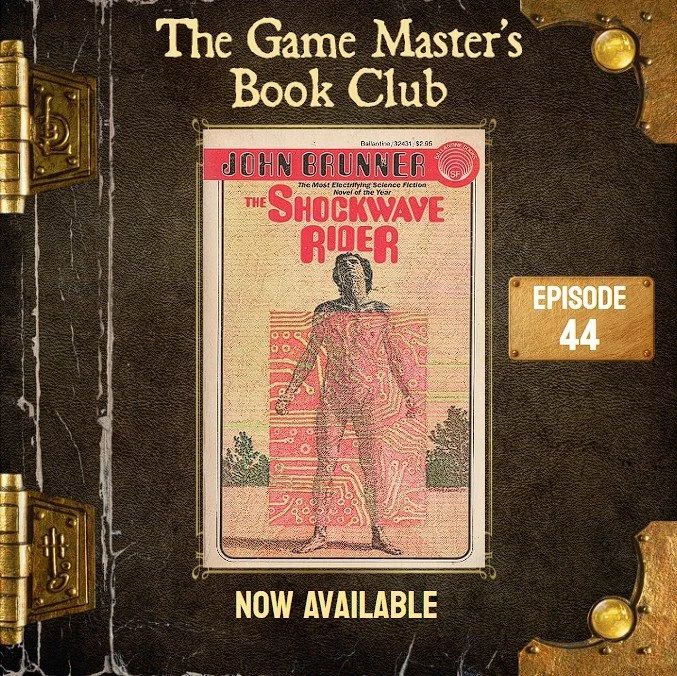
John Brunner
The Shockwave Rider
Speaker A
00:00:10.160 - 00:00:44.460
Hello and welcome to the Game Masters Book Club where great fiction becomes your next great tabletop adventure. The Shockwave, writer by Jon Brenner is a near future sci fi thriller about the 21st century as seen from 1975.
Hidden government programs that indoctrinate children to win the brain race, touch tone, telephone hacking and a fragmented American society held together by anti anxiety meds from an open load of rapid change.
Rick Steck, Michael Sanier and Mauricio Cordero are back to discuss this prescient and dated piece of sci fi so that you can bring this unique story to your tabletop. Let's get into the conversation.
Speaker B
00:00:44.940 - 00:00:45.660
Hey everybody.
Speaker A
00:00:45.660 - 00:00:48.780
Welcome to another episode of the Game Masters Book Club.
Speaker B
00:00:49.100 - 00:01:24.320
I'm here with three amazing game masters who you've met before, Rick, Mauricio and Michael. And they're going to talk to you tonight along with me about the book the Shockwave Rider by John Brunner.
And this is going to be a cyberpunk extravaganza. It's actually a really interesting proto cyberpunk book. Can't wait to hear what these guys have to say about it. But first let's talk about them.
But we'll have everybody talk about not only a brief mention of their gaming past as well as their favorite cyberpunk experience on the tabletop.
Speaker C
00:01:24.320 - 00:01:24.500
So.
Speaker B
00:01:24.810 - 00:01:29.450
So Rick, would you want to pick up on that and take us into the net, as it were?
Speaker D
00:01:29.610 - 00:03:33.440
It may be a little bit of a hot take, but there is some definitely cyberpunk adjacency to Warhammer.
If you take it to like a gritty, grim like you take all of the nasty, gnarly urbaness of cyberpunk, which is supposed to be this like cellophane sacchariny, instant gratification, instant death, like this very brutal space.
But if you take it like 10,000 years into the future where no one knows how any of this shit actually works anymore, it's all like tech cults and pieces being held together by like someone with metal clamp for a hand and a metal clamp for a hand. Like holding the two sides of a wire and using their body as a conduit so that like water pumps will work like that.
That's like my kind of my favorite thing about 40K is, you know, cyberpunk plus epic amounts of entropy gives you 40k. And so my experience with it is predominantly initially through books and media.
You go Dune, Dune to Foundation, foundation into the sea of netrunners. And we'll talk about some of what those books are. But basically that was how I ended up there.
And also the video game playing the Cyberpunk 2077 played when it came out, and it didn't matter what you played it on, it looked like it was being played on a potato. It was terrible. It has come around in this kind of an amazing immersive experience.
And so in that way, I think cyberpunk, at least for me, is seeing a little bit of a heyday. Because books, man, that's, that's, that's passe, right? That's print media. I gotta use my imagination.
But being able to like plug my eye beams right into the matrix and just have like images and sounds just pumped into my prefrontal cortex. I just want to take some space drugs and out of a nebulizer, suck them back and just melt into the web. So that, that's my exposure to, to cyberpunk.
Speaker B
00:03:33.520 - 00:03:37.760
Michael, do you want to talk to the folks about your tabletop cyberpunk experience?
Speaker A
00:03:38.770 - 00:03:39.010
Sure.
Speaker E
00:03:39.010 - 00:03:41.890
I mean, my first experience with cyberpunk was Tron.
Speaker B
00:03:41.970 - 00:03:42.450
Yeah.
Speaker E
00:03:42.610 - 00:04:16.520
Then, you know, obviously you know the, the Sprawl trilogy by Gibson.
But in a gaming context, the first was Shadowrun, which remains to this day one of the more difficult games I play, but one of the more beloved environments and worlds that have ever been created. Love that game.
Beyond going past that gurp Cyberpunk, which was a whole different kind of hard, and then, you know, spreading out, spreading out beyond that into paranoia is absolutely cyberpunk. And I'll fight you on that one.
Speaker C
00:04:16.520 - 00:04:17.200
There you go.
Speaker B
00:04:17.280 - 00:04:25.120
All good. Mauricio, do you want to tell the folks about your tabletop role playing experience as it has to do with cyberpunk?
Speaker C
00:04:25.280 - 00:05:20.680
Yeah.
As far as Tabletop Cyborg, the Elaine and Johan did a offshoot of Merckborg called Cyborg, and a lot of people confuse the name because it's just too simple. And when you try to find it on the Internet, all kinds of other stuff comes up. But that's an excellent game.
And Blade Runner, I'd say, also from Free League and also one of my early video gaming experiences. So the 1997 Blade Runner game by Westwood, they just did a reissue of it, I think last year.
So that, and, you know, the Tabletop Blade Runner I think is excellent in that focuses where it should be. It's really on the character's development and understanding of what sentience is rather than combat and long drawn out battles.
It's really about understanding.
Speaker B
00:05:20.840 - 00:05:52.690
I unfortunately am just going to reiterate what Michael said. My cool cyberpunk adventures have happened in Shadowrun. I've played every single edition. I think it's a great system.
Also, I was definitely influenced by, you know, the Tron movies and all the stuff that we're going to talk about later, like Neuromance. I generally am a little too much of a pretty poly positive person to really get into a ton of cyberpunk. I have to.
I have to really pace it out, but I do enjoy it when I can get there. I am in fact Rick's tabletop opposite in that regard.
Speaker D
00:05:52.770 - 00:06:05.310
I like when the. When the corporo fascist gears are acting both as grist mill and cold press of the lard of children to keep things lubricated.
Speaker B
00:06:05.310 - 00:06:06.190
Yes, yes.
Speaker D
00:06:06.910 - 00:06:09.710
You're just not seeing the right litanies, dude. That's. That's it.
Speaker B
00:06:09.790 - 00:08:40.890
But let me for a moment talk about this book specifically, and then you guys could talk to me about the book. And then from there we can talk mechanics and all kinds of great stuff. Okay.
John Brunner's proto cyberpunk cerebral sci fi techno thriller, the Shockwave Writer derives its name from From Future Shock, an international bestseller which describes the psychological effects of too much change in too short a period of time. This concept and its effect on personal perception is one of the main things in the Shockwave Rider.
Our protagonist, Nick Haflinger, is an escapee from a think tank training academy government program called Tarnover, a place to train young people to become wise in order to win the brain race which has replaced the arms race as the the main form of political power in this early 21st century world.
Nick's escape occurs because he discovers a method of identity theft, a new concept in 1975, which is when the book was written, to change himself into new Personas to avoid capture.
The story itself is structured in two timelines, one after Nick's recapture and the other as part of his interrogation through regressive personality therapy via electronic stimulation. One of the most 1970s psychobabble terms I have ever spoken aloud, and I love it.
Ultimately, Nick turns his interrogator and escapes, but is still hunted because he has the secret of a computer worm. A term coined by this book was not used before then that will expose all of the secrets of the powerful on the Internet.
Ultimately, Nick has to use his hacking skills to stop a nuke from destroying the utopian community precipice that is harboring him, his muse slash guide, Kate Lilleberg, and her uplifted mountain lion, Bagheera.
There is just a ton in this book, but ultimately it's a look into the 21st century, projected from a 1970s lens, just after Watergate, when people felt adrift amidst the turbulent political and economic currents that contained networks of information that seemed to know more about you than you did. And your life could change in an instant completely unrelated to today's world.
It is on that unstable ground that John Brunner's story, the shockwave writer, rests. Go ahead, Michael. This was your book.
Speaker D
00:08:40.890 - 00:08:41.450
You picked it.
Speaker B
00:08:41.450 - 00:08:43.290
So tell me what you think about this book.
Speaker E
00:08:43.370 - 00:09:50.570
As summaries go, not bad. The worm you mentioned is one that he writes.
Yes, but the underlying story here is how to live with how to change the constant fast moving changes that threaten to drown us all and the power that the establishment has over you. The town of Precipice is home to something called Hearing Aid, which is a free we listen, we don't judge line.
And of course, what are you going to get into those lines? Everybody's confessions.
And the people that are running it aren't stupid and the government hates them because they have all of this information about the things the establishment is doing.
I read this book for the first time in probably 1980 or so as a wee youth because it was in my stepfather's collection and I have reread it pretty much yearly since. Thank you Mauricio, for reminding me that there are used books out there, because I did find myself a hard copy, a hardcover of it.
Speaker B
00:09:50.640 - 00:10:05.680
And let's be honest, if we were ever concerned about a particular text being adjusted by massive corporations, this would be on the list. Any anybody else have additions, addendums, or other interesting things to say about the book before we move to mechanics?
Speaker C
00:10:05.840 - 00:11:11.490
Yeah, I think one thing I want to pick up on is Michael said write, but he doesn't actually write this computer virus. He's using a telephone, a landline to create worms.
And as someone who just fondly remembers that screech of your dial up Internet connections, it just brings me right back there into a future that could have been. And I do remember things like party lines where you dial into a number and everybody was talking at the same time.
I remember some friends doing some light hacking and some heavy hacking using a stolen Ma Bell. You know the old they had these portable owned things that you could plug into jacks and there were testing devices.
And I remember a friend got a hold of that and he could do all kinds of stuff and people even trying to hack like payphones and all this stuff. And it's just fascinating to see the future that could have been if we didn't Wind up having keys to write our viruses and programs on.
Speaker D
00:11:11.970 - 00:11:12.450
Yeah.
Speaker B
00:11:12.530 - 00:11:24.830
When you said, heard the screech, I was sure you were going to talk about, like, the Captain Crunch phone freak whistle that had the certain Hertz thing that could get you a free phone call, like. And I was like, oh, no. But dial up screech also true.
Speaker A
00:11:24.830 - 00:11:25.510
Absolutely.
Speaker D
00:11:25.510 - 00:12:28.930
That scene reminded me of. There was a movie, 90 something called Hackers. Right. Was Angelina Jolie and a handful of people. There's a scene where this kid is in.
It's like in jail, getting his one phone call, yet somehow he has, like, slipped his Dictaphone into his prison pocket so he's able to produce this thing and he. And he plays this series of tones into the phone and it just like, you know, boo, boo, beep, boop, boop, boop.
And it's able to, like, get him out onto the greater network to, like, make a phone call. That's outside of whatever. The idea that this hardware that existed ambiently in the world was this way of getting in. Everybody had to use it too.
That, like, the government is using their own, like, networks, but they're also connected to landlines and they're like. The idea of, like, air gapping anything is just like a bridge too far.
It's definitely a world where Nixon has just gotten clipped because people are like, yes, when the powerful step in shit, we will hold them to task. There will be accountability.
Speaker B
00:12:29.170 - 00:12:46.850
This whole thing is happening in this, like, again, in this milieu of. There is accountability and there's a way we can get them.
That's why I didn't, like, crumble as the little, precious little flower that I am when I read this dystopian novel, because it is very dystopian, but it has a kind of silver lining there.
Speaker A
00:12:46.850 - 00:12:47.530
Right at the end.
Speaker D
00:12:47.530 - 00:14:01.600
It is very much so in the modernist tradition, talking about things that will be foundational to postmodernism. That's like. That's like a. It's sort of like before the cell, like the Burroughs adding machine at the top of its fucking game, right?
Everybody needed one if you were a serious, you know, mover and shaker of money. And then this personal computer would come around and knock everyone off their pedestal. Like, the shockwave rider was like, they had it.
And then as soon as everything changed, it was both incredibly prescient and immediately obsolete in a strange. In a strange way. It's also a hard book to read. I'm just gonna say that out loud. Can I. Is that. Is that okay?
It's not fun Like, I did not find it a fun read. It is very much so harkens back to a time. It has this little bit of, like, Greek tragedy.
There's two figures just, like, wearing one mask and the other one wearing another mask. And they just, like, kind of say things across the room to one another. It doesn't move. Like, it doesn't have this sort of. Like, there's an.
A heist or whatever. Like, it's very. We're gonna talk about the themes of this book, and we're gonna show you some stuff.
We're gonna set up some set pieces, and we're gonna, like, lay down our philosophy. And then when the book is done, like, you know where we stand.
Speaker B
00:14:01.600 - 00:14:33.970
The good news is, is that because it's set up like that, it contains so much stuff. There are so many side conversations that go on to talk about.
There's an entire, like, four pages about how this one electronic fencing game that they do, it's all completely described verbally out for you and, like, how the strategy works. And I was like. And I'm a fencer. And I'm, like, going, I'm having. Okay, all right. Where's he going? How is he doing with the thing and the bar?
And I'm like, it doesn't matter.
Speaker D
00:14:34.130 - 00:14:34.530
It's.
Speaker B
00:14:34.530 - 00:15:05.610
But it's this really interesting, like, cerebral concept of what.
Of what people would find entertaining that you could play based on the limited sort of video game concepts that were around in 1975 that, like, fencing could be, like, a thing that you could do. Just that. That's, you know, like. But it's full of all. It's like every time you turn a corner, there's a. There's an uplifted animal. There's a.
There's a thing over here. There's the. Here's how we cook. You know, nobody. Nobody actually makes beer anymore. Like, what?
Speaker C
00:15:05.610 - 00:15:05.930
What?
Speaker B
00:15:05.930 - 00:15:13.489
And it just goes on about all that. And so it can get a little wandery. But that makes it a great place to, like, to get stuff for your game.
Speaker E
00:15:13.490 - 00:15:18.850
It's not fencing with a sword. It's fencing with a fence, where you fence in the other player's points.
Speaker B
00:15:18.930 - 00:15:31.300
I'm having a winner of a show. This is my best show. I love this. That's fantastic. I'm trying to figure out how he's hitting things on the screen. All right, awesome.
Speaker E
00:15:31.700 - 00:15:39.380
I'm going to vibe code that into a game. I thought about that recently. It's like, look, I'm going to figure this out and how to do it. Because he does give enough detail.
Speaker B
00:15:40.180 - 00:15:45.740
Okay. It makes a lot more sense if you're not actually using a sword while you're doing it. So that totally works for me.
Speaker E
00:15:45.740 - 00:15:46.100
All right.
Speaker B
00:15:46.100 - 00:16:14.640
Okay. Problem solved.
And speaking of problems to be solved, if we wanted to take this kind of a story and put it into a tabletop role playing game, what system could we use that would evoke this kind of feeling? This. Through a lens. Through a different lens.
I don't want to say a lens darkly, but like the smoky 1970s Nixon lens that the future is being projected through. How do we make that work for Tabletop? Mauricio, do you want to start us off?
Speaker C
00:16:14.720 - 00:17:45.640
Yeah. So I'm thinking Tales from the Loop is the book that I think can encompass the storytelling that occurs or the world building that occurs.
And the Electric State is the follow up. Takes away the kid aspect of Tales from the Loop.
And I think combining those two, because the gameplay is about exploring a mystery, about finding some conflict within these mysteries.
And it also throws in a bit of mischief where there are agents in Tales from the Loop that are kind of derailing or subverting your quest to discover this mystery. But also, very specifically, they include everyday life. And that is. It just feels like this book where you are thrown in the deep end.
He's describing some concept that you're just supposed to pick up on and understand that's quite esoteric. And then they're talking about food or, you know, just really mundane everyday tasks. So. So I feel like Tales from the Loop is.
Is a system that really holds the different aspects of the book together quite well. And then the other system would be Blade Runner, but it would be a stretch because it's so proprietary.
You'd almost have to rewrite everything to fit Shockwave Rider. So that would be. My first choice is Tales from the Loop.
Speaker B
00:17:45.960 - 00:18:02.680
Those are great systems, and really, again, very evocative of the kind of flavor and feel and look. I think, although it's a book, we don't know what it looks like, but that's what I.
The pictures in my head definitely conform to some of that art that's in there. Rick, did you want to go next and tell us about systems for this book?
Speaker D
00:18:03.240 - 00:19:17.270
I think that it would. For me, it would makes a lot of sense to, like, drop this into an environment that has, you know, loop for the broader elements of it.
At its core, I think that this book is a book about the weaponization of deception, sort of in both.
Both ways, like from the powers of authoritarian powers that be onto the Greater populace and then individuals who are able to manipulate that network and disappear in the forest of all of that data. And so I had imagined a concept wherein there are certain roles that could be played. Right.
Government officials, scientists, convicts, hustlers, augments and like null agents. Sort of like think of the cigarette smoking man in X Files.
Someone's sort of like outside of all of this and is able to operate sort of Agent Smith style through it, but to tie it all together, glue it all together through a card game. So something along the lines of you're kind of like playing your cards and bluffing, but playing a game. Sort of like if you ever played Werewolf.
Speaker B
00:19:17.350 - 00:19:18.030
Yes, yes.
Speaker D
00:19:18.030 - 00:19:23.670
Are you familiar with as like an icebreaker among us is another example. Right.
Speaker B
00:19:23.910 - 00:19:25.510
Kill, kill, kill Hitler.
Speaker D
00:19:26.150 - 00:19:48.850
Always a good kill Hitler. Yep.
And so you'd have sort of a broader game world, but instead of combat where you're actually like duking it out, shooting you know, blasters at each other, you're doing these like social pugilism a la the interrogation scenes and all of these sort of like faux.
Speaker E
00:19:49.330 - 00:19:49.690
When.
Speaker D
00:19:49.690 - 00:20:57.410
When Nick is putting on all of these personalities and trying to come across as being older than he is or younger than he is, having essentially this card game system where root or something where it's asymmetrical.
If you're playing a government agent or you're playing a hustler, or you're playing an augment or you're playing a null agent, you've got different win cons.
So you're like playing these cards and bluffing, trying to get to your win condition but like also trying to out other players as to who they are in these environments. I think could be, could be, you know, a lot of fun like gotcha moments.
And it takes role play and isn't like roll a performance, roll an insight, roll a deception, roll an insight and the dice kind of does it like you gotta kind of bluff and play your cards like you got playing your secret cards and you're playing your your out front cards to try and take people out or out people or get the focus off of you. I think would be an interesting way of playing the combat elements of a game like Shockwave Rider.
Speaker B
00:20:57.490 - 00:21:17.610
Finally a cyberpunk descendant of Castle Falkenstein which is a game that's all based on using cards in order to get all your skills checks done.
And you had to like harbor certain cards to at certain points because you could play your higher level cards at one time and your lower level cards and you had to sort of. Yeah, you were Bluffing and whether you had the high card still or not.
Speaker C
00:21:17.610 - 00:21:17.970
And.
Speaker D
00:21:17.970 - 00:21:51.860
Yep.
And maybe there's a political element where you're like, you're making alliances and breaking alliances to create this environment where, you know, you're, you're, you're getting away with things. And you know, in the way that like Nick, you know when Nick has that blowout with that faux social worker at his inflatable church, right.
And then he's like, I got burned. I got a shad. I gotta, I gotta change what, who I am.
I was also thinking, well, we're gonna talk about how we would integrate what we're gonna integrate into our system. So I'm not gonna not go there.
Speaker B
00:21:52.360 - 00:21:52.760
Okay.
Speaker D
00:21:52.920 - 00:21:55.000
I release the rest of my time, Michael.
Speaker B
00:21:55.000 - 00:21:56.200
Excellent. Go ahead, Michael.
Speaker E
00:21:58.360 - 00:22:32.370
I would do it into.
Really the thing that gets me is like the Amber diceless rpg because this for, for me to turn this into a game, it would have to focus on roll with an E playing versus roll with two Ls. You still need something to introduce chaos and, and a card system is perhaps probably pretty good. It'd be an interesting deck I would have to build.
But that is where I would go is something like Amber diceless or I mean, I could shoehorn it in a shadow run, but that's just because I don't play by their rules. And I, you know, the dice tell the dice say what I want them to say.
Speaker B
00:22:32.370 - 00:22:40.610
And the, the net running bits that are in that in shadow run can get a little like sidetracky in compared to the rest of the game.
Speaker E
00:22:40.690 - 00:22:46.970
So as someone who played a decker, I often said, no, let's condense this and make it, make it roll with.
Speaker B
00:22:46.970 - 00:25:07.950
An E. Yeah, we need to make this roll with an E because this is no fun. Which is kind of where I was going with with my stuff. I originally I was sort of took it down from the opposite way.
I was like, okay, well I always have to have a, I like a little crunchy structure around what I'm doing. So I was going to go with top secret New World Order. Everything is based off of bonuses with your attributes and your tradecraft.
And one of the trade crafts that you can focus on is SIGINT or signals intelligence, which is interception from electronics or other instruments, which obviously Nick would be, that would be like his high level trade crap there.
That game also has a tension track in it which builds over time and makes things harder to do and makes, makes all the, the difficulties of all of the skills harder as the tension builds. So again, I felt like that definitely happened to Nick when he had his blowout and all these other things. Things.
So there was like ratcheting tension at various times. So both of those worked really well. But for the hacking system I would go with Cities Without Number.
They have this interesting hacking system that's much more narrative, like you were saying, Michael.
Similar to, but not based on the Ars Magic role playing game which when it does spells, it has nouns and verbs and adjectives and you learn certain ones of those and then you can combine them into interesting things and you basically tell a story with your spell.
In this case, you tell a story with your hack which would give us get us right back to where you were talking about, where we got to make this roll with an E as opposed to more of a roll with a. With two L's there. So we are in agreement with that also. Cities Without Number has a very lethal combat system.
It is not designed to be like D and D where like you can take, you can soak some hits or you have armor or anything. It's basically like you get shot, you're done and you. Or you get shot and you need cybernetic implants.
Because that game is designed to be a much sort of crunchier, much more advanced cyberpunk game. But in that regard, I think that's how I do it. I would do top secret New World Order and then throw in bits from Cities Without Number.
All right, as has been foretold by Rick, we are now going to talk about the stuff in the Shockwave Rider.
Speaker A
00:25:08.510 - 00:25:08.990
For sure.
Speaker B
00:25:08.990 - 00:25:21.870
There is a ton of stuff here for everyone to take out and put into their games. I'm going to start, I'm going to jump right over to Michael. Michael, again you've read this every year.
You must have stuff that you really want to put into your games.
Speaker E
00:25:21.870 - 00:25:55.410
The biggest one specifically for cyberpunk games is going to be the paid avoidance areas. The quick behind the tails. There was a big quake. The big one hit and took out a very large chunk of California.
And the paid avoidance zones are places that they took money from the government instead of increasing their technological base.
So instead of having computer networks, instead of having high tech things going on in their world, they're somewhere they chose to stay somewhere around like 1985 technology.
Speaker C
00:25:55.650 - 00:25:57.650
Levels for the real world.
Speaker E
00:25:57.810 - 00:26:38.210
And I would love to take a bunch of hardcore, say shadowrunners and throw them in a place where they have only the barest of dial up. They only have the barest of a modem. They can't rely on their cred sticks. They can't rely on the technological.
Technology is a tool, but it's also a crutch. It just takes that away from them and makes them go there. That's the kind of guy that I am when it comes to running a game.
It's like, oh, I can predict exactly what you're going to do. So I'm going to take the ability for you to do that away. Not in a way that hurts you, Tim. I hear you way out there.
Speaker B
00:26:38.370 - 00:26:41.970
Tim's like, Tim says, no, you tried to hurt me bad man.
Speaker E
00:26:42.450 - 00:26:49.330
Hey, just because all he ever did was sleep spell and fireball and I removed his ability to cast magic.
Speaker C
00:26:49.730 - 00:26:50.370
That's fair.
Speaker B
00:26:51.650 - 00:27:27.150
I just want to give a super quick book plug that is related to what you about these zones and that is if you've read Hope Jaron's book Lab Girl, which is fantastic if you're interested in science. But she also wrote a book called the Story of How We Got to Climate Change and Where We Go From Here.
And it talks about how the, the level at which we would need to regress in order to help us stop climate change. And it feels like these avoidance zones, very much so. Again, not part of the topic.
But the avoidance zones also fit within that structure that she talks about.
Speaker E
00:27:27.550 - 00:27:30.990
Book recommendations are always part of the game. Masters book club.
Speaker B
00:27:30.990 - 00:27:40.350
Book club, yeah, of course, absolutely. But it's non fiction. Mauricio, do you want to tell us about the things you want to make portable from this book into your game?
Speaker C
00:27:40.510 - 00:28:48.770
I think the flavor is what for me is most intriguing. And we're reading this book now and it just reads a lot like retrofiction, but it was certainly not written as retrofiction.
When it was written, it was really hardcore futurist that now is dated so far. And I think that's kind of what's cool about reading it now is to just catch a glimpse of what they thought the future would be like.
And this book's predicting social media. It's predicting so many things that have come true and so many things that are a burden on us now.
And for example, when hearing aid is being tapped by the government, that is exactly what my fear was coming back from France. Like, you know, are the border agents going to demand that I let them see my phone and see all my anti Trump posts?
Oh, are we not supposed to talk politics? Because I have a hell of a lot of anti Trump things on my social media account.
Speaker B
00:28:48.930 - 00:28:56.370
I am fairly certain that dozens of our listeners does. If they have problems with that, they're listening to the wrong podcast. So please continue.
Speaker D
00:28:56.770 - 00:28:59.650
This is a podcast about reading books.
Speaker C
00:29:00.130 - 00:29:25.400
So yeah. So ice.
And on that note, I, I just, I love that feel and, and it's something that feels a little forced when you read something that's expressly retro futuristic. That is a joy to kind of put yourself in that author's head of saying in 1979. Wait, 79.
Speaker B
00:29:25.520 - 00:29:26.060
75.
Speaker C
00:29:26.060 - 00:29:41.440
No, earlier 75. What is the future going to look like? And being so terribly wrong and right simultaneously. It's scary.
And that's kind of what I want to throw into my future.
Speaker B
00:29:41.440 - 00:30:19.510
Cyberpunk games, if people are looking for something like that.
I think actually now the more that we've talked about this during this discussion, I keep thinking that the X Files is a sort of text very similar to that. Like what did we think government corruption was going to look like? What did we think big government was going to be?
And here's this period of time where this is what we thought now. Yeah, I mean sure, they're aliens, but that's not the important.
But it did give us a sort of prediction on what we thought conspiracies in the government looked like. And then now you look at it and you think, oh, how so quaint. It's a reflection of that time period.
Speaker C
00:30:19.670 - 00:30:27.270
And the short lived Chris Carter series he did after that millennium that went even further into the paranoia.
Speaker B
00:30:27.890 - 00:30:31.730
Those are great shows. Rick, what would you want to put into your games?
Speaker D
00:30:31.890 - 00:31:05.530
I'm going to take one moment to just backtrack to the thing that one of the mechanics from previously just to say, because I wrote it sort of in this garbled mess of freedom of consciousness here, combat in the card game and then treating the reveals of what your intentions are sort of in the role play a little bit like papers please.
As you're kind of like giving some documents and taking in information and taking notes on who's what and having the payoff be a little bit, wait for it like Wheel of Fortune.
Speaker C
00:31:06.490 - 00:31:06.890
What?
Speaker D
00:31:07.130 - 00:32:15.920
Right. So you don't want to tip your cart. Like I'd like to solve the puzzle and then you fuck it up, right? It's the, the last word is sun instead of fun.
And then the person next to you gets to take it and you get arrested. Right.
So you know the combat element of it, but also this sort of like slow burn of kind of like taking in information and revealing information and not trying to out yourself too quickly. And that's sort of the long game that Nick is playing in his interrogation, right?
Winning this guy over and Kind of working the locks and then gets himself out of the snare. Anyway, in.
What I'd like to take from the Shockwave Rider and integrate into my games, I think is really interesting, is the concept of multiple Personas, right? You kind of come to the table, kind of doesn't matter what game you play, but nine times out of 10, here's who you are.
Got this, you know, you got your stat sheet. You got your index card with your stats on, whatever it may be. The idea, like, actually, Eric, you brought up a game one or two shows ago about.
It was in the Planet one, the last one.
Speaker B
00:32:15.920 - 00:32:16.440
Okay.
Speaker D
00:32:16.600 - 00:32:29.310
Game system where you, you know, you have the person that's sort of presenting as the lead of this rabble, and then they either, like, break their oath or they get killed or whatever, and then they recede into the background and then become sort of like a named character kind of thing.
Speaker B
00:32:29.630 - 00:32:33.910
Yes, I know that. Keep talking. I'll get that name in a second.
Speaker D
00:32:33.910 - 00:34:02.070
Yeah, sure.
But I like the concept of having this, like, almost Final Fantasy or JRPG style, where, like, you've got a face of a party and then, like, a group of party people that are with you and having those skills kind of come to the fore different times.
And so, like, not just having a Persona, like a single character, but the idea of having an ensemble and being able to present as being like, well, I'm playing this character right now because it makes sense for them to be, say, 5e.
It makes sense for my bard face to be the front of the ensemble going into the tavern, and my barbarian to be the face when we're going to, like, you know, parlay with naked blades out in front of the bandit's cave or whatever. And so it plays a little bit like in the video game sphere. The analog I'd use is, like, watchdogs or GTA 5, where, like, kind of on the fly.
You just kind of go like, oh, I'm gonna toggle a new character.
I think it would be really cool to kind of be able to use that Nick Haflinger Pixel Payphone dials a bunch of shit in and is like, I am a Venetian clothing designer, and I'm just here on vacation so that he can infiltrate this place and then, you know, assassinate somebody or whatever.
Just the sense of being able to not just have your character be this one insular character, but have this character be an ensemble of characters to be.
Speaker E
00:34:02.070 - 00:34:05.790
Multifaceted, I think would be Rad the digital chameleon.
Speaker A
00:34:06.030 - 00:34:06.550
Okay.
Speaker B
00:34:06.550 - 00:36:29.310
The game that Rick was talking about is called Durance by Bully Pulpit Games. This takes place on a prison planet where people play as either the Authority or as convicts.
And what specifically Rick was talking about was the oath, which is a line that they won't cross. And if the character crosses that line, that character becomes the npc.
And then the player picks up another character from the cast to become their PC. And now onto portables for me I want to talk about the Delphi Pool.
This idea that people predict their own future and that there's a market like that. This is apparently based on like a real thing that the Rand Corporation does.
And this is the basis of the Rand Corporation designed around this principle. I think it would be really cool to take this idea that you could predict the future with a bunch of experts.
And then I, as always, I'm almost always in a fantasy realm.
I'm thinking what if you had actual diviners, but you like we're pulling diviners to try and get the correct portent for moving to the future because everybody's portent is going to be a little bit different.
And if you're relying on one person and so if you could combine those together to create this sort of like cabal of diviners, you could really have this very interesting fantasy piece that's based off of the Delphi Pool here. I think that would just be a fun little thing to throw into my current game since most of them tend to be fantasy oriented.
As I mentioned in the pre game, what I absolutely want in real life is I want hearing aid.
I don't trust the concept of I can scream into a void and tell somebody and have it known that it was heard and have someone tell me that I have been heard and then have it never come out again by people who I would trust to never have that come out again.
Now that we've talked about stuff that we want to put into our games and we've talked about the mechanics, let's talk about, hey, if we wanted to get more ideas like this, if we wanted to put ourselves in the headspace of the Shockwave Rider, how would we go about this? What media might we interface with in order to get that vibe? And I'm gonna start off with Rick. Rick, can you give us some media.
Speaker D
00:36:29.870 - 00:38:25.130
That you think would work for this low hanging fruit? In the text format in paperback is Neal Stephenson's Snow Crash 1992. William Gibson's Neuromancer 1984.
So that's only nine years after Shockwave Rider and then Life During Wartime by lucius shepard. That's 1987. That's what I go to for books, for passive media movies. Blade Runner and for world building purposes.
My favorite Blade Runner material is the 2049 vignettes. The stuff that Denis Villeneuve had commissioned to play out like the Blackout and like all these things that had transpired. The.
The replicants on Calantha fighting each other. Like all that stu. Like beautiful, incredible. Very, very deep cuts, but very digestible. Dread 2012. Carl Urban and Lena Heady. That movie slaps.
It's so metal. They've got future drugs, gang wars. Like the world building's incredible. The action sequences are brutal.
Like it's a really good, really greasy, dark, dystopian cyberpunk. And if you're sitting down to read any of those books that I mentioned, I highly recommend the soundtrack.
Being Street Cleaner, who is a faux actual musician, plays a keytar but also plays Street Cleaner, the titular character that is the main character of the action movies that don't exist. That all of his albums are the soundtrack to said movies. And I recommend Payback and Annihilation. Perfect. Awesome.
Speaker B
00:38:25.530 - 00:38:29.290
Mauricio, why don't you tell us Media would be of similar vibe.
Speaker C
00:38:29.369 - 00:40:11.120
I'm just going to. Well, you know, Blade Runner, everything. Matrix, the video game. I can't remember what year that came out, but it was a really rich one.
And also the Matrix Animatrix. That world building is awesome. But the book, the book that I'm thinking of is not the one that I told you guys in the pre game show.
I'm gonna slap something else on you. Infinite Jet, David Foster Wallace. Infinite Jest is as complicated a read as this, except three times longer.
And also a lot of the themes about addiction and doctrine and worship I think are present in both. It plays a lot with mental health and where is the main character at? And it forces you to really read it in a certain way.
I've talked to people who have read Infinite Jest and not read the footnotes and I'm like, oh my God, got to read the footnotes. And you know, I think it's.
It's really unforgiving in that way that both John Brunner and David Foster Wallace want you to read this in a very specific way and they're not making it easy for you. And lastly, you know, the ideas of entertainment and worship kind of meld into hearing aid in John Brenner's book. And yeah, so that's.
That's my pitch for corollary Media is. Is just that one book, Infinite Jest.
Speaker B
00:40:11.360 - 00:41:58.810
I'm going to let Michael take the end of this because it is his book. And I'm just going to throw my choices in right now. I'm going to say that Red Team Blues by Cory Doctorow.
Actually, anything written by Cory Doctorow is going to have that right kind of subversive feeling, but also this idea of highly technical knowledge that causes the world to change in some way. The Martin Hench books, specifically the. The Red Team Blues is about a guy who can like, does forensic accounting and uses spreadsheets.
And it's exciting. I don't know how he does it, but that is.
But that made like this book was very much about like we were doing computer stuff, but it was more about the stuff that was getting done and the cool things that were happening more than about the technical little bits. And I think that that's probably one of the best places to go besides that. Dungeon Crawler Carl, which is our episode 11. We covered that already.
It is very much about how the world has changed much more abruptly in this case, but also about exploitation and how people are being just used by the current government. In this case, it's imposed by aliens as to opposed. Opposed to imposed by ourselves.
But it has a lot of that same feel and a lot of that pushback, if that's what you're going for. And from there you could go with a whole bunch of other things.
I'm going to just say for the way that it looked in my head when I was reading it, there's a great graphic novel called Lady Killer by Joelle Jones. It's about an assassin and she's a housewife and she's leading this double life and she's got all these other different identities.
There isn't as much of the technological bits, but that whole spy, 1960s, 1970s feel is right there. So those are my three choices. Red Team Blues, Dungeon Crawler Carl and Lady Killer.
Speaker C
00:41:58.810 - 00:42:02.170
And Lady Killer. The artwork is exquisite.
Speaker B
00:42:02.170 - 00:42:18.060
It is oh so pretty. Such. Such. Yeah, just really that wonderful, stylized like 1960s, great line work. But also the gore that goes with it. You would like this, Rick.
I think you would really appreciate the ferocity of that particular book is quite good.
Speaker D
00:42:18.060 - 00:42:53.310
That sounds like high praise. You've got me hooked. I just wanted to say aloud, when Mauricio brought up the Animatrix, it made my nerd brain whirl and made me think of.
I hope that I'm even close to this. Shinichiro Watanabe, who did Cowboy Bebop, is the cat who does the Animatrix. And then Also did Nexus dawn for Denis Villeneuve.
And so like, how's that for a. Through thread?
So if you, if you like, if you like any of that stuff, double back and look at those other things because they're in the same kind of, kind of pocket.
Speaker B
00:42:53.470 - 00:43:00.990
Fantastic. All right, Michael, you brought us here. Why don't you take us out? What's some other media that vibes with the shockwave writer?
Speaker E
00:43:01.070 - 00:43:30.980
I got a couple of things that I did not actually remember when we were doing our pre show. One by Norman Spinrad, a book called Bug Jock Baron, which ties into so much of what's going on.
The cult of personality of a talk show host, and the cabal that uses children's blood for endless use. Oh, and this comes from 1969. And it just like.
Speaker B
00:43:30.980 - 00:43:31.300
Whoa.
Speaker E
00:43:31.300 - 00:43:38.450
Yeah, that's. That's in the same vein. It has the same sort of. Holy crap, he got it. All right. And. Oh my God, did he get that wrong?
Speaker B
00:43:39.090 - 00:43:39.570
Yeah.
Speaker E
00:43:40.530 - 00:44:10.080
The other is a cyberpunk game from 95 or 96 maybe. It's called Burn Cycle.
The issue with Burn Cycle is you can only play it on period hardware because it is a time limited game and the time is dependent. Dependent on the clock cycle of your processor. So if you try to play, play it now, even, even in emulation, it's done.
Speaker B
00:44:10.560 - 00:44:11.360
Oh, wow.
Speaker E
00:44:12.400 - 00:44:31.720
It goes that quick. It also has an amazing soundtrack that goes in. The soundtrack is not time limited. You can start anytime you want. But that, that game was amazing.
The reason it was time limited is the concept behind the game was you had to hack all this stuff or you had an implant that was going.
Speaker C
00:44:31.720 - 00:44:33.080
To go, oh, cool.
Speaker E
00:44:33.480 - 00:44:41.480
So I tried playing it in like 99 when I first got my first power Mac G3, and it ended in half an hour.
Speaker B
00:44:42.840 - 00:44:43.320
Wow.
Speaker E
00:44:43.560 - 00:44:46.040
Okay, that's at 300 megahertz.
Speaker B
00:44:47.160 - 00:44:50.120
So now it'd be like 2/10 of a second. Oh, my God.
Speaker E
00:44:50.120 - 00:44:52.840
Second. Yeah, I've tried it on emulators recently.
Speaker B
00:44:52.840 - 00:44:59.600
And it's just like done more interesting bits of history lost to modernization, I guess.
Speaker E
00:44:59.600 - 00:45:14.480
Like, I mean, creative, creative programming. They're like, all right, well, we need a way to time this that is going to persist between sessions.
Well, they're going to be playing it on the same game on the same computer. So we're going to lock it to the processor.
Speaker B
00:45:15.120 - 00:45:29.760
Brilliant and unfortunate for us. Okay, so that brings us to the end of our discussion. Except of course, where you folks are concerned, I'm going to throw it right back to Michael.
Michael, do you have anything that you want to promote to the folks.
Speaker E
00:45:29.840 - 00:45:46.040
Before we take off here, Saint Air Ecom, I am continuing to push the envelope of trying to do live podcast hosting, particularly at conventions, because I think it's really cool to do that. In fact, we have several things coming up. However, by the time this comes out, they'll probably already have been passed.
Speaker B
00:45:46.040 - 00:46:03.420
Yes, they will. But the shows are coming up.
You will hopefully hear Michaels and I results from both Total Con in February of 2026 and rising Phoenix in April of 2026. And we'll see if we can't book something else before the year is over and hopefully there'll be more of that happening. Anything else?
Speaker E
00:46:03.420 - 00:46:07.340
Sanior.com Rick Anything to promote?
Speaker D
00:46:08.060 - 00:46:14.940
I'm going to. I'm going to flex and just push that back on to you, buddy boy, because we do have something to currently,.
Speaker B
00:46:15.180 - 00:47:01.860
Every first Sunday of the every first Sunday of the month, the the Hive Public Market will be hosting Heroes of the Hive, which is a open gaming space that we're going to have folks in and they can come in and play games. If you're a Dungeon Master in the area, we'd love to have you stop by and run a game for us.
And if you're a player in the area, we'd love to have you come by and play some games with those Dungeon Masters. And we're trying to make a really nice little space for folks to come in and at least once a month know they have a place that can play a game.
There's going to be a cafe there eventually. Eventually it's going to be great. It's.
There's already amazing vendors who stay for us after the Sunday farmers market and it's a really nice place to hang out and get coffee and play games. So you should stop by every first Sunday. It'd be great. See you Heroes of the Hive catch the buzz, as it were.
Speaker D
00:47:02.660 - 00:47:17.730
And you can attest to this, Eric, you can attest to this. I might be there gming some bastion land and maybe you can, you know, maybe you can do some jobs for Savage Henry and see if we survive.
Speaker B
00:47:17.890 - 00:47:39.800
Yes, Savage Head, Savage Henry, who, who I, who I definitely worked for last Sunday and can tell you he is an incredibly sick fuck. So if that's the sort of thing that you're interested in, there's a game for you.
And kudos for making the game sick while still making it clean enough for like the 13 year old who was at the table. Like, that was amazing.
Speaker D
00:47:40.040 - 00:47:41.720
That kid was 8 years old.
Speaker B
00:47:41.880 - 00:47:47.240
I don't know how you managed it. But it all worked out really well. Mauricio, do you have any provost for us?
Speaker C
00:47:47.320 - 00:48:28.120
I'm just going to pull us back into the misery of our current state. I've kind of paused all my TRPG activities to respond to the current moment. So I'm making art.
If you send me a couple of bucks for postage and just tell me who you've donated to worthy cause, I will send you a lot of anti ice. I'm doing silk screens. I'm doing all kinds of print making methods.
I'm using a lot of recycled junk to portray recycled junk like these junk ideas that they have. So that's it. Nothing really monetary. Just go out, make some good trouble. John Lewis will kiss you from heaven if you do.
Speaker B
00:48:28.520 - 00:48:51.090
All right. Fantastic. Once again, gentlemen, thank you so much for doing this.
Despite the brain fog that plagued the beginning of this and my inability to say Shockwave writer, I think this has been an awesome, once again super awesome episode and I really appreciate it. And we will have you back again soon to do some more really awesome books.
Speaker D
00:48:51.250 - 00:49:00.510
Shockwave Runner is going to be the name of the Heartbreaker when we pull all this together mechanically and make it into a zine. Gonna be the Shockwave Runner.
Speaker A
00:49:01.470 - 00:49:16.070
And that was the Shockwave Runner by John Brunner.
Not included in this episode are the multiple times I called the book the Shockwave Runner and for all the times that Mauricio, Michael and Rick corrected me. Thanks guys for keeping it light and breezy even as I goofed up.
Speaker B
00:49:16.070 - 00:49:16.750
You're the best.
Speaker A
00:49:16.750 - 00:49:49.440
If you want to hear from Mauricio, Rick and Michael again, they'll be discussing wizard of Pigeons by Megan Lindholm, which is the pen name of Robin Hobb in Epic Episode 52. Meanwhile, in our next episode, number 45, we'll be covering the pre Columbian inspired Mesoamerican fantasy world of Black sun by Rebecca Roanhorse.
You can find a complete transcript of today's discussion as well as links to all of our podcasts at k square productions.com GMBC. You can learn about upcoming episodes on our social media, on bluesky, at gmbook.
Speaker C
00:49:49.440 - 00:49:49.720
Club,.
Speaker A
00:49:51.970 - 00:50:32.410
On Facebook at Gamemasters Book Club, on Mastodon at GameMastersBook Club, and on Instagram at Gamemasters Book Club.
If you've enjoyed the show, please like subscribe and comment on our episodes in your chosen podcasting space and be sure to share those episodes with your gaming community. You've been listening to the Game Masters Book Club brought to you by me, Eric Jackson and K Square Productions.
Continued praise and thanks to John Corbett for the podcast artwork and Otis Galloway for our music. Later, gamers, and to paraphrase the great Terry Pratchett, always try to be the place where the falling angel meets the rising apartment.