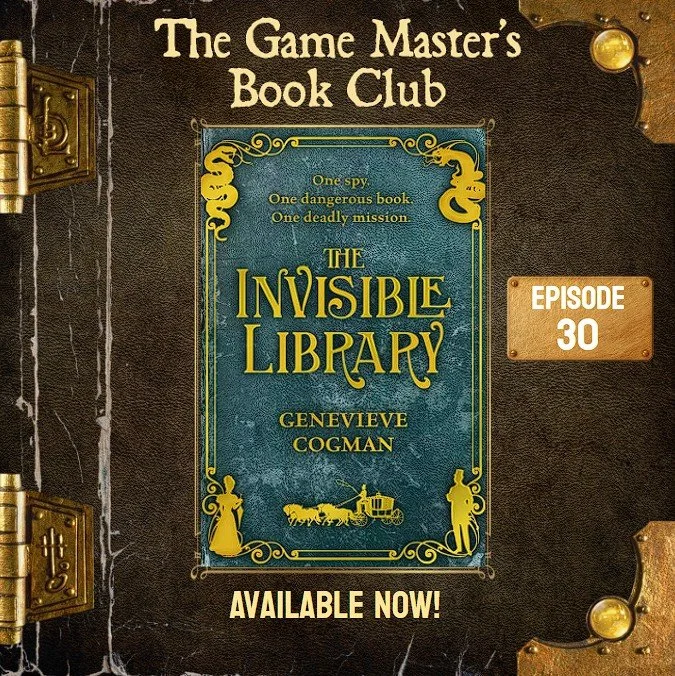
GMBC ep30 - Secrets and Soceities: A Dive into Genevieve Cogman's *The Invisible Library*
Genevieve Cogman
The Invisible Library
Speaker A
00:00:05.360 - 00:01:12.600
Welcome to the Game Masters Book Club, where great fiction becomes your next great tabletop role playing experience.
Marshall Smith, George Krubski and Eric Driks leap through the multiverse to help us explore Genevieve Cogman's the Invisible Library, where we accompany Irene, our librarian, and Kai, her animatic assistant to an alternate supernatural London in search of a book that could alter reality throughout the multiverse. Let's get into the conversation and welcome to another episode, the Game Masters Book Club.
The place where great fiction becomes your next great tabletop adventure. I am Eric Jackson and I am here with three of our returning game masters.
And today we are going to be talking about the Invisible Library, written by Genevieve Cogman.
Today we're going to have our Game Masters talk to us about this great book, but we're also going to have them talk about building trust in non playing character groups, secret societies that are in their games. How do you get people to buy into those? So we're going to start off with Eric.
Eric, tell us about your gaming experience and of course about how you get people to trust an NPC secret society.
Speaker B
00:01:12.600 - 00:02:23.520
All right. My name's Eric, not to be confused with the other Eric. Yes, although I guess maybe I'm the other Eric. Anyway, I'm from the Philadelphia area.
I played a lot of TTRPG games over my years, heavily into D and D and other games. And I have a corgi important fact in a world where there's a lot of cynicism and a lot of distrust in general of big organizations.
I would find though two different, different ways for me thinking about it. Number one is create a hierarchy that really is vulnerable.
You know, sometimes you play upon if you have a king in charge of a kingdom, maybe make it a child king, somebody who the players would naturally might want to lean into, support.
The other thing in thinking about the book that we're reading, there was a little bit of a good cop, bad cop situation where you have someone who you trust and someone who you necessarily don't trust, who's in authority.
So a little bit what you're doing is you're giving the players a little bit of that cynicism distrust that they might have with one character and then you're absolutely putting another character that they would then trust right in that other NPCs path to support the players.
Speaker A
00:02:23.840 - 00:02:32.080
Thank you, Eric. Marshall, would you like to talk about yourself and about how you build Trust in your NPCs and their secret societies?
Speaker C
00:02:32.400 - 00:04:18.470
Sure. So my name is Marshall Smith. I've been playing D and D since Redbox way back in the day.
I've written for some RPGs and done a lot of DMing down through the years. One of the critical things when building trust is not just at the beginning.
A lot of times you can get your PCs to buy in early on based on just the concept.
But in order to make a secret society interesting, at some point you have to have the twist where there are higher ups in the organization that are not doing things the way they are supposed to.
Either you have people using the society for personal gain or you have some people who are going way too fanatic with the ideals of the organization and hurting people on behalf of the organization.
And you need to be able to make sure that the PCs continue to believe in the organization even as there are people inside the organization they don't agree with.
And as Eric mentioned, one of the best ways to do this is to make sure you have a counterpart within the organization that still supports the ideals that the PCs originally joined up for.
You also want to find ways to make it clear that the PCs are correct in the way that they are engaging with the organization, that they were not lied to about what the organization is about. It's a tricky thing to pull off without just as a dm, looking the players in the eyes and going, really guys, you're right.
Finding ways to communicate that in character. It's a tricky, tricky thing to handle.
Speaker B
00:04:18.470 - 00:04:22.470
Great points. Better phrasing than I think I did, George.
Speaker A
00:04:22.470 - 00:04:26.630
You want to tell the people about yourself and about how to build trust in secret societies.
Speaker D
00:04:26.630 - 00:06:11.550
My name is George Krupsky from Jersey. Been playing for decades, more often as a game master than as a player.
And I actually did do a campaign for I think close to seven or eight years that's appropriate to this topic. I did a game where the players were treasure hunters for the Vatican.
It was sort of a Indiana Jones Pre World War II kind of thing crossed with Mission Impossible. And what I did was, and I guess it's wrong, it's called the Vatican, a secret society.
But the group that they were working with was a secret society within the Vatican. I made sure that every one of the players had a reason to be there to begin with. And then I reinforced it.
So they were either true believers in the church or in the cause of rescuing treasure from the Nazis, or they were being paid very well, or they had their own agenda. And the folks who were paid very well continued to be paid very well. Their contact was sort of a. A true believer both in the church. And in the cause.
And that eventually led to its own Dory arc when he was sort of on the out with the organization. And then folks who had their own agenda that had to throw them a bone every once in a while. To me, it's relatively simple, but you just.
You give them a reason for being there, and you keep that reason intact. I will say you can sort of play it the other way.
I did a Star wars campaign where one of the characters was a Jedi Padawan, got out in Rim space and became not so fond of the Jedi way. And that was a very interesting story arc that did continue to play out even into the last session when.
When we were talking about what does it mean to be a Jedi. And one final.
I will just say, if anyone has seen Peacemaker, the TV show, especially season two, they sort of do play with the idea of what it means to be loyal to an organization and how
Speaker C
00:06:11.550 - 00:06:12.270
you deal with that.
Speaker A
00:06:12.830 - 00:09:10.190
All great points. I'm Eric Jackson. I'm the other Eric or the other other Eric. I'm not sure how that works, and I've been playing since the Pleistocene.
I really enjoy the idea of a secret society, and I think it's an interesting way to create a boatload of really great NPCs. But the way that I build trust is not based on anything that I've done as a game master in my other life. I am a trainer and an educator.
And one of the things that's important in an education setting is that you have to build trust with your people and build an authority that makes it sound like, hey, that guy that was up there who's talking to you, he knows what he's talking about, and I should listen to him. So this is actually something that I literally train other trainers on how to do.
The main thing that you need to do is you need to provide for the character's needs, which George already pointed out. You're picking something that the character needs, and that group is supplying it. So that's the.
Whether it's loyalty or money or fame or fortune, whatever that is. And then the next thing you need to do, draw on other authority. So again, I'm going to pick George because he gave the specifics.
You talked about having the Vatican. The Vatican is a huge thing which lots of people believe in and has worldly and spiritual authority.
And this subgroup gets to draw on that authority, which is something you can always do. You can pick something and be like, the guy who's running your secret society works for the king.
Well, he works for the king, which means he kind of borrows the king's authority. You have a higher power that everybody you know. I am a servant of a God. Well, you got some authority there, pal, so that's pretty good.
So feel, don't, don't be afraid to have your secret society. Draw on something else for its authority. Set clear rules. They follow certain rules.
The library here that we're going to be talking about has clear rules. We're here to get books.
And then there are probably some unclear rules or rules that you learn later on just through existing, and this is something I picked up as a classroom teacher, that you can set a bunch of concrete rules at the beginning and then the non concrete rules just sort of form organically over time. And that's where you can really get some of that great buy in and variability and be right. This is the other thing.
And you have an advantage as a dungeon master because you can change the world to fit what you want it. So when you say something is true, it's true. It's hard to disprove because you're controlling the entire universe.
If you can make your secret society right and reliable, even if they're doing bad things, they're powerful and they know what they're talking about. That's enough to get people to question whether do we immediately go against them or not. And being reliable is very important.
So draw on other people's authority, provide for the character's needs, set clear rules and be right Most. Be right 99.9% of the time and you will get people to believe you. So that's my secret, my DM teacher. Secrets revealed to the Internet.
Speaker B
00:09:10.190 - 00:09:11.390
Nice. I like it.
Speaker A
00:09:11.950 - 00:10:08.420
So now that we've talked about the Invisible library, at least as a general secret society, let's talk about the book, the Invisible Library. What is this book actually about?
Set in the multiverse, a library between worlds, an invisible library collects the continuity of every book in the multiverse. Irene is a librarian. She is a retrieval expert. She is training Kai, her new enigmatic assistant.
And they are adventuring in a magical steampunk reality that is infested with fey creatures of chaos that seek to take over the world.
This book is crammed with chases, escapes, magical languages, a brilliant detective, secret identities, clever clues, magical monsters, vampires, werewolves, and a shape shifting big bad evil dude. It's a pretty awesome book. Anybody have other things to add about the Invisible Library? I will start with you, Eric.
Speaker B
00:10:08.500 - 00:10:52.870
Thanks. Yeah. Now, the Invisible Library, that was a great book.
It has a lot of great themes in It I think this notion of having this in between world that very much exists out of time and out of place is pretty cool in general. And I think it opens up for a game master.
It opens up endless possibilities, some of which they focus on one in the book they focus on one world in particular, but they do reference. There's so many other rich worlds out there.
Thinking about running a game with it, I thought, wow, this could be a great shared game world or shared game campaign for multiple GMs to weigh in on. You just pick a different world.
Speaker A
00:10:53.110 - 00:11:05.110
Marshall, I know you're the long term reader of this series. There are eight books in the series and you've read them all.
So any other thoughts on themes that this book brings up that would be interesting to talk about?
Speaker C
00:11:05.190 - 00:12:00.470
So this book in particular is largely laying groundwork.
One of the things Genevieve Cogman does really well with this series is a lot of world building and just laying the structure for what's gonna go forward as a series as a whole. She explores a lot of themes of the fight between order and chaos as it rages across the multiverse.
And there's a lot of balance between what that kind of fight means on a universal level and on a personal level. So as it continues, Irene is very involved in conflicts that can affect the entire multiverse.
But her specific relationships with Kai and with Vale and with her mentor in the library, all of these things are still extremely important to the stories going forward.
Speaker A
00:12:00.550 - 00:12:02.630
George, do you have anything to add about the story?
Speaker D
00:12:02.790 - 00:12:34.010
I'll just note that we sort of discussed in the first question. The book definitely establishes early on that both Kai and Irene have a reason to be a part of this organization.
And we see multiple times throughout, they reinforce, the writer reinforces, giving both of them a reason to stay and to trust the organization, even when maybe, you know, stuff starts to come up that they shouldn't, is still supporting their best interests. So the writer did what we said. Yep, of course we did. We're agreeing with the writer.
Speaker A
00:12:34.010 - 00:12:55.530
You are correct. The writer does a very good job. Marshall, I'm going to jump over to you when we start talking about mechanics.
So if this is obviously a world that has lots of potential for role playability, what game mechanic do you think could embrace this huge jumble of a multiverse of worlds?
Speaker C
00:12:55.770 - 00:13:26.630
What I would go with is something fairly simple and fairly flexible.
So my choice would be Fate, especially because one of the big advantages is that the aspect mechanic in Fate is a very quick and easy way to indicate this world is high chaos. This world is high magic. This world has different rules that it has to abide by, how magic works in that world, etc. You can do.
You can indicate all that very easily and quickly with fate's aspects. That would be my choice.
Speaker A
00:13:26.630 - 00:13:33.630
Eric, do you want to talk about what system or systems you might want to embrace this, embrace the invisible library with?
Speaker B
00:13:33.860 - 00:14:38.810
Oh, yeah.
So one of the things that made this a little challenging when I first started looking and considering this was there's not just one type of magic, there's multiple types of magic with each round have their own rules. The library has their own magic, the fae have their own magic. So there's multiple and hinted at other magics also. So mutants and masterminds.
Just because it's a fairly open system that you can point by and customize different things, you could, as a gm, you could say, all right, you want to use magic, have a magical base character. You have to choose in these types of drawbacks or limitations to tag on to your power. And then it becomes a little bit flavorful for the setting.
The other one, a little bit more grounded in some of the rules, but has a wide open area, is White Wolf's World of Darkness. But it incorporates a lot of stuff in there.
We're talking vampires, mages, werewolves, all sorts of stuff you could pin into that world setting in that system. So those were the two I would sort of lean into.
Speaker A
00:14:38.890 - 00:15:16.070
And why it just struck me when you were talking about the multiple types of magic that exist that way back in the day in first edition D& D, when they tacked on psionics. And I think also in older versions of Dungeons and Dragons, the clerical magic felt different than the wizard magic.
I think they've moved away from that in the current system. But this book definitely feels a little more old school in that regard in that they're like, this is chaos is magic, and I can't use that.
And this is this magic. And you have to learn a whole other system to make it happen, as opposed to like a more freeform. Everybody uses the magic.
Speaker B
00:15:16.070 - 00:15:31.670
Absolutely.
And they even hint at that whole nest, that sort of danger in using the more powerful magic or chaos magic, which I think White Wolf has some levels of there, where he can really mess things up by using the more blatant magic.
Speaker A
00:15:31.750 - 00:15:40.240
That would definitely serve this story well. George, do you want to talk to us about the mechanics you would use to make this multiverse work for you and your campaign or.
Speaker D
00:15:40.320 - 00:16:27.380
So I was thinking more in terms of the balance of the characters than in the multiversal aspect of it. And I was thinking about something like Cortex, a version of it where you're prioritizing knowledge, technical skills and social skills and fighting.
And I'm going to call it fx. Whether it is chaos magic or whether it's the language that the librarians use or Kai's particular twist or they.
I'm assuming this gets explored more in later books, but they sort of imply that Val has some low level precognitive powers.
So he is obviously deprioritized his FX because it doesn't show up a lot and has prioritized his knowledge skills because he is essentially a Holmesing character. So something like that that ties in
Speaker A
00:16:27.380 - 00:18:21.390
really closely with the system that I wanted to use. Because I'm going to talk about City of Mists, which I have mentioned previously on the show. It's based on Powered by the Apocalypse Engine.
So there's playbooks where the character building and balancing really works is when you're choosing the two parts of your character, your mythos and your logos. The mythos is your character is a representation of a type of story.
And I know from having talked to Marshall during our pregame, I haven't read all the way through, but I do know that the fae are really based around this idea of stories. So that's already sort of playing into that.
And then there's the logos, which is your practical job, like the fact that you're an investigator or the fact that you are a martial artist or something along those lines. The non FX part of this. And the characters can be either more logos or more mythos.
So our Holmesian character might be a bit more logos and only have like a little bit of the mythos going on there for the Diviner character. Whereas our assistant Kai definitely like way up on the Dragon High mythos, only a little bit of logos hanging out there.
There's one other thing I wanted to mention and that is the Stygian Library. It's an old school game supplement, but it can work for just about any game.
It's a set of random tables and basic rules for exploring a magical library between worlds, which is wow, exactly like the invisible library. So this, this, I love this little package. It's a PDF, it's maybe about 40 pages. It's like 10 bucks.
But though we don't spend a lot of time in the space of the library in this book, and according to Marshall, one more time, I think you told me there's a little bit of stuff that happens in the library, but it's never really the focus. Is that correct?
Speaker C
00:18:21.470 - 00:18:28.750
Correct. Yeah. There's one plot line a few books down the road that focuses inside the library, but for the most part it's outside.
Speaker A
00:18:29.190 - 00:18:39.750
And that's the thing, because as a game master, you know that if you don't have something, if you're like, oh, well, you're never going to spend any time in X place, you know, that's the place where your players are going to go.
Speaker D
00:18:40.150 - 00:18:40.470
Right?
Speaker A
00:18:40.470 - 00:19:27.640
Like, no matter how hard you try.
So having this book ready for them for when they eventually end up randomly popping into the invisible library, it's a great way to be prepared for those pesky players who go where you don't want them to go. So those are my two recommendations.
City of Mists as the primary game, but as a backup, the Stygian Library for when your characters eventually go to the library and you need something to make it feel mysterious and creepy and infinite. And that supplement is perfect for that. Eric, you've already talked a little bit about some of the portable aspects of this.
You were talking about how the library itself is this really great item in and of itself. Do you want to expound more upon that and how you might put that into one of your campaigns?
In fact, you said you were putting something like it in one of your campaigns.
Speaker B
00:19:28.030 - 00:20:35.210
Yeah, absolutely. I had actually tried developing an entire campaign. It wasn't multi world, but it was time travel, where an organization gets shunted out of time.
And there's other organizations that have also done this and they're at war with each other in terms of how they want to interact with the timeline. I've done something like that. That's a challenging one. But you're bouncing players on time travel, which always gets a little bit hard to do.
But the latest group I was working on was something called Guardians of the Seamless. And they are a organization that's trying to make the world safe from evil and that live in between the different worlds.
Maybe not realities, but different sort of worlds in the universe. So I love this idea, when they presented it, of this. This library that lives out of sync with everything else.
That these books and items could anchor the realities and affect how they interact with them. And making the books and things that they're going after just that much more valuable. But it's a value that maybe no one in that world could see.
And I love that aspect of it.
Speaker A
00:20:35.210 - 00:22:04.080
I agree. I think this book has a lot of really just obvious things that can be picked up and put right back into your game. Just whole cloth.
I've never read this book before this week, but I have always been a big fan of the idea of the Fae and their representation in chaos. That's what I would take from it. I would absolutely take invading Fae that are spreading chaos.
One of the great things about that idea, if you've got the fae and this idea that they're there to spread chaos, they're these harbingers of the destruction of the world and they have a reason for it. A lot of bad guys are like, I will destroy the world. And it's like, yes, but you will die too.
And that doesn't seem productive in a lot of ways unless you have a very tragic sort of character who wants to die. But these guys, if they come in and destroy the world, they get more chaos and it's all good.
And then they go on to the next world and it's fantastic. So I like them as a purposely motivated big bad evil dude who doesn't have a problem destroying the world.
And then of course, you've got all of practically every European mythos to pull your minions from. You can have red caps and all sorts of other fey creatures. So you can get that really good rogues gallery.
Plus you've got a reason for destroying the world. That's what I would take from this particular one.
Marshall, I know this is one of your favorite books, so I'm betting you've got a bunch of things that you might want to talk about that you would put into your campaigns or maybe already have.
Speaker C
00:22:04.080 - 00:24:03.260
Yeah, there are so many things that I would take and have taken from this series. The big one for me is the language, which is the primary magic that is used.
Librarians are able to use the base language of creation to speak to the objects around them and command them. It's phenomenal, especially because the way it is set up in the book.
Whereas that sounds initially like it is ludicrously powerful, it's also very self limiting.
First of all, you have to be extremely precise with the language because the things will do exactly what you tell them to do and not interpret what you tell them to do. So you got to be very exacting in your grammar and word choices. It really only works on inanimate objects.
It does have some ability to work on living creatures, particularly in altering their perceptions, mostly because sensory organs are objects that you can manipulate. But it's a lot harder. So that's a limitation that eliminates a lot of the crazy abuses you could engage in.
And then it really only works when you are asking the object to do something that it is already inclined to do. So you can ask a lock to unlock. You cannot ask a lock to catch on fire because locks don't catch on fire. That's not something they do.
And so putting these, these rules together, you end up with a system that is extremely flexible, has a lot of flavor to it, but it's also nicely self limiting so it doesn't get crazy out of control. I actually have a setting where there were AIs in it that developed magical abilities and I gave them the language.
Speaker A
00:24:03.420 - 00:24:10.290
Ooh, Remy, when we get to media, I have to say something to you about that, George. Do you want to talk about your takeaways?
Speaker D
00:24:10.450 - 00:25:23.960
I wound up doing a little research after the book and realized, not too surprisingly, that the writer is also a game designer because I Things that I liked about it were the. The balance among the characters.
We've got three main characters who are all very different with very different abilities and focuses, and none of them really feel overshadowed. There's arguably even a fourth character who's at PC level as the story progresses. So I like the balance. I like the.
And I don't know where the series goes, so I like the sort of shadow war between order and chaos with the library as a third faction. Even though I grew up loving Star wars, which is A versus B, A versus B versus C is always a much more interesting game.
Setting three major agendas is something that I like and would probably regularly try to steal. And I will also note, although it's not something that I would actively steal because I think we all do it anyway.
The book often, to me seems to include the dynamic of, okay, things are slow. There was a lot of exposition. Let's throw some ninjas in. And it's not always ninjas, but it's always all right, we talked a lot.
Time to fight now, which is always a good gaming dynamic.
Speaker A
00:25:23.960 - 00:25:26.480
Yeah, we're gonna break up all this storytelling with some fighting.
Speaker D
00:25:26.480 - 00:25:31.770
This is all some lovely British exposition. Let's have some American fighting in there now.
Speaker A
00:25:32.570 - 00:25:48.330
All right, Marshall, you suggested this book. This is clearly your favorite. Like you said, like I've said before, you've read the whole series.
What other media do you think resonates with this particular story? That people wanted to get in the mood and they had already read all eight books.
Speaker C
00:25:48.410 - 00:26:30.030
Specifically from a gaming perspective, what I associate with it is the sci fi show from the 90s, Sliders, where a group of individuals stars. Jerry O', Connell, John Rice Davies.
John Rice Davies is a scientist who creates an ability to travel to alternate dimensions and then they lose their ability to find their way back to their own. And so the whole series is trying to get home by just each week jumping to a different alternate world.
I have long wanted to try to run that as an rpg. I've not figured out how to make it work, but for me it has a very similar vibe to jumping from world to world in the Invisible Library.
Speaker A
00:26:30.830 - 00:26:46.350
Oh, yeah, absolutely. And it would be pretty difficult.
Folks who are listening to the podcast, feel free to comment and let us know where you think Marshall should base his Sliders campaign in. George, do you want to go ahead and talk about your media that you think that pairs well with the Invisible Library?
Speaker D
00:26:46.350 - 00:27:55.480
I do have a couple books, but I always love other stuff as well. First thing that occurred to me was the Librarians, which is sort of a different version of it. They don't go to other universes.
Crazy stuff happens in our universe, but it's still centered around an invisible library. And there's wacky stuff of all different stripes going on. I also feel like there's a bit of a Loki vibe.
The TV show Loki with the TVA as the analog for the library. Book wise, I honestly don't know how close these are because I haven't read them in decades.
But reading the Invisible Library made me want to go back and reread Mark Frost's Duology, the List of Seven and the Six Messiahs, which is sort of a fictionalized origin story for how Arthur Conan Doyle came up with Sherlock Holmes. And it also made me think a little of Katherine Kurtz's Nondorini series, the Adept.
I think it's about five books of a genteel Holmesian detective who uses magic, but also is involved in a number of secret societies.
Speaker A
00:27:56.280 - 00:28:02.160
Fantastic. Eric, you want to put in your two cents for best pairings for the Invisible Library.
Speaker B
00:28:02.160 - 00:28:56.290
Yeah. So to me, it was a great original work.
When I thought, when I first started reading a little bit, I thought like, okay, Hidden Worlds, Magic London took me right back to Neil Gaiman's neverwhere. I just have a soft spot in my heart for that book.
When I thought about alternate worlds and sort of tech versus magic and sort of different types of magic, even the Frugal Wizards Handbook by Brandon Sanderson came to mind.
And then when I thought chaotic Fae and sort of an urban fantasy, hidden worlds and this idea of barriers between worlds and fae as this force of chaos, it took me to Fairy Tale by Raymond E. Feist. So I'm sure if we combine all three of those books, it gets closer to the Invisible Library.
But yeah, those were what came to mind is just things that remind me a lot with some of the themes and some of the components.
Speaker A
00:28:56.610 - 00:31:05.520
I do agree with you this being a very original work and also it being very influential on both games and it actually is very influential on other writers.
When we had Melissa Caruso on for her book the Last Hour Between Worlds, she cited the Invisible Library as one of her primary sources for a lot of her fantasy ideas that she thought that this was a fount of really great material for any writer. I found that the steampunky Werewolf, some magic, but not necessarily out in the open as much.
The Parasol Protectorate series by Gail Carragher I'm a huge fan of Gail Carragher's writing. This is her first breakout series. The first book in that series is called Soulless. This is a classic of the field.
I think everyone should read Soulless and at least that first set of series.
If you like that series, there's like two or three others that are set in the world, including a school book where they train young ladies to be assassins. Great.
Just character is fantastic and really captures that mix of magic and steampunk funkiness that I think this first world that we're in in the Invisible Library does. For language magic, I'd recommend either R.F. kuang's Babel or Diana Duane's Young wizard series.
The former is a dark academia story about colonialism and the latter is a YA multiverse that confronts the concepts of death and the nature of evil. Like all good YA books, it's, you know, very subtle. The Young wizard series is absolutely amazing.
I cannot speak enough about it, and Babel has been a darling of the book talk era for a while here. Finally, just a quick shout out for the Air Affair, the first book in the Thursday Next series, which deals with alternate universes inside of books.
I recommend this not only because it's a great book, but because it's also the subject of episode 13 of this podcast. So go back and check out episode 13 if you're interested in finding out how that can be put into your role playing game. Time for promotions folks.
Marshall, anything that you want to talk about that maybe it doesn't directly involve this book but you want the people
Speaker C
00:31:05.520 - 00:31:08.440
to know I do not have anything at this time.
Speaker A
00:31:08.919 - 00:31:13.120
Totally fair. Eric, Anything that you would like to tell the people about in our promotion
Speaker B
00:31:13.120 - 00:31:37.189
section here in the promotion section, I'm actually just starting to work on my own beginner D&D adventure targeted for new gamers and new DMs to really run their own game.
So that's going to be coming and it involves this whole Queensguard organization and also this whole notion of trying to find a lost member of royalty.
Speaker A
00:31:37.350 - 00:31:43.750
Oh, should be fun. Keep us posted. Want to hear what's going on there? George? Anything you want to tell the folks?
Speaker D
00:31:43.750 - 00:32:05.540
I don't really have anything personally and if you want to cut this out you're welcome to, but it is because I know based on timing it's a while until these get out. It is currently late October so I hope that everyone who is listening to this voted.
And if you didn't vote, I hope you're having the day that you didn't vote for okay, I'm going to do
Speaker A
00:32:05.540 - 00:32:25.580
a tiny tiny plug.
For those of you who live in the Massachusetts area, I'm starting to run some games at our local cat cafe, the Lazy Cat Lounge where I'm running all Tabaxi based games 5e, D and D. So if you'd like to donate some money to getting some cats adopted and play some Dungeons and Dragons, check out the Lazy Cat Lounge in Lowell, Massachusetts.
Speaker B
00:32:25.660 - 00:32:26.700
That is amazing.
Speaker A
00:32:27.100 - 00:34:02.980
For that first game I actually handed out they fought goblins and there is a group called Snowshoe Dice and they make catnip goblins and every time they killed a goblin we threw one to one of the cats at the cat cafe. It was a blast. We had a really fun time. And that was the Invisible Library by Genevieve Cogman.
Thanks again to our GMs and definitely not secret agents and librarians in residence Eric Drix, George Krupsky and Marshall Smith. Great show guys.
Look for them to return when they buckle on their swashes to discuss the action packed Airship Adventure Retribution Falls by Chris Woodring. And join us in two weeks when we explore the Empire of Canem in Robert Jackson Bennett's the Tainted Cup.
You can find a complete transcript of today's discussion as well as links to all of our podcasts at k square productions.com backslash gmbc.
You can learn about upcoming episodes on our social media on bluesky@gmbookclub bluesky social, on Facebook, at Game Masters Book Club, on Mastodon at Game Masters Book Club and on Instagram Gamemaster Masters Book Club if you've enjoyed the show, please like subscribe and comment on our episodes in your chosen podcasting space and be sure to share those episodes with your gaming community.
You've been listening to the Game Masters Book Club brought to you by me, Eric Jackson and K Square Productions continued praise and thanks to John Corbett for the podcast artwork and Otis Galloway for our music. Later, gamers and to paraphrase the great Terry Pratchett, always try to be the place where the falling angel meets the rising ape.