GMBC ep52 The Wizard of the Pigeons brings Magic and/or Madness to Urban Fantasy
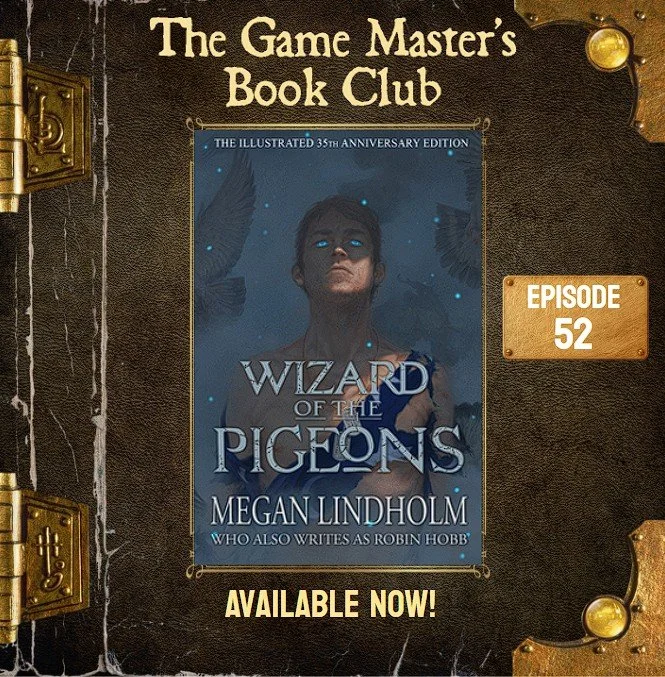
Wizard of the Pigeons
Megan Lindholm / Robin Hobb
Speaker A
00:00:08.880 - 00:01:40.210
Welcome to the Game Masters Book Club where great fiction becomes your next great tabletop role playing experience.
The world of wizard of the Pigeons by Megan Laholm exists in many forms.
It is the story of Wizard, a man who uses his powers to keep evil off the streets of 1980s Seattle.
It's also the story of an unhoused man trying to find himself while dealing with PTSD from Vietnam.
And it's also the place where Mauricio Cordero Michael, stair Rick's deck.
Give us a tour on rapid fire role playing design with playing cards, building characters with great weaknesses to mirror their abilities, body hopping ladies of the lake and reminiscences of first edition AD D Paladins.
Let's get into the conversation.
Welcome everybody to the Game Masters Book Club where we take great literature and we turn it into a great role playing experience.
And today we're going to be talking about wizard of the Pigeons by Megan Lindholm, AKA Robin Hobb.
I'm very excited about this.
This is a personal favorite of mine and I have some amazing people here to talk to you about this book and to tell you how to turn it into some amazing role playing experiences.
So we're going to start off with Michael.
Michael, since this book revolves mainly around the idea of mental health and its representation, talk about a time that you represented mental health in one of your TTRPG and tell them about that and then we'll be good and everybody else will do the same.
Speaker B
00:01:40.290 - 00:01:48.850
I don't know that I've ever specifically called it out.
I've played a few crazy characters, but, you know, those are more for lulz than anything else.
Speaker A
00:01:48.930 - 00:02:14.950
I think that's one of the things that's going to make this a really interesting piece is that it's very difficult to think about a time when you're absolutely playing a character who are not necessarily.
As you said, we're not playing it for the laughs or for the total stereotype.
Right.
That's something that role playing games are good for, but it's also, in this case, maybe not the best possible representation.
Right.
Speaker B
00:02:14.950 - 00:02:22.350
Like, so my own state of mental health went, oh, I need an example for my real life.
And I'm like, that's kind of personal for this, isn't it?
Speaker A
00:02:22.590 - 00:02:28.630
Moving on to you, Rick, let's talk about you and talk about mental health in your TTRPGs.
Speaker C
00:02:28.630 - 00:03:35.250
You know, it's funny, we, we've talked about this a little bit and we really kind of glossed over this.
Probably the only thing we didn't talk about in rehearsal, but it's so.
I've never really taken a.
Taken a direct shine to it, because I think a lot of what people show up to, to TTRPG games to do is for some degree of escapism.
And we all come to the table with our own traumas, and sometimes you want to poke the bear, sometimes you don't.
Sometimes you want to shake some loose in a safe environment.
And, you know, there's.
There's ways to do that, but I think one of the most pervasive ways to definitely do it is in patron roles, right, that you have all of these.
These PCs that speak to a higher power, and there are circumstances in which it's like, maybe it's a little opaque.
Maybe their connection to this higher power is not as productive as it could be for them as safe and sovereign person.
And sometimes.
Is that shit real?
You know, I think kind of like it's the.
The Joan of Arc ness of like playing a paladin.
Is it a tumor or you speak of God.
Speaker A
00:03:35.410 - 00:03:36.130
Yeah, no.
Speaker C
00:03:36.210 - 00:04:12.310
And so without like, you know, taking the piss out of it, but that.
That sort of arc of like, you know, what are some of these, you know, we're playing in, say, a high fantasy environment.
People don't, you know, they may understand the gods, they may understand magic, but they don't necessarily understand that your typical everyday person might not understand the scientific method of medicine, how deities and mental illness and, you know, voices and visions and those things sort of have interplay in that person's experience.
I try and interweave into the.
Into the story, sometimes to great effect, and sometimes I'm not in the driver's seat.
My.
My characters, you know, players do it well.
Speaker A
00:04:12.310 - 00:04:12.950
Mauricio.
Speaker D
00:04:13.110 - 00:06:14.150
I come from it as a professor of RPG design and production, and I think whenever I try to explain what a TTRPG is to another academic who's never heard of it, they start to back away slowly, right, and kind of head to the exit.
So I think that's the first level of mental health and TTRPG contact that I have.
But seriously, I teach a lot of students who are neurodivergent on many different levels.
And so I've adapted all my courses, both the TTRPG and the comic book courses, to try to honor and favor that modality, that way of thinking.
And so I use a lot of visuals, a lot of mnemonics, a lot of ways to touch, feel, see what we're experiencing when we're designing games and analyzing games.
One recent game that comes to mind is flail, which is a lot like mousrider.
I was explaining this in the rehearsal that it's just got a wonderful visual system that sits in front of you.
And for someone like me and someone with certain types of neurodivergence, it really helps with trying to keep track of all these things that I feel get in the way of telling the story.
Because when my players are anxious, they're not telling great stories unless it's the good kind of anxious, like we're playing Alien or something.
So I think that's where I circle around mental Health and TTRPGs.
Also this week, the people at Art Green Publishing were generous enough to give all my students, like hundreds and hundreds and hundreds of pages of Delta Green material for free.
And so they are currently devouring that.
And I wish I could tell you next week how it all turns out, but I'm really curious to see.
We talked at length and gave them a lot of warnings about the content, which is decidedly about mental health or maybe not.
Speaker A
00:06:14.150 - 00:09:29.830
Yeah, no.
I think you guys have hit on some really interesting things.
That one, that people who have different neurodivergent states are very drawn to role playing games, as are people who are lgbtq, mostly because the game encourages everybody to think in a different way.
Think in a way that is.
That is not necessarily within the regular mainstream.
But my real take with the TTRPG and mental health also comes back to the same issue that I occasionally have with just the system of like, say, D and D and the idea that you can heal people by touching them and saying you're healed now, and that's great.
And there is a.
There is a cure disease spell, which is literally you press, you touch somebody and you say you are cured of a disease.
And when you have that sort of magical.
That magical concept that's running behind your disease, you can.
It becomes very easy to put in what was true when we had that concept back in the.
In the olden days.
It's very easy to go back into the.
Well, they're possessed by demons, right?
Or there's a spirit inside of them, or there's something happening.
You know, there's something happening that's making it happen that isn't them, that becomes the.
The enemy of what you're doing or becomes your adversary.
Right.
Taking an adversarial approach to mental health can be good sometimes, but also, you know, may not be great.
And I just want to be 100% clear.
Nobody here has a.
Nobody has a social work degree or like a degree in psychology.
So we are all just kind of.
We're all just game masters who as Rick pointed out, we're here to help on like the daily with general storytelling and human interaction.
We're not here to like prescribe any mental health sort of things, but we are here to talk about how these mental health things can come up in your campaign and what are the best systems to use them for, what are the best systems to use when you approach them, and how to handle it, and what are great sources for it.
Which is where we're going to head to next.
That's going to bring us to the summary of this book, which is the wizard of the Pigeons, which is an urban fantasy set in a post Vietnam Seattle by Megan Lindholm, AKA Robin Hobb.
It is an explor generation of homelessness, poverty, mental illness through the eyes of wizard, an unhoused person who lives in a liminal magical state in the streets of Seattle.
The book focuses on his battle with a malignant force that seeks to destroy that world.
But is it the real world or just a product of his own mental break with reality?
And is the malignant force just his own psyche trying to reassert itself to get him back into reality?
Or is it really an evil magical force?
The book doesn't really take a side on this, I think.
I think it stays relatively neutral and it makes the Wizard Mitchell character an unreliable narrator to a certain extent because he's not sure of what reality is.
He is the wizard of I don't know.
And so we are led to believe that we are not sure what the reality is.
So there's this constantly shifting landscape of what is really real in the story.
The amazing writing and the very gentle and caring handling of wizard and his mental health issues is what makes this not be tropey and not be just like not be something that's hilarious.
And I think it's a great book.
Rick, what other themes or things did you want to say about the book?
Speaker C
00:09:30.070 - 00:10:47.110
So I don't have a degree in social work or psychology, do have decade of working in social services under my belt, specifically with unhoused teens, you know, folks aging out of the foster care system and coming out of institutional care for mental health stuff.
And you know, yeah.
And list goes on and on and on.
And so I do have a particular lens on which to view this.
And it is that it is handled with such a great degree of humanity.
Right.
It's hard to walk.
I think this fine line between the sort of fetishization and kind of holding the unhoused characters because they're characters in a book, but holding them up in such a way that sort of like mystifies and makes this like some like Kipling esque peer into the savage world of the other and just kind of, you know, here's a different modality.
Human beings live like this and this is an experience that is.
That is happening.
And so I look, I looked at that and read this and kind of didn't find myself rolling my eyes throughout this very compact and concentrated little piece of fiction that I also really enjoyed.
I just wanted to give that little bit of context.
But I'm also on lots of headache medication and have forgotten your.
Speaker A
00:10:47.270 - 00:10:54.830
You did it.
You did it.
No, you answered the question.
You're doing fantastic, Mauricio.
You want to go next?
What else do you want to.
Yeah, what else do you want to say about the book?
Speaker D
00:10:54.830 - 00:12:43.850
If anything was a little bit skeptical, but then I don't.
It was very quick, like 10 pages in.
I was in it all the way.
It's very asutely written and you know, to your point of is he really magical?
Is this inside his head?
What does it matter?
You know, I think the narrator is what matters.
Whatever that experience is, that's the reality, right?
And I think we are sitting outside of that internal reality that's represented in the book.
So we can wonder, you know, is this the real world?
Is it fantasy?
But it doesn't matter to Mitchell.
I believe he's going through this and whatever it is, it is.
And I kind of like that about the book, that it doesn't give you an easy answer.
And I did my homework last night I watched the Fisher King and that is a very different read on mental illness, where we are constantly outside of mental illness.
Watching a person with mental illness go through a story arc and he kind of gets better, you know, at the end.
Another thing that was interesting to see between the two treatments is that in the wizard, love seems to extinguish magic.
Where in Fisher King it is sought after and it is the healing element.
And I thought that kind of gets to why I prefer the wizard to the fifth King.
That level of seriousness, stokeness, that you're in the story and whatever you think is real doesn't really matter.
Speaker A
00:12:44.090 - 00:13:01.900
And those movies are only like about 5ish years apart.
Like this book was written in 1986 and the Fisher King is 1991.
Although the story obviously takes place a little bit earlier at a post Vietnam.
Closer to.
Closer to Vietnam.
I don't think it's necessarily in the 19.
No shaking head.
Speaker B
00:13:01.980 - 00:13:03.460
It's somewhere in the early 80s.
Speaker A
00:13:03.460 - 00:13:03.740
Is it?
Speaker B
00:13:03.740 - 00:13:17.580
Okay, there's a phrase, and I don't remember the exact phrase that talks about how long it's been since he went in as a child.
He came out as this age, and then it's been roughly this long.
That puts it solidly in the early to mid-80s.
Speaker A
00:13:17.740 - 00:13:37.330
We're not dealing with a huge time difference between those two particular pieces of media.
So that also makes it very interesting that they have such a different view on what love does for their magic and what it does for the characters.
Michael, off to you.
Any other themes you want to hit before we jump into mechanics?
Speaker B
00:13:37.330 - 00:14:28.360
I mean, for me, I am a personal believer in small magic.
Small magics are things that we can do to make somebody else's magic experience a little better.
I do have some experience in the world he came from.
Don't need to get into it, but I did spend a couple of years unhoused.
And there's.
There is a lot of magic that can be had by kindness.
And at the same time, if you're in that place, people will walk away from you.
People will push you away as soon as they hear that you have this thing, whether it be something in your head or, you know, just you're down and looking, you're out.
And.
And it does come to a point where you can feel like that love is just a dangerous thing and it must go away.
You must keep it away from you, which can break many magics.
I thought this was a brilliant book and I'm going to be rereading it again soon.
Speaker A
00:14:28.440 - 00:14:48.450
I haven't reread it in a long time, but I was.
I was really happy with it.
And I am absolutely just a huge fan of.
Of this.
Let's talk about this world, this literal world.
How would we go about representing that story and that world in a tabletop role playing game?
I'm going to jump to Mauricio first.
Mauricio, what do you think?
Speaker D
00:14:48.530 - 00:15:38.910
I'm really fascinated about the limitations on magic.
So on two levels.
One, casting magic, who has certain rules, like he cannot hold more than $1 at a time or else it'll affect his magic.
And there are various other ones.
He can't hurt the pigeons, et cetera, et cetera.
But that.
That sense of magic at a cost, or magic that is limited.
And so the more you have of one thing, the less you have of the real stuff, the magic stuff.
And I just, I love starting characters off whenever I do Character creation with flaws that are not just, you know, backstory, but actually mechanical flaws.
And when I created new systems, I really like to weave that in.
And at a certain point in the book.
And I guess we're spoiling.
Speaker A
00:15:38.910 - 00:15:43.710
Yes, absolutely.
If anybody wants to read this book, if you've not already done so.
Stop.
Speaker D
00:15:44.430 - 00:15:44.870
Okay.
Speaker A
00:15:44.870 - 00:15:47.470
Okay, good.
Now you're back.
You've read the book.
Okay, great.
Speaker C
00:15:47.790 - 00:15:50.430
It's 221 pages.
Chop shop.
Speaker A
00:15:50.430 - 00:15:51.230
Yeah, you got this.
Speaker D
00:15:53.150 - 00:16:40.450
I, I like that it's revealed that the rules that he.
That limit his magic are self imposed.
And so that he's actually chosen those rules for himself.
Maybe unwittingly or not.
It's not quite clear.
Like, I think, is it not Rasputin but Euripides that gave him the rules or was it Rasputin?
Rasputin, yeah, Rasputin.
And there's an interaction there where they discuss it and basically says that the rules were yours to begin with.
And I love that.
I think that makes for really compelling role play when a player kneecaps their own character right at the start and then has to figure out what to do with that.
Speaker A
00:16:40.530 - 00:17:29.209
We previously did an episode with Jim Butcher's the Aeronaut's Windlass and the magic users in those books, the people who use magic have these deficiencies.
Well, they're not deficiencies, but limitations.
Right.
Like they're.
One person is limited.
Like they must carry their entire collection of magical tomes with them or else they can't cast the spell.
And the other one is.
Has to do with like, etiquette.
If they don't follow the exact right etiquette, they can't cast spells.
Right.
Like they have to go through the ritual of like, hi, this is my name and now I'm going to kill you.
And if they don't get a chance to get that out, they can't.
Like it just, it prevents the magic from happening.
So that's, that's, that has a very similar feel to.
Over to you, Rick.
What do you think as far as mechanics are concerned, what do you think would be the best way to represent the wizard of the Pigeons?
Speaker C
00:17:29.209 - 00:18:47.850
No, it's funny to piggyback on what Mauricio was saying, I was thinking how useful this environment, this, this sort of universe would be in character creation.
At my tables for D and D. I'm a big fan of the micro session, which is like everybody gets like their 15 minutes before we start a campaign or start a one shot or whatever where like you bring that character and they're under a Limelight.
And what we do is we run through, like a DM and that character one on one little session that basically gets you from the moment before the actual group gets together, right?
And how useful this would be in a more like, streamlined group setting to be like a character creator.
And so I was thinking that, like, you know, having the ability to, like, develop your.
I broke it down into these two categories insofar as I was able to kind of parse through everything that happens in the book, of which there are just a cornucopia of delicious little moments.
I just found this book so effervescent with these little magical, inspired little bibs and bobs.
But essentially it falls into two things.
Ritual and pact.
Speaker A
00:18:48.650 - 00:18:48.930
Right?
Speaker C
00:18:48.930 - 00:19:54.320
You've got this connection of this thing that's like, otherized from you.
And then this thing that you're doing that's like, within yourself.
And so creating circumstances in real time, you're figuring out the specific thing that the character has to do that can be impeded by the scenario they're in.
Like what you were talking about Eric always having to hold a drink.
I think of you guys ever seen Trailer Park Boys, right?
One of the main characters is always holding a fucking rum and coke.
Always, like, running from the cops, you know, breaking, holding, holding up a gas station wearing a Bali clava.
But he's holding a drink, right?
The idea of, like, being the dude and always having to have like a White Russian app full at all times so that you can engage with your magic, you know, along those lines, winking after you speak, never letting your hair totally dry, right?
As being sort of one of these, like, ritual things that you have to do.
And then this idea of a pact, I think, because we're spoiling this, right?
Cassie is sort of like the lady of the lake of this, right?
Speaker A
00:19:54.320 - 00:19:54.600
Yeah.
Speaker C
00:19:54.600 - 00:21:30.090
From an authorian, she sort of represents pure magic.
She appears when she's most needed.
And so creating this sort of shared patron, shared mentor, that gives them their.
Their power, right?
Speak the truth, you can see magic, good or bad.
And what is your job?
Take care of the wildlife and bring beauty everywhere that you go in the form of, like, dance or whatever.
And so in the doing of those things and setting that up, I was thinking to keep it mechanic light, this would be the kind of thing that you could potentially do just with the deck is regular bicycle playing cards and being able to say, like the DM or GM or whatever flips a card and you're gonna do a thing and everyone's got a couple of you know, piles of cards in front of them and you flip your card and you're either over or under.
And depending on how far over or under you are, shows how successful or not you are in the doing of this.
Because I feel like magic, like waxes and wanes so mercurially in this book and can be representative of sort of like not being in control of your magic early on.
And so this kind of amalgam of things of, you know, this really works most for casters, but could be an interesting way of kind of getting the feel of like an apprentice.
How do you treat a level 0 wizard and get them to the place where they go on their first adventure to get their spell book or their spell focus or something like that, and treating it like this commoner that's been touched in this specific way and, you know, had this vision.
Speaker A
00:21:30.330 - 00:21:39.530
Yeah, it's almost like old school traveler building.
That's what this whole book is, right?
It's this like you're watching the character get built as you're.
As you're going through it.
Speaker C
00:21:39.610 - 00:22:05.690
I think we were talking about it before.
In most games, you build your character and go on a journey.
In this book, becoming this character is the journey, like wizard becomes wizard, like calcifies as wizard, finds their place in and amongst it doesn't need Cassie anymore and is like, you know, sort of assuming a little bit of her role by the end of this book.
And I think that kind of encapsulates some of the rambling that I just did.
Speaker A
00:22:06.410 - 00:22:11.450
Sounds good.
Michael, what do you think about TTRPG mechanic?
Speaker B
00:22:11.680 - 00:23:31.600
The thing that I'd go with is something that is absolutely diceless, which does tie into what Rick was saying about using a deck of cards.
I don't have a lot of information or a lot of experience with with diceless RPGs.
I did do some diving earlier this afternoon.
There's Amber, of course there.
There's a couple of other things that I looked at.
They almost all have some sort of mechanic for doing challenges, which I think is good.
But there's something that I want to be able to lead by the building the story between the game master and the players that doesn't involve anything more than really a flip of a coin.
The place that I would describe this character's journey is you start out with a character that seems to be full and good, and then he breaks and has to be rebuilt.
And the concept of Linda as a bbg.
Bbeg.
Yeah, Big bad evil guy, just really.
That tickles me because she comes in and there's a lot of people that would be, oh, this is a hero.
This is my patron goddess.
She's taking care of me and she's going to keep me.
And really, that is the thing that, that really breaks him and robs him or steals his magic from him because he's not following his rules.
Speaker A
00:23:32.200 - 00:24:36.020
And it makes for.
It does make for a very interesting character.
And I think it's the perfect foil for this character because this character, if you gave him a direct enemy, as we see in the book a bunch of times, if you give this guy direct enemy, he takes them out.
Like he's got extreme physical abilities.
So if you put like a monster against this guy, that's not a challenge for him, right?
Like he can take it out.
But they.
And this is something that everybody does with their player characters, right?
The characters get really good at doing something and then you make sure that they don't get a chance to do it.
Every game or like every session, everything shouldn't be about that, right?
Like if you're so if you have a combat heavy character, that's the character who's going to have to charm the guard, right?
If you have a non combat heavy character, all of a sudden they've got to like run through a room of guards.
Now what do they do?
You know, like that kind of thing.
My kind of character who has, who has a dump intelligence dump stat.
And he's the one trying to stop the Megami machine from killing everybody.
And everyone's like, pull the switch, pull the switch.
And I'm like, there's just so many, you know, that kind of a thing.
Like it's really a great opportunity to go against that, those specialities.
Speaker C
00:24:36.180 - 00:24:39.140
But Gorgash the Unstoppable doesn't roller skate.
Speaker A
00:24:40.580 - 00:24:42.340
Yes, absolutely, 100%.
Speaker B
00:24:43.220 - 00:25:26.570
One of the things that took me in this, you know, especially as I'm reading it and thinking about the applications and the source that we're the series where we're going to be talking about it is that here's this guy who suddenly seems kind of surprised at his physical prowess.
He didn't know he could do this and just naturally did it.
And I'm like, oh, that would be.
That would be a neat little trick to play in a game is you have a character who is, you know, a magic user who suddenly remembers that, well, I was a fighter when I was young.
I've blocked all that out.
It's been 500 years.
But especially can you imagine handing that to a player character?
To a player and Going, hey, you just remembered you have all of these skills.
Speaker A
00:25:26.570 - 00:25:27.450
Yeah, yeah.
Speaker C
00:25:27.450 - 00:25:33.610
This sword feels really, really comfortable in your hand.
You should give it a.
Give it a swipe or two.
Speaker A
00:25:34.010 - 00:26:03.930
Have you guys ever seen.
Not to jump ahead to media, but have you ever seen the Geena Davis film, the Long Kiss Goodnight?
She's a deep undercover agent who like, literally has a mental break and thinks she's the her cover.
There's a scene where she's like, you know, she's.
She's chopping onions and all of a sudden she's like, amazingly fast with a knife and like, and she's able to like, do all these cool knife tricks that she wasn't able to do before.
And that's like the beginning of her starting to realize that she has those kind of powers.
Something like that would be really cool.
Speaker C
00:26:04.090 - 00:27:15.580
Just to backtrack for a second.
I definitely read the book, really enjoyed the way that the arc of it and everything, but wasn't focused on that element, Michael, of.
Of that character Linda as A. I kind of viewed her as being like a catalyst.
But as soon as you put that title on it, I was thinking like, B, B, cg, Like big bad complication guy.
Where it's like, because the myrrh is the thing.
Like, the myrrh is coming.
It's the grayness.
It is going to suck magic out of everything.
It's going to ruin everything.
Right.
You know, like, there's a dragon shadow cast above Seattle and Linda's like, all this.
We're gonna eat ribs and like, get fat in front of the tv and it just complicates everything.
And I love that element of just like some rich baron someplace being like, yeah, adventuring and cementuring.
Let's get to drunk in my manor.
Everyone here loves you.
Just, you know, take off your spurs and let's hang out for a decade or two.
Would just be like, you know, have a few party episodes, but would be like, I now I don't want you to leave so you can't go on your adventure.
Would just be like, you know, a delicious little heel turn for a beloved NPC or something.
Speaker B
00:27:15.660 - 00:27:18.300
Yeah, look at that thing over here.
Just look at me.
Speaker C
00:27:19.420 - 00:27:20.020
Right?
Right.
Speaker B
00:27:20.020 - 00:27:23.100
I've got, I've got the booze, I've got the weed.
You won't need anything else.
Speaker C
00:27:23.740 - 00:27:30.470
What is his superpower?
It is irresistible side quest in here,.
Speaker D
00:27:30.470 - 00:28:26.320
Guys, because I had a different read towards the end of the book on Linda.
At first it seems like a savior, then she seems like a BBC.
Yeah, yeah.
But then towards the end I thought, wait, actually, maybe she is that savior.
Because she pointed towards banality, which kind of snapped wizard back onto the path.
And towards the end I thought, wait a minute, Linda was actually Cassie in disguise.
And he even says that at one point, even says, oh, she is Cassie.
And so, yeah, that was my read that Cassie was playing tricks because she is a shape changer.
And I'm not even sure if the last person we see on the bench, the chameleon, isn't Cassie as well.
Speaker A
00:28:27.280 - 00:29:57.230
I hadn't thought about that.
I see where you're going with Cassie and the whole idea that she is Linda or like an aspect of Linda as a sort of trickster character.
Because that has that strong feel to it there.
And you just said banality, which is I'm going to jump onto my mechanic stuff real quick and then we'll move to stealing stuff because we're already there.
I'm just gonna throw.
But I want to get this here too.
You said banality, which immediately made me think of changeling the dreaming, which this absolutely could rep. Could be part of the whole idea that you're fighting against.
This idea of if I take on too much banality, I lose all my powers and if I take on too much magic, I become an archetype and I lose control of myself as well.
See, like Cassie kind of moves along that.
That a little bit more.
So that's a possibility.
The other game that I thought this would really work well with is Unseen Armies.
It's got this really cool thing where it's dealing with your various madness meters, where it talks about violence and dealing with the unnatural and helplessness and isolation and self identity.
This is a real self identity track that they're working on in this particular game.
You can get hardened on those and as you get hardened on those, you aren't affected by it, so you aren't freaked out by it.
But if you get too hardened, you lose your magic.
And I think that was another way of that.
That's almost that same banality kind of thing that we're talking about here.
That the idea that wouldn't it just be better if we just went home and like watch tv?
You don't really need this magic.
You can have warm socks and sex and drugs and you're fine.
Speaker B
00:29:57.390 - 00:30:00.270
Why, why have all this Socks are so important.
Speaker A
00:30:01.230 - 00:30:10.100
Once I know that whole scene where he's running around with like wet soppy socks is perhaps the grossest part of the entire book is fine.
Who cares?
Speaker B
00:30:10.420 - 00:30:15.140
So uncomfortable.
I could feel the robe hitting the Back of my leg.
I didn't like it.
Speaker A
00:30:15.540 - 00:30:23.620
It's terrible.
We've already started hitting on things that we're going to steal and put into our campaigns.
Michael, you had mentioned that you wanted to put Cassie in your game.
Speaker B
00:30:23.620 - 00:30:28.620
Yeah, I want to put.
I absolutely want to put Cassie into a game.
No, I said Linda.
Speaker D
00:30:28.620 - 00:30:29.140
Okay.
Speaker B
00:30:29.540 - 00:30:40.460
I mean, I do want Cassie because Cassie is.
Cassie is the ultimate wise woman and, and those should always be honored and used in the telling of stories.
Speaker A
00:30:40.460 - 00:30:42.700
I meant Cassie as a body hopping character.
Speaker B
00:30:42.780 - 00:31:18.250
I mean, I like the idea a lot.
The gentle small magics would be really interesting and I'm going to be.
We have session one for a Heroes of Terra game coming up and it's a new game master.
So I'm going to try to put some, some of this small magic stuff in there for him because it fits with the Irish mythology, the small magics, the, the body hopping characters.
Body hopping character is easy to do poorly, if that makes sense.
Those two things are the things that I would, I would pull and want to put into something.
Speaker C
00:31:18.330 - 00:31:23.690
Yeah, Being shitty at being a body hopping character is something I do as a DM every single session.
Speaker A
00:31:23.930 - 00:31:27.610
Yes, I'm this character.
I'm this character now I'm this character.
Speaker B
00:31:28.030 - 00:31:31.150
Suddenly I'm this character that sounds like the third character.
But whoops.
Speaker C
00:31:31.310 - 00:31:41.390
Yeah.
I could just see my, see my players like raising their eyebrows now and being like, huh.
This dignitary sounds exactly like the guy who was selling stuffed onions outside the castle like two days ago.
Speaker A
00:31:41.390 - 00:31:48.670
Well, that's weird how that works out.
Rick, was there anything else that you wanted to talk about that you would steal from this book that you want to put in your campaign?
Speaker C
00:31:48.830 - 00:34:12.020
I fell in love.
So, you know, you read the whole, the whole book and the arc of it sort of is this kind of hobby horse kaleidoscope of these roles kind of shifting ever so slightly.
Like, I like Mauricio's take where it's like.
And maybe the chameleon is Cassie, but I feel like there is this sense of like the wizards are sort of coming into the role of being like.
I see this character like before he was the wizard of.
I don't know.
And now is the wizard of.
I think this is that.
Right.
And there's a little bit of like, you know, to.
At least the way I saw it, like Cassie going and being like, and now I will go to the west and remain Galadriel right at the end where that's a little bit of that aspect gets spread out and to keep the Pantheon as being populated, Another character is coming into the fold.
And to do that, everyone's kind of taken a lateral step, not a whole one, but maybe like a half one, into a slightly skewed role that takes over some responsibilities of the other wizards.
It just kind of half shifts.
And I was thinking how cool that would be in.
When you play characters, typically they stay static, right?
I play my paladin.
This is the way I play my paladin.
They're affected by the outside world, but, like, I'm me.
And I love the idea of presenting a dynamic where the classic werewolf, I'm this when I'm a human, and then I transform and I'm this.
How to create a paradigm within a circumstance like this, where there's, like, there's your powered version of yourself, there's your unpowered version of yourself, there's this transitional part of yourself, but also wizard plays roles all the time, is trying to ingratiate himself or present himself as more intimidating in some circumstances and more normal in other circumstances.
And so really putting the R writ large in RPG in the design of things, by saying, like, your character is going to play multiple different roles in multiple different classes, as opposed to being like, here's your thing.
You're going to play this thing would be, I think, a lot of fun, especially if it was a table of forever DMs, forever GMs, and just going like, let's.
Let's be like the, you know, Jim Henson crew and just all sorts of different hats and puppets and stuff.
Could be a blast.
Could be fucking nightmare, but could be a blast.
Speaker A
00:34:12.340 - 00:34:16.100
Mauricio, you want to talk about what you take into your campaigns?
Speaker D
00:34:16.260 - 00:35:51.060
Well, first, I'm just stunned, and I want to play that game with other GMs and literally have puppets.
I want the puppet RPG where we're just like, yeah, I'm going to jump off of what Michael said and say that, yeah, the soft magic is the cure to so many boring things in RPGs.
All right, it's getting late.
Do you have rations?
Yes.
You eat the rations, all right.
No, no.
There's a cafe there.
You want food?
How are you going to get it and approach it the way a rogue would break into a castle?
Right.
You know, you have to have the timing right.
You have to, you know, in order to get that food, there are a lot of obstacles to overcome and also finding a place to sleep or shelter and these things that are just kind of mostly just waved away, like, oh, I've got 10 gold pieces for the Inn tonight.
No, no, no, no, no.
You're in a city.
You're in Seattle.
It's raining.
How are you going to get some rest?
Because you ain't getting your spells back unless you rest.
The other thing is just going back to what I said earlier about defining some of your flaws or, you know, however you want to put it.
Limitations at the beginning of the campaign.
And I'd say I'd like to see players spell those out and then play the role of Rasputin and say yes, and.
And just give them one more limitation on top of whatever it is they set up just to make life difficult for my players.
Speaker B
00:35:51.540 - 00:35:51.900
That.
Speaker A
00:35:51.900 - 00:36:19.060
That goes falls back to Rick's thing about this being a character creation kind of thing, where you could see everyone at the table participating in the rulemaking to a certain extent.
Like in this book, it's just the one character, but you could see everyone at the table be like, hi, my name is.
I'm wizard, and I'm gonna be take care of pigeons.
And somebody says, and since your pigeons don't need a lot of food, you only get a dollar.
Speaker C
00:36:19.060 - 00:36:19.460
And.
Speaker A
00:36:19.590 - 00:36:29.190
And, you know, somebody else says, and you always have to wear a crazy robe because you said you were a wizard, like, and you could see how this would help the whole table build the character.
I think that would be really neat.
Speaker B
00:36:29.510 - 00:36:31.670
I am also going to steal the attack pigeons.
Speaker A
00:36:31.670 - 00:36:35.350
Yeah, absolutely.
Everybody should have attack pigeons.
That's.
That's on the list.
Speaker C
00:36:35.510 - 00:37:37.410
I just wanted to.
As Mauricio was kind of laying that out, I was imagining that scene where he goes in and sits with that family in through the lens of the card mechanic that I was talking about.
And just imagine it's like, all right, you're trying to, like, make yourself look a certain way.
I slap down this card, and then, you know, I slap down an 8.
You flip your card, it's a 10.
Okay, you're a little disheveled.
The father at the table is feeling a little bit put off by you.
You sit down, he's being gruff.
He doesn't like that you're there, but you're like, I slap down a 10, and then you slap down a ace of spades.
And suddenly he picks up the candle and it glows.
And there's this illusion, and the kid looks older, and the dad's on a back foot.
And then the last thing is like, I flip a two or I flip a.
An eight, and you flip a four.
So he puts a cigarette out on that, on the hamburger, right?
Where it's just like, you could see how those quick, quick scenes without like, all right, I gotta look at my character sheet.
You're just like, I flip a card, you flip a card.
I flip a card, you flip a card.
It's just like role play, machine gunning.
Instead of everyone, like taking a beat and seeing if it fits within raw, you know?
Speaker A
00:37:37.570 - 00:38:22.900
Yeah, I'm just gonna go in and just give my one little put my one little thing, which is that I love the idea of.
We've talked about this a bunch of times, of following rules and how rules work.
Rules are controlling what your characters get.
And I really wanted to just mention first edition Paladins because they were my.
That was my first character of all time.
And this felt a lot like that.
The idea that you have to follow these rules or else you lose your powers.
I think it's very reminiscent of that.
And we've actually already.
We've been all over the place today.
Let's get to media, let's get to things.
If people wanted to read more of stuff, stuff like this, and I will be the first to admit that this is a pretty unique book.
I have run into very few books that are like this book.
But if you wanted to try experience something similar to this, how would you want to go about that?
Michael, do you want to start?
Speaker B
00:38:22.900 - 00:38:43.000
Absolutely.
This is 100% Carlson Newford, combined with Roger Zalnzi's Amber, with additional assistance from Stephen King and everywhere, particularly in the New England based stuff.
For a bonus point.
Although you don't want to watch it without several boxes of tissues.
What dreams may come.
Speaker A
00:38:43.080 - 00:38:47.160
I immediately thought of Charles de Lint and King of Urban Fantasy.
Absolutely.
Speaker B
00:38:47.160 - 00:38:49.160
If I could move to Newford, I would.
Speaker A
00:38:49.160 - 00:38:53.120
Mauricio, you already mentioned the Fisher King, but you want to talk more about it.
Speaker D
00:38:53.120 - 00:39:32.280
Yeah.
So definitely the Fisher King.
And I already said a lot of my bit about that.
And just Terry Gilliam in general is often dealing with mental illness in a smart way in his films.
And just creating that positioning of who's actually quote unquote crazy here, society or the character who is experiencing society.
The other thing which I was so reluctant to watch and I just, I was like, never.
Nope, not going to do it.
And finally I watched and I said, damn, that is a good movie.
Joker Foliage.
Speaker A
00:39:32.920 - 00:39:33.560
Okay?
Speaker B
00:39:33.800 - 00:39:34.360
Yep.
Speaker D
00:39:34.600 - 00:40:37.580
Joker with Phoenix and Lady Gaga, I believe is it was touted as a musical and it is not a musical at all.
It is.
It's much more aligned with this book, I think, than musical music is a liminal space.
Oh, gosh, I was trying not to say that word.
I hate that word.
Liminal.
Everyone's saying liminal these days.
It's.
It's one of those quasi spaces between order and disorder.
And I just really enjoyed how the.
The movie treated that.
And.
And the first, first Joker as well I think is further exploration into especially healthcare.
The aspect of Joker that really spoke to me the first movie was.
It seemed like a.
An examination of New York City 1970s mental health care breakdown.
Speaker A
00:40:37.820 - 00:40:41.580
Rick, you want to take us on a media journey?
Speaker C
00:40:41.580 - 00:43:11.920
Mauricio, don't be so hard on yourself.
As postmodernism breaks down the sense of self in the world around us, people are looking for words that categorize that feeling of unrealness and liminals just, you know, popping up high in the zeitgeist.
So you know, sometimes.
Sometimes you just gotta.
Gotta eat the chocolate pudding.
It's right there, buddy.
I had a bunch, actually there was a bunch of media that was.
That really kind of bubbled to the surface for me on this.
That dreamy, dreary unrealness that is written through hard with this earnest humanity smacked of this band that I love from late 90s, early 2000s.
Karate.
Put out a couple of records sort of back to back unsolved.
The Bed is in the ocean in Pockets which is like a perfect sort of undulating guitar rock post punk soundscape to really enjoy this book alongside.
It's not super distracting but it just kind of puts you in this heady sort of space to enjoy the book more.
More, you know, fully video game Hellblade Senua's Song Definitely a different time period takes place during, you know, sort of north central European Viking raids and things of that nature.
But it toes that line between Joan of Arc visions of grandeur and glory and horror or schizoaffective disorder.
And it's really, you know, a beautiful.
Wear headphones, you hear all these sort of voices swirling around and it feels like it's very experiential.
Jacob's Ladder definitely a darker view.
I think it's more of a lens on what wizard feels like is happening within him versus us looking at him from the outside and sort of hearing how he is talking about what he's processing.
All those moments of brimming with tears lashing out.
That's really the experience of the.
The main characters and the in the world in Jacob's letter.
And lastly, this character wizard definitely informs Tom O Bedlam from one of my favorite pieces of media which is the Invisibles incredible comic book series.
If you haven't wrapped your head around it or wrapped it around you like a big, warm, sticky blanket.
Invisibles pick it up after you read this book.
Essentially, Invisibles is a sequel in a way, at least a spiritual sequel to what happens to wizard when he comes to the fullness of his powers and finds himself in London town.
Looking at it through that lens, just delicious.
Speaker A
00:43:12.080 - 00:44:31.310
Okay, definitely a great recommendation for everybody.
In the Unknown Armies role playing game, you can play on the street level, which this game absolutely is, or you can play on the country level, the world level, or the cosmic level.
And if you were going to move a little up the chain on that, I would recommend the City we became by N.K.
Jemisin.
It's much more about being an avatar of the city as opposed to being sort of more of a low, a lower level sort of working magic.
The magics get a little bigger, but it works on that same soft magic principle.
And there are rules.
The people in that book are all boroughs of New York.
And so they have to act within the character of what New Yorkers are like in order for their magic to work.
So it has.
There's definitely some of that happening there.
I already already mentioned, or Michael already mentioned, Charles de Lint.
Almost anything by Charles is amazing from the urban fantasy area, as is War for the Oaks by Emma Bull.
That's a Los Angeles one, as opposed to the Pacific Northwest.
So that's another possible piece there.
And that is all of.
There's a bunch of other great books out there, but those are the ones that I've read and I think they're great.
And I obviously picked this book.
So this is my recommendation, so please read it again.
I think it'd be fantastic.
All right, it's time for promos.
Speaker B
00:44:31.390 - 00:44:41.230
Michael, the standard.
If you have a panel in New England and you want it recorded.
Stair.coms T-A-Y-R-E.com all right, fantastic.
Speaker A
00:44:41.470 - 00:44:42.270
Anybody else?
Speaker C
00:44:42.270 - 00:44:56.590
Hi.
Public market open for business 11 to 6.
We have an art market that is revolving something different every Saturday 11 to 6, and then a farm market on Sundays 11 to 5.
Speaker B
00:44:56.590 - 00:44:59.030
I promise you, you can go there and have fun.
Bring people.
Speaker A
00:44:59.190 - 00:45:02.470
Yeah, it'd be great.
Mauricio, anything you want to pop out.
Speaker D
00:45:02.470 - 00:45:15.670
Six months from now, just check NAU Guild.
There will be many more games, modules, adventures, etc on the itch page.
Or you can go to our website and@nagill.com.
Speaker A
00:45:17.200 - 00:45:29.040
All right.
And we've had another great episode, guys.
Thank you so much.
This was.
This is another one of those bucket list ones.
I was like, oh my God, if only I could do an episode about wizard of the Pigeons and you guys made it possible.
So thank you so much.
Speaker B
00:45:29.200 - 00:45:30.560
Welcome.
Thank you for having us.
Speaker C
00:45:30.720 - 00:45:33.200
This is the best book that we've read in a long time.
Speaker A
00:45:33.200 - 00:45:33.840
Is it real?
Speaker C
00:45:34.160 - 00:45:54.330
Yeah.
It really harkened back to a time when, like, sitting down with a book felt like opening a door to a world that I was really genuinely a grieved when I closed it.
That's something like my, you know, I just eat so much media that like, hasn't happened to me in a long time.
It was just so sweet and earnest and inhuman.
Speaker B
00:45:54.330 - 00:45:54.930
I just.
Speaker C
00:45:54.930 - 00:45:56.730
Thanks, Eric.
It was really, really lovely.
Speaker A
00:45:56.730 - 00:46:33.060
I'm happy to have provided.
And that was wizard of the Pigeons by Megan Lindholm, AKA Robin Hobb.
Thanks again to Michael Ceynaire, Rick Steck, and Mauricio Cordero for discussing this book with sensitivity, creativity and a great deal of fun.
Thanks so much.
Join us next time when we discuss another speculative fiction classic, the Last Unicorn by Peter Beagle.
You can find a complete transcript of today's discussion as well as links to all of our podcasts at k square productions.com GMBC.
You can learn about upcoming episodes on our social media, on bluesky, at GM.
Speaker B
00:46:33.060 - 00:46:33.620
Book Club,.
Speaker A
00:46:35.950 - 00:47:10.760
On Facebook, at Gamemasters Book Club, on Mastodon AmemastersBook Club, and on Instagram Amasters Book Club.
If you've enjoyed the show, please like subscribe and comment on our episodes in your chosen podcasting space and be sure to share those episodes with your gaming community.
You've been listening to the Game Masters Book Club, brought to you by me, Eric Jackson and K Square Productions.
Continued praise and thanks to John Corbett for the podcast artwork and Otis Galloway for our music.
Later, gamers and to paraphrase the great Terry Pratchett, always try to be the place where the falling angel meets the rising ape.