GMBC ep41 - Exploring Whodunits: How 'Scales of Justice' Inspires Role-Playing Adventures
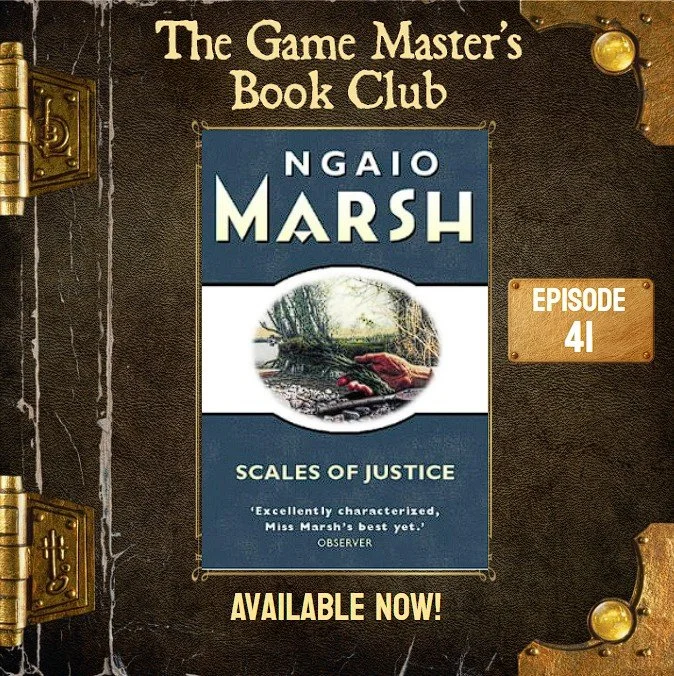
Ngaio Marsh
Scales of Justice
Speaker A
00:00:07.120 - 00:00:08.800
Welcome to the Game Masters Book Club,.
Speaker B
00:00:08.800 - 00:00:16.359
Where great fiction becomes your next great tabletop role playing experience. Today we journey to the small English village of Spevening to discover who murdered.
Speaker A
00:00:16.359 - 00:00:22.800
Colonel Carteret in the Scales of Justice by Neo Marsh. Alex Jackel, Sean Murphy and Ian Eller.
Speaker B
00:00:22.960 - 00:01:02.820
Will be the sleuths who ferret out the secrets of running mysteries in your next tabletop game. Let's get into the conversation and welco. Welcome everybody to the Game Masters Book Club.
My name is Eric Jackson and I'm here with three great game masters who you've met before. It's Alex and Sean and Ian. But they're going to introduce themselves in just a second.
And today we're going to be talking about, I think, something a little off the beaten path in a small, cozy English town, as it were. We're going to be talking about Scales of Justice, a cozy English mystery novel. Sean, can you pronounce the author's name for me?
Because I got several versions of it.
Speaker C
00:01:04.980 - 00:01:05.860
I cannot.
Speaker B
00:01:06.180 - 00:01:13.740
Okay. I was like, oh man, he's gonna know because it's his book. All right, So I don't have to.
Speaker C
00:01:13.740 - 00:01:16.980
Know the name of the author to enjoy the author.
Speaker B
00:01:17.540 - 00:01:45.520
No, very true, very true. So the author's name is Nio Marsh. That's spelled N, G, A I, O. Marsh.
Given that since we're going to be talking about mysteries and we're going to be talking about cozy English mysteries, that means we need a detective. And so I'm going to be asking each of our Game masters who their favorite detective, literary detective is. So we're going to start off with Ayan.
Ayan, give the folks a quick little hello and then tell us about your favorite detective.
Speaker D
00:01:45.760 - 00:02:53.550
Hi, I'm Ian. You may know me from writing all the way back in the early 2000s, under exalted, all the way up to the relatively recent.
For the Sundering was my last major project, but mostly I am a game master as opposed to a writer. That's sort of a side big gig. And as far as favorite detectives go, I don't, I don't think there is a better choice than Batman.
Now, not every iteration of Batman is a great detective. I think that depends a lot on how much effort individual writers put to Batman as a detective.
But when written as the Dark Knight detective, I think Batman definitely sits up there among those, those pinnacle pop culture thinkers that work their way through crimes.
And the best Batman stories, I think mix his physical capabilities and his tech stuff with him actually having to figure out what's going on Stuff like, and this is an obvious one, I'm sure lots of people have read it. But like the Long Halloween is a big, long detective story that really follows Batman thinking his way through a mystery.
Speaker B
00:02:53.630 - 00:03:00.270
Well then, Sean, I leave it to you to prove Ian wrong and tell me who is the best detective, at least for you.
Speaker C
00:03:00.350 - 00:03:44.890
Well, no, Batman is a great choice. Sorry, I'm Sean. I do a lot of role playing, gaming, I'm on a couple of podcasts, that sort of thing, blah, blah, blah, let's get to the topic here.
But you know, the first detective that I encountered would have been Encyclopedia Brown. And you know, whatever you encounter when you're 11 years old imprints on your brain more than most other things.
I probably read some Batman, but didn't appreciate him as a detective so much as a super friend.
But the idea of a mystery to be solved and then you had to puzzle it through before you went to the back of the book to get to the right page to find out who did it and try to figure out which clues you missed. I mean, that was, you know, pure, pure joy for somebody who lived in his head. Entirely too much.
Speaker E
00:03:45.450 - 00:03:46.090
No, no.
Speaker D
00:03:46.090 - 00:04:06.270
So this is kind of a weird admission.
So I grew up with parents that were like science fiction and fantasy readers and we had a huge lib of like literal books from the Science Fiction Fantasy Book club downstairs. I never read any children's fiction. I have a vague awareness of who Encyclopedia Brown is. Not a single story. Not whatever.
Speaker E
00:04:06.270 - 00:04:14.390
No, that's great. I'm actually same boat. I, I started with War of the Worlds when I was like, so many.
Speaker C
00:04:14.390 - 00:04:16.790
Cards are turned over on the table now.
Speaker B
00:04:16.870 - 00:04:19.990
Yes, a lot. This makes a ton of sense.
Speaker C
00:04:20.680 - 00:04:29.560
It's like you're getting into the last chapter of a good mystery and all of a sudden someone flips over the card and says, well, I never read things that would have endeared me to childhood.
Speaker B
00:04:32.040 - 00:04:32.600
Alex.
Speaker E
00:04:32.600 - 00:05:07.950
My name is Alex Jackal.
I'm a GM for many, many years and love this art and science of gaming and studying gaming and listening to how people GM and how people play and everything about it. So I'm a long time GM and player. I'm not a big detective reader. Right. I don't read a lot of detectives. I definitely don't read cozy mysteries.
And so when I thought about this, who came to mind was Harry Dresden, wizard and private investigator. Not really a detective. Right.
Speaker D
00:05:08.510 - 00:05:12.550
I don't believe Harry Dresden has ever solved a mystery and all of the books written about him.
Speaker E
00:05:12.550 - 00:05:14.590
Yeah. Yes. But he's blown up A bunch.
Speaker B
00:05:14.590 - 00:05:16.990
Oh, yeah, absolutely. Yes, yes.
Speaker E
00:05:17.630 - 00:05:37.150
And I recognize his weakness as barely fitting into the. As a square peg into the round hole of a detective. But he is a private investigator and he did try.
And he walked towards mysteries, often blowing them up in the process. But that was what came to mind for me when we asked about favorite detective.
Speaker B
00:05:37.480 - 00:06:34.880
Well, my name is Eric Jackson and I am the host of the podcast and I do like mysteries, but I rarely read like a straight mystery. I'm much more of a. A genre mystery guy. I'm gonna pick for my particular detective, Peter Grant from the Rivers of London series. It's great.
And also Kavna Holbrook Smith. He's just got the best voice in all of book narration. I could listen to that man, read the phone book. He's fantastic.
And Ben Aronovitch is a great writer and he takes this character who really isn't a traditional copper, but has a lot of modern policing skills, particularly social policing. He's very good at getting consensus from the community and that sort of thing. And in a time where maybe we're less excited about police people.
He's the one police detective that I'm usually pretty fond of. Well.
Speaker E
00:06:34.880 - 00:06:44.640
And I think his cultural background is very interesting too. Right. He has that whole. He's not a typical British, you know, cop, and I think that's very interesting.
Speaker B
00:06:44.640 - 00:07:50.140
Well. And yet he is. And yet he really is a British citizen in every sense of the imagination, which is what makes him great. Absolutely.
That is our favorite detectives. But today we're going to be talking about the scales of justice. This. It's 1955 in the cozy English village of Swevings.
I think I'm gonna go with that. Swevenings. Yeah, Swevenings. And Colonel Carteret, head of the Lachlan family, lies dead by a stream, a massive trout by his side.
Inspector Allen navigates the society of the four main families held tightly together by secrets and intense social snobbery, to find the murderer among them.
The novel explores the rigidity of the British class system at a time when traditional feudal villages were crumbling in the face of post war modernity. The characters are quirky and well drawn.
The fish clue is ingenious and the social atmosphere expertly described in all of its stifling conservative glory. Long live the queen. Sean, this is your book. How did I do?
Speaker C
00:07:50.380 - 00:08:37.790
Oh, I think you captured it fine. Absolutely. I mean, I think it's so I should say I did pick this. I'll take responsibility for the drubbing.
That's about to occur here if it softens the blows or maybe it'll increase them. I read about six of her books before I picked this one because I was really looking for one that was more of the cozy mystery.
And the other ones I read were all really good crackling mysteries, if you will, but weren't necessarily. I didn't want to do Agatha Christie because I feel like every book club eventually does Agatha Christie. So I picked a different person.
But this is the one I thought was most transferable to a role playing situation. And we'll see how good I was at guessing.
Speaker B
00:08:38.110 - 00:08:50.830
Yes.
And this author has been cited a number of times and this for being very, very Agatha Christie like and specifically for this story being very much in the Agatha Christie vein.
Speaker D
00:08:51.150 - 00:08:54.790
So are they contemporaries? I don't know anything about either author.
Speaker E
00:08:54.790 - 00:08:55.630
Really, to be honest.
Speaker C
00:08:55.630 - 00:09:20.080
So they were publishing at around the same time.
Her, Dorothy Sayers, Margot Allingham and Agatha Christie were all called the Queens of Crime because they were all doing these sort of mysteries where they had a lead detective who would show up from novel to novel. And Agatha Christie, it's Miss Marple and Hercules Perrault.
Speaker B
00:09:20.480 - 00:09:24.480
Anyone else want to comment on the themes that are in the book?
Speaker E
00:09:24.480 - 00:10:45.730
I initially was. I couldn't. I could barely get through it and I. I was about a halfway through and I was complaining to Sean about it.
Deservedly, I started to warm up to it when I started to sort of really pull the themes out. And the themes like how much of it was about status and pride and social hierarchy and people who belong and don't belong.
So there's all these fairly complex themes. And as I started to think about how you would do this in a game, that started to become very interesting, right?
Because I think it would be very difficult to do. I'm not saying impossible, but it would be challenging to really capture that because so much of it is about a stratification.
Wasn't like once you know what happened, it's not a surprise, right. It's sort of almost an inevitable result of the kind of tensions that were in this little town.
And so that I found interesting, I started to appreciate that part of it and also appreciate sort of the mental exercise of how would you do this in a four hour run, right. How would you create that kind of feeling of status and social hierarchy and stratification and do that?
And I think that would be an interesting challenge.
Speaker B
00:10:46.760 - 00:10:51.840
Well, good news. We're gonna get a chance to do that. I. Did you have anything themish that you.
Speaker D
00:10:51.840 - 00:11:09.320
Wanted to throw for anybody who is like listening and has a little bit of like a, a quirked eyebrow.
I would say that it was not my genre either, and I would never have, like, necessarily chosen it, but I actually think it's worthwhile experiencing new things, especially, especially literarily.
Speaker C
00:11:09.400 - 00:11:09.800
Right.
Speaker D
00:11:09.880 - 00:11:19.600
Like, so in the end, I enjoyed it and I appreciate having been exposed to it when I wouldn't have had on just my own personal, like, choices.
Speaker B
00:11:19.600 - 00:11:33.360
About what the reason that is, that is what book clubs are for, right? A chance to try out new things. And hopefully our listeners are listening in to this one going, huh, A murder mystery.
Am I going to, you know, how can I run that?
Speaker D
00:11:33.680 - 00:11:35.680
If only I knew what cozy meant.
Speaker B
00:11:35.680 - 00:11:58.250
We will, we will talk about cozy. Cozy, one of the big debates of the literary world right now. But let's, before we get into cozy, let's talk about gaming.
I'm going to jump over to you, Alex, if you're going to try and represent scales of justice as a role playing game, get that feeling, get that, get that exact plot rolling through. What system would you use and why?
Speaker E
00:11:58.490 - 00:13:36.580
I would use a derivation of one. There's a game called the City, right?
And it's one of those games that's a mixture of role playing and drawing where you have like a sheet of paper on the, on the table and you actually, you go around the table and each person draws an element of the story, right? And I think you could use that structure, I think, to build the story. Like you set the condition.
You say, oh, you're in a little town in England, right?
And it's a little, you know, and you set that context and then have people start to, oh, draw the butcher shop and draw the, the granary and draw the, you know, the fishing location or, you know, whatever it is, and then slowly build the town and as you do that, start to describe the characters in it and have that mix of the characters and the slowly building thing.
You just have to make sure that it would be difficult to capture that stratification in that kind of thing, because every player, who knows what they're going to draw, right? It could go in all sorts of different ways.
But I think if the person running the game had thought it through and had little triggers could actually just slowly build it to recreate that idea of a cozy mystery and weird characters and people with interesting pasts and slowly start to build the relationships between things.
Because that's one of the things you do in that game is you say, oh, this is related to this, and slowly have that build into this kind Of a feeling of this deeply interconnected social network of this small town. And. And then you just need a murder.
Speaker C
00:13:36.660 - 00:13:39.860
So it's. So it's fiasco for urban planners is that.
Speaker D
00:13:39.860 - 00:13:40.660
That is actually.
Speaker E
00:13:41.300 - 00:13:44.500
That's actually a great way of describing this game.
Speaker B
00:13:45.540 - 00:13:53.780
Nice. I'm even. I'm even more excited about this game now. I know, but that, but that says more about me than it does about anything else.
Speaker D
00:13:53.780 - 00:13:55.380
And now I draw the abattoir.
Speaker B
00:13:58.500 - 00:14:02.260
I had. How would you solve a problem like scales of Justice?
Speaker D
00:14:02.810 - 00:14:10.250
All right, so despite the fact that I am. I don't want to toot my own horn, but probably one of the top three game masters in the 21st century. Wow. The.
Speaker B
00:14:12.090 - 00:14:12.570
Whoa.
Speaker D
00:14:13.850 - 00:16:48.810
The mystery genre is actually like hard for me. Like, I'm not. I'm not a big fan and I don't feel like I do it well, so I don't do it right.
However, of the games that I have played that people have presented mystery games and have worked really well, the one that, that really resonates with me is Gumshoe. And the reason Gumshoe resonates with me is sort of. Its central premise is that we don't hide things from the players.
Like, it has a core system that says if you are good at this thing, you will find whatever clue is related to that thing that you're good at, not you could roll and then miss it. And in case everything stops and grinds to a halt. And it's built, as I understand this development, it was built for that purpose, right.
In order to understand how mysteries work and mysteries rely on clues. And if clues are lost, then you can't move forward and so on and so forth.
And my experience with Gumshoe is two different, very different games, but the, the system, that part of the system that matters is the same. You have Knight's Black Agents, which I have played and never run, but is a espionage game against vampires. And you have to find clues, right?
And in that game, as long as you are good at the thing, you find the clue awesome, you move forward. The other one is one called Timescape, which is more of a retroactive clue.
In other words, like it's Bill and Ted's excellent adventure where you go back in time and you leave stuff for yourself and then go forward. But it is a similarly in that space where we need a thing, we have the thing now we can move forward.
And my belief is that with mysteries, especially if you try and run them in a traditional game like D and D, boy, if you rely on either the Players being as smart as you or smarter than you or just pick up on your nonsense that you're talking or will absolutely must make that skill check. You're gonna find yourself ground to a halt in a mystery game. And Gumshoe avoids that problem entirely on both of those aspects. Right.
And, and if, and if the players are good or if they're lucky or if they spend their stuff, they can get more and that makes it gives them a little farther push. But you are never stopped by the lack of a clue. And I think that's super important when trying to do a mystery game.
And again, not so much as a GM because I just, I, I've never run one successfully even though I've tried. But as a player, those games that have gone well have embraced the idea that the information comes to you. What do you do with that information?
Speaker B
00:16:49.530 - 00:17:56.880
Yeah, no, I agree. My, my selection, Matrons of Mystery is powered by the Apocalypse piece. And there's a bunch.
Obviously you've got all your powers and things or actions that you can use and this one is designed specifically around you being a.
Unlike this book which has a professional detective, this is based around the idea that you're a bunch of old ladies in a British cozy British town and you're solving murder mysteries. More like Murder She Wrote than this book, but it does have the charming British village part to it. So that was why I sort of gravitated towards it.
And even though it uses the Powered by the Apocalypse based system, it does have a move called Put it all Together that's in this particular brew of this Powered by the Apocalypse, which allows you to determine a solution to your. To whatever set of clues you're working on.
So you've always got that ability to resolve as Ian was pointing out, that so that your game doesn't grind to a halt. Sean, I think you had a. You had a different way of approaching this. How did you think you were going to approach scales of justice?
Speaker C
00:17:57.600 - 00:19:58.730
Can we actually just take a quick step back here? I want to gently rebuke the notion that if they don't get a clue, that's it, it's over.
I don't know how many people have looked at Jason Alexander's the Alexandrian website. It's brilliant. It's well worth looking at if you're ever run a pre made.
I don't know about the most recent ones, but the older D and D older as in the last five years or so D and D scenarios, he goes through those and comes up with better ways of running Them.
One of the things he talks a lot about is the three clue rule, which is the idea that you should always have at least three places where they can get the information they need and you can move things around as necessary to get those clues. Like if there's a clue that they have to solve, maybe you don't even make them roll for it, which is the gumshoe way.
If you do make them roll for it, make sure that you provide means for them to get that. And the three clue is just a notion of saying like there are three logical ways when you go into scenario that they don't get log jammed.
I take that to heart. The first scenario I ran post my hiatus in gaming, I ran a mystery and I had happened to have seen his website.
So I happened to put in three clues and afterwards was like, oh my God, if I hadn't exactly that the game would have come to a halt.
And I don't know if you've done one on one gumshoe or Cthulhu Confidential or any of the Gumshoe system one on ones, but those are really an interesting way of doing this as well, because you as a player have, much like the detectives do in novels, this one here as a sergeant, you have people who can give you information on things and bring them into the. Into the fray. If you're playing for with multiple players, certainly another character could be that.
But then you run into that inevitable problem where one player is the Doctor and the others are the companion who's going to lead what happens next.
Speaker D
00:20:00.650 - 00:20:02.650
Right. Very special episode.
Speaker C
00:20:03.050 - 00:20:49.600
A very special episode. Exactly. Run mysteries and lots of different things.
But if I was going to someone saying like, I want to try it for the first time, I'd encourage them to look at the. Pick up a box of how to host a murder mystery and look at how they do those clues.
They're generally set up so that everybody in the first round has a set of clues that they need to make sure that they give it.
So it's not the players having defined it so much as the players have agency and are basically told, you should be getting this information out in some way or another. It's usually gossip about another player and then there's another round and the last round.
That's often where a character finds out, hey, you're the murderer, you can lie all you want. From here on out, Alex, you can speak to. Well, how well the Outlander Scottish game went.
Speaker E
00:20:51.040 - 00:20:52.320
It went excellent.
Speaker C
00:20:53.680 - 00:21:19.880
And that was one where, you know, there was a rivalry going on. They need to Pick a leader and at the same time somebody died. Apparently I fell down so hard to the floor people thought I had a heart attack.
So that was not a, an outcome I had been looking for. But anyway, then I for the rest of the session could walk around and offer people clues and encouragement.
How to play the game while the players churn the engine. That's what I would look at if I was starting out one new mystery.
Speaker D
00:21:19.960 - 00:22:27.070
I have friends like we, you would classify as non gamer friends, although I think that's a little bit of a hard line.
But anyway, they run a murder mystery every year and we go and it's a great time and there are like the whole cast and crew is, you know, 14 people and some of them are familiar with RPGs and most of them are not. And it's a mess and everybody has great food and gets drunk and so on and so forth. But I hadn't quite thought about it that way before.
Sean, where the interesting thing about that is that in those moments where they let you loose and you're supposed to be in character, your job is to give the other players the clues. And in retrospect, thinking about it like that's the knives out thing, right?
Like that's the room full of people like doing fun and interesting things that we like to watch that ends up leading us toward the killer.
And I don't know that I've ever seen that done in a tabletop RPG as opposed to just a, a dinner party by a bunch of like quote unquote, for lack of a better term, amateurs doing a, doing a.
Speaker C
00:22:27.730 - 00:22:58.890
For, you know, it's hard to do it at a table because it involves lots of people talking all at the same time.
And it's already, you know, you need initiatives, initiative roles just to sort of have talking, you know, or pass around a talking stick in a way that, in a large group.
But you know, my wife Elizabeth used to regularly do LARPs and she would have her clues and she'd give them out right away and then spend the rest of time just eavesdropping on other conversations. And she just found that just so, so lovely and Victorian.
Speaker D
00:22:58.970 - 00:23:10.490
But I like, I like that bit and I bet you could integrate that pretty easily where people, people have information and give them a, give them some sort of benny for releasing it as opposed to hoarding it. Right?
Speaker C
00:23:10.650 - 00:23:11.930
Oh, that's interesting.
Speaker B
00:23:12.970 - 00:23:20.730
No, I like, you know, to put it in the D and D vernacular. You're going to have advantage once you've told at least three people this piece of information.
Speaker D
00:23:20.730 - 00:23:22.740
Yeah, yeah, something like that. Yeah.
Speaker C
00:23:23.220 - 00:23:23.580
Yeah.
Speaker E
00:23:23.580 - 00:24:30.200
Oh, that's really interesting. It's good. Yeah. And one thing I wanted to say that I thought was really good about what you said, Sean, is the. That you can move the clues around.
Right. I have a superhero game I play where people get powers and then they discover their powers.
And the scenario starts in exactly the same place and does exactly the same way every time. But the players can go wherever they want. But I have real time tags. And then the thing that happens is going to happen wherever they go.
Not that it's on rails, although that part is on rails, but that it's triggered so that they do that. And then I make sure that at least two other people see the person with the power use the power.
And the person who's using the power usually doesn't know that they just use the power. And so that actually creates a little bit of that environment where the power players have to tell the other players what's going on.
So I just, I just thought about that and that there's a. The idea that giving people advantage for helping the other players with clues, so to speak, I think is a. That's sort of a cool idea.
Speaker C
00:24:30.360 - 00:25:32.660
But normally when we, we draw a mystery, we start with a starting point and then we'll go. Well, then there'll be three different places they could go and from there maybe they'll go to some other places. It's City of Mist.
If you've ever looked at any of their scenarios, they do a pretty good job of saying if they can get to the third layer through these two places.
And then there's another place like show you the spiderweb so that it starts with one point, works its way down and eventually comes down to one point, which is the ending point. On the Alexandrian he talks about, that's a lot of extra space that people not like you wrote up a whole scene that they may never see.
He recommends node based scenario design, which is what I think you're talking about, which is they're interesting things. And whichever one the players think is the most interesting place to go first, that's where you put your first clue.
That clue there leads to the second or third clue.
If they go to the third place, then the next clue leads to the second and then you're only writing three locales rather than a lot of space you've wasted. Yeah, exactly.
Speaker B
00:25:32.900 - 00:26:00.180
Sounds like we're actually already stripping this story for really great ideas for our campaign, as we're doing right now. We're already Figuring, oh, we could use this and do that. So let's move into that more formally. Let's talk about what's portable from this story.
What could you take out of it and bring into your game, even if you weren't going to be running a murder mystery. Ayan, do you want to kick us off and talk about what you think scales of justice could bring to your regular game?
Speaker D
00:26:00.340 - 00:26:14.680
Sure. And Sean briefly touched on this. But one thing about this story is that it is, it is definitely a single protagonist story. Right.
Like it opens feeling like there'll be multiple protagonists, but in the end it's about the detective.
Speaker C
00:26:14.680 - 00:26:15.000
Right.
Speaker D
00:26:15.000 - 00:27:07.770
And I think, I think a lot of detective stories are that way. And so what that got me thinking about is as an example of duet or one on one play, which we, you know, is a thing that exists for sure.
And you can see ads for it all over, you know, on your Facebook feeds and whatever. But is still not the standard in tabletop RPGs. Right. Like, we usually expect that there will be a group and whatever.
And a story like this in particular kind of underscores how you might structure a one on one game where the only PC is the detective. And then you. Your job as the GM is to be the sounding board when they interrogate a witness or investigate a, you know, a site or whatever. Right.
Or look at evidence. And I think that's valuable to have because sometimes we want to play those games. Games.
Speaker B
00:27:07.770 - 00:27:08.050
Right.
Speaker D
00:27:08.050 - 00:27:16.530
We want to do the one on one thing with our. Our so or our kid or only one person shows up at your slot in the con.
Speaker B
00:27:17.490 - 00:27:19.890
Oh, that's never happened. No, never at all.
Speaker C
00:27:20.930 - 00:27:32.770
So do you think the rise of those. I mean, I hadn't really heard of them until just about COVID Right.
I feel like this is a Covid product where people are like, huh, I stuck it with this other person.
Speaker D
00:27:32.770 - 00:27:58.590
I mean, I'm sure it's probably product, but only insofar as so is also role playing in general. We saw how big the change happened, right?
In 2020 and 2022, the number of people playing RPGs, most of them D and D, but not exclusively, significantly increased. And among those people were people that were stuck at home with just their other person. Right. Like they had to learn how to play that game just then.
Speaker B
00:27:58.830 - 00:28:13.550
Yeah, we needed something that, that all of us could do but didn't require going out somewhere and ta da. There was, hey, I heard this live. This live podcast thing or where someone was doing a live play and then everybody was talking about it.
So, yeah, it's great.
Speaker D
00:28:13.790 - 00:29:15.000
And I'm no expert, but based upon what I see, I think Covid absolutely gave it a boost. But I think people have actually, like, especially.
And I don't want to be, like, generationist or whatever you would call it, but, like, especially millennials and stuff where, like, money's kind of tight. A thing you can do with your. So is play D and D together, right? Or whatever. Like, whatever game. Right.
And I think that, like, those kinds of experiences that are interactive and can. Can occasionally even be deep without, like, just sitting in front of Netflix, I think. I think people have.
People have found that there is value in those things and just sort of thinking about it, books like this, and there are plenty of fantasy novels that are about a single protagonist and so on and so forth, so those qualify, too. But books like this really give you an illustration of what a story between a person and the world look like.
And if you were inclined to build a game around that, this would not be the worst place to start. With an example, John, do you want.
Speaker B
00:29:15.000 - 00:29:20.480
To talk about what you would take from this book? You had talked about a method that you kind of took from this.
Speaker C
00:29:20.560 - 00:30:49.030
As I said, I've written a bunch of mysteries, and one of the things I try to do, and I think this book does a really good job of it, and most of the best ones do, is every character has a real motive and opportunity to do the murder. They have a reason that you could look at and say, that's a real reason that they might be a suspect.
And sometimes they even sort of freely acknowledge, oh, yes, you probably do think I'm a suspect, don't you? And it reminded me they found Agatha Christie's writing notebooks, and somebody wrote a book on those.
And one of the things that came out from that research was that she sometimes didn't know who was committing the murder until quite late in the process, like, down to the final few chapters, went, oh, huh? And then would go back and rewrite to make either sort of move clues around or sort of soften the clues so that they were more of a red herring.
Look like a red herring. And even when she had sort of picked her cases that this is a person who did it, she would keep the suspect list open while developing the story.
Like, she would always write it as if it could be any. Any of them who did it. You know, she knew who was the actual culprit. And I think that that's important.
We've started watching man on the Inside because while we're Sitting in front of Netflix, watching television, which apparently something that old people do, according to Ian.
Speaker D
00:30:49.350 - 00:30:49.750
And.
Speaker C
00:30:51.430 - 00:31:07.600
And you know, he's just gone to a college and there are seven or so likely candidates for doing the thing. And they all have some reason for doing it.
The guessing and trying to figure out which clues lead to which person is what's fun about watching this sort of thing.
Speaker B
00:31:08.480 - 00:32:52.030
I'm going to jump in with mine. This is something that Alex did talk about already. We talked about this idea of the snobbery and the reputation that was in there.
And I really find that sort of thing interesting in that it is. I think it is difficult to systematize in a game as opposed to it just being written.
Because part of what makes social class the minefield that it is is that everyone just sort of knows this. If you're. If you're brought up in the right place, you know the answers. If you're not brought up in the right place, you don't know.
And I think it would be interesting to. To have that sort of thing a little bit more systematized. Which brought me to Good Society, which is a great role playing game.
And they have a phase in their game which is called the Reputation phase, where characters evaluate their actions in the previous scene and update their positive or negative social tags. And then after that is the rumor and scandal phase.
Obviously this Good Society is based around the whole Austonian season and a little bit more in the romance sort of thing.
But I do think that the changing of reputation tags and having the rumor scandal part be for social consequences put in there might be a great way to emulate this part of the scales of justice. I agree with Alex. That was the part that I found the most fascinating was like, why are these people able to get away with this? Oh right.
Because they're kind of feudal lords, but they're not. And. But where's the line? And I think it would be really interesting to explore that. That from a mechanic.
And I think Good Society is a great place to start.
Speaker E
00:32:52.030 - 00:33:02.670
I think that's right. And I think it's one of the things I. I think I'll take away is the coziness. Even though that's the part that I. I don't intentionally seek cozies.
Speaker B
00:33:03.470 - 00:33:07.510
What going on, Alex? You seem like a cozy kind of guy.
Speaker E
00:33:07.510 - 00:33:13.710
I am. I'm a big huggy bear. But. But let's see. I like to do something else in my fiction. Right.
Speaker B
00:33:13.870 - 00:33:14.420
No, they.
Speaker E
00:33:15.290 - 00:34:39.609
One of the things I do sometimes when I'm running is I create what are called Moments of Truth. And in my campaign, I create these moments of truth for each character, at least two of them per session.
But it's like taking a minute or two or three where something mundane happens where they have a conversation with a guy, they meet on the street, or they have a conversation with a shopkeeper, or someone bumps into them and.
Or someone drops their groceries in front of them or, you know, some event that's not about the Dark Overlord or the, the person drawing a weapon on them or something like that that creates a feeling of them living their life inside a real place. And one of the things I thought this book did is once you got used to the fact that, that it's this English society, right.
And you're in, once you get into that, it created this lived in feel. Doing stuff like that, even if it doesn't move the plot forward, creates that coziness. I think it creates that lived in feeling. So that's.
I think one of my takeaways was to like, keep looking for opportunities to make the world lived in and cozy by creating sort of, of interesting and real NPCs and interesting and real opportunities for the players to interact.
Speaker D
00:34:39.849 - 00:34:52.969
One of the things I thought of while I was listening to it, I had forgotten about until you were just talking now, Alex, was. I remember thinking, there is nothing in this book that couldn't have this book set in Hobbiton.
Speaker E
00:34:53.129 - 00:34:54.169
Right, right.
Speaker C
00:34:55.369 - 00:35:32.870
And we'll get to this when we talk about some of the choices.
I often read mysteries and enjoy them and then try to think, are there plot lines, ways that these characters interacted and the clues were sort of tucked away that could be brought into a scenario at some later point. Like I have a scenario in my head that's based on a mystery book that I read years ago. I'm just waiting for the right time to write it.
Because if a book entertained you while reading it, assuming that you, you know, the elements that of the mystery that entertained you should be transferable into an RPG for the most part.
Speaker B
00:35:33.910 - 00:35:50.230
I do enjoy me an opportunity to drop some science knowledge whenever I'm in a role playing game. So the idea that like fish scales are almost the same as like, as fingerprints. And I'm like, oh, now I have to go check that.
And I'm like, oh, that's true. All right, fantastic. So I was really excited by that.
Speaker D
00:35:50.230 - 00:35:54.390
But I don't think that's the kind of thing that emerges organically in play.
Speaker B
00:35:54.550 - 00:35:55.310
No, it doesn't.
Speaker D
00:35:55.310 - 00:36:47.460
Unless you happen to have a player who would say such a thing. And so it feels to me personally clunky to include like.
And mystery novels and movies seem to do this all the time, where there's that rare esoteric piece of knowledge that, like, sort of is the major clue. I feel like that's harder. Right.
If you want the players to feel like they are solving the mystery, not that they rolled well, and therefore they get to solve the mystery, that's kind of what I'm talking about, this little bit of information, this little thing. Because the two fish scales will not be the same because of blah, right?
In the book, how do you translate that into a thing that actually happens smoothly and organically at the table to make the players feel smart without you just hammering that in front of them so that they are. This is a clue. Right? Like that, I guess that's the stuff I find difficult.
Speaker E
00:36:47.540 - 00:37:54.120
I have one way I've done that in the past very successfully. And it's tricky because you do have to rely on the players not being completely oblivious. Right. Which is a dangerous assumption.
So you have to hammer it a lot. Right. But there. One way I've done it in the past is you may not be able to give them, but if you know what the clue's gonna be like.
There was a quest. It doesn't matter what it was. There was a thing, a MacGuffin, and the MacGuffin had a particular attribute.
And I introduced the attribute early on, like, at the very beginning of the game as a side thing, like in one of these moments of truth things. Right? But I made it memorable enough that they would remember it.
And then three hours later, when that became relevant, all it took was one of the six players to remember that I had said that. That I had described that thing. And then they. They said, hey, wait, don't red rubies have electricity power in them? And then.
And then they felt all brilliant, right? Because they figured this esoteric thing out, when, in fact, I just planted the clue in the first 10 minutes of the game.
Speaker D
00:37:54.200 - 00:37:56.760
And what would you have done if no one had remembered that?
Speaker E
00:37:56.760 - 00:37:58.680
Oh, some NPC would have remembered.
Speaker C
00:38:06.120 - 00:39:06.540
So my approach tends to be more organic to those things because I occupy the three clue.
First of all, I would have said, the next time they're poking around the guy's house looking for papers, they find a journal with a marked page, and it's an article the guy who's dead wrote with a, you know, a biologist on why fish scales are unique and that he's noted on there as the.
As the catcher of the Fish, because A, it reinforces he really liked fishing, and B, it puts the players, because you give them such scant knowledge at a table, I think it tends to hold on longer than you might think. You wait for them to go and say, all right, well, I'm. I feel like. Is there. Is there somebody who might be an expert on what's going on here?
Well, you know, maybe. Do you. Do you think your character would know somebody who's really good at fishing, maybe knows this guy? Oh, you do?
Well, because no player ever says, no, I don't have a thing that might help me.
Speaker B
00:39:06.700 - 00:39:07.100
Right.
Speaker C
00:39:07.740 - 00:39:37.230
And then that person says, well, I don't know. But, you know, are there any fish scales? Because those are as good as fingerprints. Oh, wow. Okay, now we can work. I wait for them.
I have the clues ready to go in places, but I also wait for them when they get a little frustrated to say to them, like, well, what do you think you might do to get new information? And whatever they pick, why, by Jove. That's how they got the clue they were looking for. And it was there all the time.
And weren't they smart to figure that out?
Speaker B
00:39:37.230 - 00:40:06.130
Ah, the magician's choice place. Fantastic. Let's talk about things that feel like this book. Alex has addressed the fact that it's. It's cozy, and we've talked about that.
It's one on one. It's a small group of people. It's. It's a mystery. What other media might inspire other game masters like this book might inspire them?
I'm gonna ask Sean to start. Sean, what media do you think is like this? The scales of justice?
Speaker C
00:40:06.770 - 00:40:49.570
Well, let's. Let's define cozy mystery because you said you would and then we didn't. A cozy mystery is generally. And this is general.
It's amateur detectives, although not always. I mean, Agatha Christie's Hercules Perrault is a. You know, often cozy mysteries, even though he's a professional detective. It's in a limited locale.
It's in a small area. It's contained. It's not, you know, running all. All over the places. And that there's limited amount of violence, either either the murder or.
Or fighting or anything like that. It's the sort of thing that you would sit. Sit on your reading chair with. With a hot tea and read.
Speaker D
00:40:50.210 - 00:40:57.010
Isn't there also a stakes element where it's kind of just this situation, not the. The president is the killer kind of deal?
Speaker C
00:40:57.010 - 00:42:30.070
Right, right, right, right, right, yes. So that, I guess that's limited locale and limited Sort of field of influence. Right.
And so, you know, I think that the, the people that did it best in terms of media, Masterpiece Theater did adaptations of Hercules Perrault and of Miss Marple, a few different. BBC's done a few different adaptions of Miss Marple, both of which are Agatha Christie's. And there's a new one that just came out.
The name escapes me. I think the word clock is in the, the title. That's six part series. It's really well done.
And the nice thing about it is if you have a spouse who enjoys seeing period costuming, then you're all set. Only murders in the mystery, at least the first couple of seasons, have that same feel to them. It's a small group of amateurs.
They're only working with murders in their specific building. You don't see the violence occurring, you just see dead bodies, which are described in the books.
I think those books there, I think is one of the reasons why they're sort of appealing to people. And then if you wanted a strict Sherlock Holmes detective and you didn't, you know, you'd already seen Sherlock, which is an obvious one.
I really enjoyed elementary too. It was a Covid pleasure of ours. They're an interesting couple. They've got, you know, partners, not couple who have interesting backstories.
And the mysteries are.
And when I was mentioning before, like, oh, I have a mystery in my head, if it's one of the books from that series I read, that was like, oh, that's very clever. I need to figure out how to bring that into my next game. And that was like five years ago, but it'll happen.
Speaker B
00:42:30.630 - 00:43:13.410
I agree that the cozy part has something to do with both the space and the action that is taking place there. As a result, I have, I have three possible books that are in this range. And once again, my area is in genre mysteries.
I'm going to go from closest to, to least close. But I think they're all pretty good representations of this idea of the cozy mystery. And the first one is Once Upon a Haunted Moor by Harper Fox.
There's a psychic element to this. There is some actual psychicness that happens.
It's pretty low key, though, and very much in the I don't have a feeling kind of a thing, as opposed to I cast a Divination.
Speaker D
00:43:13.730 - 00:43:15.970
Not the Professor X Mystery Movie.
Speaker B
00:43:16.770 - 00:45:34.200
No, it is not the Professor X Mystery movie. And I know it's you because I can read your mind. No, that isn't what's happening there.
And it also, like Sean described the series of books that the scales of justice is part of. It is also part of a long romance. It's a male. Male romance that takes place there. Really great characters there.
Tayak and Frayne are the two main characters there. And that's really. I like that. And I think that's probably the closest, although it's also modern, as opposed to 1955.
But it's also a tiny village, and you're seeing how the village is changing and certain institutions that existed aren't existing anymore. So it does have that sort of like things are changing and we need to change with them or not that I felt really strongly from this book.
The second one, which I think is also in the same vein, is A Murder by Memory, which is by Olivia Waite. Science fiction murder mystery that takes place on a generational ship. Everybody knows each other.
You know, obviously it's a closed system and there isn't a lot of violence, you know, and yet a murder occurs. That one is really good. Olivia Waite is an amazing writer. I have mostly read her romances.
This is her first real foray into mysteries, and I really enjoyed it. The last one which is the most D and D oriented of these that would happen is the Hunter's Haunt by Dave Duncan.
It has a character who I am very fond of. His name is Omar the Storyteller.
And there's a bunch of people trapped in a small cabin in a pass at winter, and they're sort of forced to tell their stories. And as a result, we sort of figure out why they're all here, and then eventually we figure out who's done the murder.
So I think it really does have that feeling of everyone's a suspect. And then we kind of narrow it down a little bit.
And then eventually, after telling all the stories and getting all the background on everybody, we eventually figure out who it is. So in that regard, it's very personal the way this story is. So those are my three.
Once Upon a Haunted Moor by Harper Fox, Murder by Memory for Olivia Waite, and the Hunter's Font by Dave Duncan. Alex, what are some books that you think that would vibe with this book?
Speaker E
00:45:34.200 - 00:47:22.840
Well, interestingly enough, I have two. One of them is a book and also a show now. Right. But the book and show is Murderbot.
That may sound weird to people because, like, you know, again, less cozy, more murdery. And I think we're seeing a theme here. Right.
What I like about Murderbot is there is a fundamental mystery, and it's all about him figuring out himself. And he's in this closed arena with this small group of people and trying to figure out what's going on. Right.
And that's what sort of reminded me of it.
But the other one, which is much, much closer is Knives out, the movie Knives out, which was just absolutely brilliant and is a very small, constrained location. So small town that is a church. There's a murder. It's a closed door murder. Right. No one. They're trying to figure it out.
And there's a list of suspects, all of whom have excellent reason to do the murder. And you sort of watch it unfold. And I thought that was a great example of this kind of thing that I think would be very.
A good inspiration for this kind of work. And it also, I think what it highlights is one of the things that's been brought up a couple places is the characters.
I think one of the other aspects of A Cozy Mystery is they always have weird characters, but not weird like, oh, it's a guy with two heads. Although I guess in a fantasy setting, that could be the weirdness. Right.
But it's more like weird like they all have quirks, interesting quirks, and hidden secrets in their own lives. And they're. And the characters themselves are entertaining.
Just learning about the characters and meeting the characters are part of the entertainment of the story.
Speaker C
00:47:23.640 - 00:47:45.460
So when you say Knives out, there's the first movie that came out just before COVID which is all about the patriarch who dies. The clues all point to his. His nurse. Then there's the Glass Onion, which is the rich guys thing. But the.
You're specifically referring Wake Up Dead man, which is the most recent.
Speaker E
00:47:45.620 - 00:47:46.340
All three.
Speaker C
00:47:46.500 - 00:47:55.380
I think they do. Yeah. But I do think, you know, Wake Up Dead man is absolutely an example of the. The. Even the traditional cozy mystery.
Speaker E
00:47:55.380 - 00:47:58.160
So, yeah, yeah, it has all the. Has all the attributes.
Speaker B
00:47:59.270 - 00:48:03.510
All right, Ayan, time for you to wrap up our media recommendations.
Speaker D
00:48:03.590 - 00:49:19.500
All right, so I'm gonna. I'm gonna dovetail a little off just on theme from Alex in that the quirky characters are what kind of make these things.
My recommendation will be a surprise to nobody in the sense that it is actually a. A narrative nonfiction slash documentary thing. In 2017, there was a podcast called S Town.
It was from the Serial people, and it is about a small town in Alabama and the attempt to solve a murder that may or may not have actually happened in that town. I will not spoil anything.
I will just say that if we are talking about strange characters living in close proximity to one another with investigators coming in, trying to understand what's going on.
Despite being a documentary and non fiction, this is right there and people should definitely, definitely check it out for understanding how weird a very sort of contained mystery can be. And it has the benefit of being really well produced and lots of fun to listen to.
And if you listen to it with friends, you will never stop talking about it and trying to figure out what was going on. Definitely S Town from Cereal.
Speaker B
00:49:20.790 - 00:49:44.070
So we've, we've reached the end of our discussion of the book, so now it's time to bring people back to you guys. I just want to check in with everybody and I know that a few of you have projects that are happening. This one's going to get released in like August.
If you've got stuff that you want to talk about, think projects you're working on, causes you need to point out, please feel free to do it now. We'll start with Alex.
Speaker E
00:49:44.950 - 00:50:09.880
Great.
Given the brilliant Success of the 2026 Rising Phoenix Gaming Con, I would like to promote the idea that we will look at Both for great GMs, people to come to the convention and if you have any ideas about things you'd like to see at Rising Phoenix Gaming Con, you know, definitely let us know and we'll be happy to include that and work that into what we're doing. And I hope to see you all there.
Speaker B
00:50:10.280 - 00:50:30.570
All right, fantastic.
There will also be before this, before this podcast comes out, you guys can go back and listen to a couple of the authors who showed up at the Rising Phoenix Game Con and here are interviews with them about their books and how those could be used in games. Ayin, I know you have some role playing stuff as well.
Speaker D
00:50:30.730 - 00:50:56.500
Yeah. So like, as I mentioned, I've been a freelancer in the industry for a lot of years, off and on and to varying degrees of success and frequency.
But given that I'm getting old, I've decided I. I absolutely need to do a bucket list thing. And a bucket list thing is going to be an rpg. I have not decided on any specifics, so I can't give them here. But I will say this.
I will run it as a debut at Carnagecon at Killington in November.
Speaker B
00:50:56.660 - 00:51:12.660
So like, be there November 2026. Ian checks something off his bucket list and everybody else gets to be entertained by it. That should be fantastic. I can't wait to see what it is.
Sean, did you have anything you needed to promote?
Speaker C
00:51:13.060 - 00:51:30.560
I did. I wanted to promote to future me in August.
When you're complaining about how freaking hot it is, I want you to think back at how much snow you've been moving and how cold it's been outside lately and just think to yourself, well, it could be worse. Thank you.
Speaker B
00:51:31.200 - 00:51:32.600
Okay, there we go.
Speaker A
00:51:32.600 - 00:51:33.040
That's.
Speaker B
00:51:33.040 - 00:51:36.400
I can't think of a better way to end it. That sounds fantastic.
Speaker D
00:51:37.280 - 00:51:38.160
Thank you, Eric.
Speaker B
00:51:38.880 - 00:51:52.170
Yeah. Thank you all for doing this once again. It is always a blast to have you gentlemen on, and I hope we get to do it again. Yay.
And that was Scales of Justice by Neo Marsh. Thanks again to our senior detectives Sean.
Speaker A
00:51:52.170 - 00:51:54.690
Murphy, Ian Eller and Alex Jackel for.
Speaker B
00:51:54.690 - 00:52:11.580
Finding all the clues to making mysteries work at the gaming table. To paraphrase Hercule Poirot, we can always rely on your little gray cells.
Join us in two weeks when the cast of the live Play podcast Twisted Tropes join us to discuss the YA science fiction classic the Giver by Lois Lowry.
Speaker A
00:52:11.580 - 00:52:30.820
You can find a complete transcript of today's discussion as well as links to all of our podcasts@k-square productions.com GMBC. You can learn about upcoming episodes on our social media on bluesky, at gmbookclub, bluesky Social, on Facebook, at gamemasters Book.
Speaker B
00:52:30.820 - 00:52:33.840
Club, on Master Mastodon Amasters Book Club,.
Speaker A
00:52:33.840 - 00:53:03.790
And on Instagram gamemastersbookclub.
If you've enjoyed the show, please like subscribe and comment on our episodes in your chosen podcasting space and be sure to share those episodes with your gaming community you've been listening to the Game Masters Book Club brought to you by me, Eric Jackson and K Square Productions. Continued praise and thanks to John Corbett for the podcast artwork and Otis Galloway for our music link.
Later, gamers and to paraphrase the great Terry Pratchett, always try to be the place where the falling angel meets the rising ape.