GMBC ep27 - The Thrills of the Rocketeer: A TTRPG Pulp Exploration
Dave Stevens
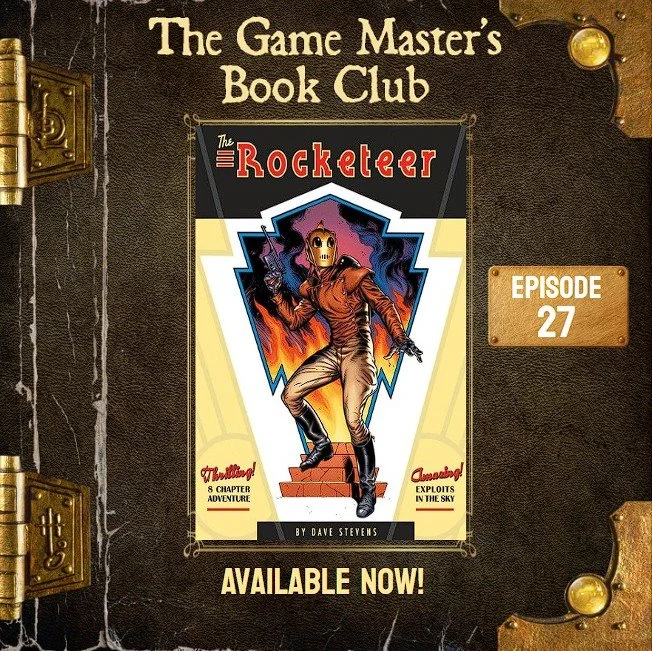
The Rocketeer
Speaker A
00:00:01.840 - 00:00:03.520
Welcome to the Game Masters Book Club
Speaker B
00:00:03.520 - 00:00:06.720
where great fiction becomes your next great tabletop roleplaying experience.
Speaker A
00:00:07.680 - 00:00:30.820
News flash to Mr. And Mrs. Dice Roller and all the minis on the board. Prepare yourselves for the thrills, chills and spills of the Rocketeer.
An homage to pulp Heroes of the 1930s by writer Artist Dave Stevens. Sean Murphy, John Corbett and Jonathan Mazur are on the ether. And let me tell you Joe, this ain't no clam bake or chin chopper of a show.
It's a humdinger, the bee's knees, the real McCoy. Lets get into the conversation.
Speaker C
00:00:32.500 - 00:00:32.860
Right.
Speaker A
00:00:32.860 - 00:01:07.680
Hello everybody and welcome back to the Game Masters Book Club. And I'm back here with John Murphy, Jonathan Mazur and John Corbett to talk about another graphic novel. This time the Rocketeer by Dave Stevens.
I'm going to be asking our game masters what their favorite pulp character is. But I wanted to start by asking our game masters what they think pulp is and based on that, what is their favorite pulp character?
Sean, I'm start with you go right ahead. And what's pulp and what is your favorite pulpy character?
Speaker D
00:01:08.320 - 00:02:26.360
Yeah, so for pulp for me and definitions can vary are the origin of it is from the pulp magazines from the 1930s, it's from the paper that was being published on and there's a series of characters, most of whom are not active in the world, but a series of crime, semi superhero, I'll say action fantasy types that were featured in those magazines and they created a certain genre of action over plot that you can still see in a lot of the literature that says it's pulp.
Although as I'm sure we'll talk about, there's other literature that's pulp based because of the feel to it, but the plot is absolutely still critical for it. So I went back and forth I'm going to take because of the definition I threw out there, I'm going to take Conan the Barbarian as my favorite pulp.
He's not what you would normally consider to be a pulp character. Normally we think of other people will say their names, I won't have to.
He's absolutely a pulp character in that he was appearing in magazines, the same magazines that Lovecraft and others as a fantasy sword sorcery type character. So I'm going to throw that out. And there you go. That's my definition.
Speaker A
00:02:26.440 - 00:02:35.980
All right, fantastic. Jonathan, I know you're a huge pulp fan, so why don't you tell us about what your definition of pulp is and what is your favorite pulp character?
Speaker C
00:02:36.210 - 00:02:57.170
Yeah, you're Correct. This is sort of my bread and butter as a game master. Fun fact for you longtime listeners.
Eric and I actually, I'm not going to say this is how we met, but one of the first things we did together. I started a pulp role playing game in college and Eric was one of the players.
Speaker A
00:02:57.330 - 00:03:01.890
Yes, I had a fantastic character there who I will be bringing up when I talk about my pulp character.
Speaker C
00:03:01.890 - 00:06:41.670
I believe Sean already covered this. The term pulp comes from the kind of paper it was printed on. It was contrasted with glossy magazines or more Reader's Digest magazines.
I think technically it goes back to the very turn of the century. It was a descendant of the penny dreadfuls of the Victorian era and it evolved into these cheaply mass produced on cheap PA magazines.
The beginning of the 20th century, also sometimes called dime novels, although I believe Sometime in the 30s the more popular ones went up to 15 cents, so they couldn't call them that anymore. And a lot of times they were published by genre.
So you would have detective pulps and western pulps and science fiction pulps, adventure pulps, and then there were spicy variants of all of those and it was quite a range. While it's often thought of as mainly a US phenomena, it really did in some cases.
They had other names in other countries, but there's a UK equivalent and a German equivalent, and it was actually pretty popular at the time all around the world. Contrast I would make here. At the risk of foreshadowing probably what Eric's going to tell us about the writing of our book.
Pulp overlaps with Saturday morning movie serials and radio dramatic cliffhangers.
The Venn diagram of these things would be a lot of overlap and certainly filtered through, I'm going to say, a modern lens, let's say Star Wars, Indiana Jones, any of that kind of stuff is harkening back to the stuff from the 30s and the 40s. Honestly, the book we're going to be talking about is effectively an homage to all of that. This is not a comic from the 30s.
It's a comic about the 30s. While I will split hairs, I'm perfectly happy to blur those lines myself when I'm running a game.
And that's not even getting into later things that come post World War II, like film noir and more hardboiled detective stuff. Because while the pulps kind of went away, they kind of evolved.
And so you had their descendants, comic books and what I guess you might term men's adventure fiction. Things like Remo Williams the Destroyer.
And I imagine someone could pretty easily draw A line back with things that are contemporary, like the Jack Reacher novels. Favorite character. That was a tough one. If I'm on the spot, I'm gonna have to go with the Shadow. He's probably my favorite.
Although referring back to what I was just saying, I don't actually necessarily enjoy him as much in the original pulps or the reprints as I do in other media like the radio, comic book versions, various attempts at movies. And I find that that focuses more on him, whereas the. The pulp novels tend to focus more on his agents a lot of the time.
Again, getting deep into the weeds, so.
Speaker D
00:06:41.830 - 00:06:42.790
Oh, that's good.
Speaker A
00:06:42.870 - 00:06:58.220
Now that John has said the Shadow, I will say that my character in John's Campaign was based on the Shadow loosely. The Magician. I did really enjoy that character. So thank you again, John, for that. I mean, it's what, 30 plus years?
I'm still talking about that character, so.
Speaker C
00:06:58.300 - 00:07:00.220
Well, we may be revisiting that.
Speaker A
00:07:00.220 - 00:07:05.900
Yes, could be coming soon. John Corbett, pulp and your pulp hero, please.
Speaker E
00:07:05.980 - 00:08:00.470
Yeah, so Pulp to me is any story that is fast paced and has a lot of action. So basically kind of what you would expect at an average tabletop role playing game table. I think that sort of speaks to the essence of pulp for me.
As far as my favorite pulp character, it's an even split. When I was really young, I really enjoyed swimming a lot and I saw a lot of Johnny Weissmiller cereals. So Tarzan was sort of my original pulp hero.
Really loved the way he was sort of rugged and he beat the odds and was sort of a master of the jungle. That really appealed to me until I saw Star wars. And then I was like, okay, Buck Rogers is the pulp guy that I like.
He was kind of a guy who was sort of cocky, but also sort of romantic. And his enemies were pretty clear, pretty villainous. And there's always something going on. And I liked all the cliffhangers as well.
So those are the ones for me.
Speaker A
00:08:00.470 - 00:09:18.870
I became a retroactively huge fan of Buck Rogers after I saw the Gil Gerard 1970s series. And I found out that in one episode, Buster Krab played a character in that TV show. My dad was like, oh my God, that's Buster Krab.
And I'm Buster Krab. I'm a kid from the 70s. What do I know? For me, pulp's an aesthetic. I'm less technical. I respect the history and where these come from.
But most of my characters that I'm very excited about, obviously I just said, I like Buck Rogers. I've played a character based on the Shadow.
But it's mostly, I think, with the interpretations that have come from Pulp and the aesthetic that goes with it. If I have to pick a singular character that I think represents that, that's Agent Carter from the Marvel series.
I thought her particular spin off series that was on Disney and was available to folks was quite good. And I'm kind of a fanatic as far as that's concerned. I also just want to throw back before Agent Carter, the entire cast of who Framed Roger Rabbit.
I know those are mostly tunes, but the setting of that, where it took place, Los Angeles as a main character. Maybe that's getting more noir based on what John was saying earlier. But yeah, I would say Agent Carter's my Pulp heroine.
Speaker C
00:09:18.870 - 00:09:24.200
That's an excellent choice, actually. Everybody had an excellent. I don't think anybody's choice was bad.
Speaker D
00:09:24.280 - 00:09:24.560
No.
Speaker A
00:09:24.560 - 00:11:21.760
And I think that's what's really great about Pulp is that it's like art, right? You know it when you see it.
And I think a lot of people have a slightly different point of view, as we've just pointed out, which is one of the reasons why it's such an interesting gaming setting that we can all use.
Because people are going to bring different perspectives to a Pulp game and we as game masters are going to have to have a handle on a bunch of different ideas that Pulp contains, which is going to bring me to our story. The Rocketeer. Originally published in the 1980s.
Dave Stevens character the Rocketeer is an homage to a Pulp era Art Deco Pre World War II America, where Cliff Secord, our headstrong aviator, becomes a flawed crime fighter when an experimental jetpack originally stolen by the Nazis falls into his possession.
Meanwhile, Cliff is trying to hang on to his out of his league girlfriend Betty, who is modeled after Bettie Page and is trying to become a celebrity herself. He's aided by a curmudgeonly old engineer named Peavey, and also aided by a number of versions of Pulp legends like Doc Savage and the Shadow.
And surrounded by autogyros, high tech planes and enough 1940s slang to stymie Amy Poindexter. The Rocketeer punches his way through Nazis and other villains in this modern reimagining of the Pulp heroes.
Quick note before I pass this on to you guys, just because I really want to say something about this.
Dave Stevens was a huge Bettie Page fan from his modeling of the Rockteer celebrity seeking girlfriend Betty, as I just mentioned, who is famous for doing 1950s pinups. He later befriended Bettie Page and arranged for her to get compensation for not only his drawings of her, but from other publishers as well.
Even though we do see some cheesecake, quote unquote, pictures of Betty throughout this, we know that they were going to support Bettie Page herself.
Speaker C
00:11:21.840 - 00:11:25.960
Honestly, you could do a whole podcast just on Bettie Page.
Speaker E
00:11:25.960 - 00:11:27.360
Oh, yeah. Oh, you're not wrong.
Speaker C
00:11:27.360 - 00:11:58.900
Yeah. Apparently she had basically no idea that her image was. I have a Zippo lighter that has a Dave Stevens rendering.
It's from the Cliff's New York adventure scene, where she's a full page, you know, top to bottom in an evening gown. And I was like, oh, I didn't know that was from this. I just thought it was a Bettie Page lighter. I didn't even realize it was Dave Stevens artwork.
Speaker A
00:11:59.100 - 00:12:06.300
He said in many different interviews that I looked up for this, that, yeah, that Bettie Page was absolutely the only person he was basing that character on.
Speaker C
00:12:06.300 - 00:13:37.780
Yeah. Actually, if I can springboard off of what you said, I think one of the things I failed to say when we were talking about what pulps are.
Pulps were mainly text. They were primarily prose.
They would have a big, splashy cover, which often had no, nothing whatsoever to do with what was going on in the stories inside a tradition that was continued in comic books. And they would have little illustrations in much the way magazines would do just to break up blocks of long text.
But they were in no means graphic novels. They were novels with a couple of images in them.
And in thinking about that definition afterwards, when I was doing some supplementary reading on Dave Stevens, I thought, here was a guy that apparently never thought he was very good at the writing part of the job, which a lot of people take issue with, and was mainly known for his artwork specifically, you know, some of it being cheesecakey, although he did a lot of animation stuff. Super friends, Hanna Barbera, etc. Etc. But again, most of it big, splashy cover. Right.
Because a lot of the images that we see with the Rocketeer are the covers from the many different versions of the comic there have been in the history of it being published by whatever it was, four or five different companies.
Speaker D
00:13:37.780 - 00:13:38.260
Yeah.
Speaker C
00:13:38.260 - 00:13:49.790
And I just thought that it was interesting that whether it was on purpose or not, he had sort of accidentally mirrored what the pulps were in terms of how it was laid out.
Speaker A
00:13:50.190 - 00:13:54.750
John Corbett, what did I miss when I was talking about our friend the Rocketeer here?
Speaker E
00:13:54.830 - 00:14:14.030
I think you nailed it pretty well. That was a very good summary, I will say. I love.
I think Dave Stevens is whatever you want to say about his writing, he's a very impressive artistic talent. On his ability to render very appealing cheesecake. He's also very expressive, does vehicles real well, expressions really well.
It was a real treat to read this one.
Speaker D
00:14:14.860 - 00:14:15.260
Excellent.
Speaker A
00:14:15.260 - 00:14:19.420
And Sean, anything to add that we have not covered about the Rocketeer?
Speaker D
00:14:19.660 - 00:14:46.860
No, other than to say that it did come out at a time when these independent books were just sort of starting. We were pre Image. We're in the early 1980s. There's a lot of sort of exciting things going on in graphic novels and such.
And I think that his ability to sort of put out his own magazine at a time when that was just starting, in addition to his artistic influence, is probably one of his lasting legacies.
Speaker A
00:14:47.180 - 00:15:13.080
I'm going to add one more thing because John mentioned that Dave Stevens did some work on the Super Friends. I just want to mention that Peavey, the character who is there, is actually also based on an animator, Doug Wildey.
He was a mentor for Stevens and he is most famous for being the main artistic director on Jonny Quest, which was on my list. When we were talking about possible pulp things, I was like, jonny Quest, for sure.
Speaker C
00:15:13.160 - 00:15:18.440
Oh yeah, that's clearly a similar, if not, you know, direct ascendant.
Speaker A
00:15:18.440 - 00:15:50.670
And that's clearly what we were doing. Johnny Quest was based off of that. And the Rocketeer also sort of falls into that general genre of the homage to the pulp.
But if we were going to make an homage to a pulp in our tabletop role playing games, how would we want to go about that? That's what this is really about. So now that we've discussed the book and pulp and all that good stuff, let's get down to the gaming.
And I'm going to start with you, John Corbett. If we were going to go forward and you wanted to run a pulp based game, what would you run it in and why?
Speaker E
00:15:50.750 - 00:16:35.480
I would have to use the seventh C system because much like the pulps themselves, as I said, I see them as being very racy and very action packed. I feel like 7th C accomplishes that very well.
It's something that the game master and the players cooperatively get to tell the story and you can influence the way it goes and change it on a dime through the use of their hero points. So I would do something like that. You're able to defeat inconsequential enemies fairly quickly, but you can also set up more challenging encounters.
And I think you can tell a pretty wide number, a wide range of stories. I think there's a lot of different types of stories you could tell.
Speaker A
00:16:35.920 - 00:16:41.840
Thank you, John. Sean, do you want to go ahead and tell us about your way of bringing the pulps to life on the tabletop?
Speaker D
00:16:41.920 - 00:17:39.360
Possibly misunderstood the mission here, but what I wanted to talk about was what system I would use to run this graphic novel. The problem with this book is that it's one character primarily.
There's some background characters who are important, but they're clearly secondary to the plot, which is very consistent with the Pope milieu. And so I would look to look at a duet system. One player, one gm.
I'll throw out Knight's Black Agents, Solo Ops, because that's a system I've used before and I know it. I know that Pelgrain Press has been doing some Cthulhu Confidential, which is one on one in the trail of Cthulhu system.
And I'm aware of Ironsworn and Star Forge, but I haven't played them before, so I don't want to recommend them other than a sort of an example of a genre of one on one, because I feel like that's with this book and a lot of graphic novels out there are really one on one types.
Speaker A
00:17:39.680 - 00:17:45.600
That is one of the things that if we wanted to match it up directly to the book, we would need something that's more of a one on one game.
Speaker C
00:17:45.840 - 00:17:49.280
Jonathan, I can never come up with just one answer.
Speaker A
00:17:49.280 - 00:17:50.160
No, that's okay.
Speaker C
00:17:50.160 - 00:20:33.430
I would probably say if I were going to do a pulp game, say right now, that I would use either the Spirit of the Century rules, which is a variation of Fate made by Evil Hat Games, I think, which I have run and played in before, and. Or the other thing I would consider maybe doing would be Savage Worlds, which I think has its own set of pulp sub rules.
What both of those systems have is. Is a method of dealing with the large inconsequential enemies. What I like about Spirit of the Century is they do multiple kinds of damage.
There's physical damage, there's. I forget if they call it psychic or mental damage. And there's like social situations too. So there's another words.
Doesn't have to be a fist fight, although certainly I'm sure there will be one. You know, they have rules for other situations. And I can say having run the Savage Worlds one, it's very good for dealing with.
Oh, and another wave of Nazis comes into the. You know, in fact, I remember one player said to me that this is a lot of Nazis, though. And I'm like, yeah, but I get where you're coming From.
But yeah, in the sense of, oh, there's just all these mooks or goons or thugs or whatever you want to call them that the heroes can take down. I don't want to say without consequence, but, you know, both of those systems are good for that.
And to touch on something that I believe John said, one of the things that I like about both of those systems is that they also have. That they have an element or elements of the players being able to affect the storyline. All games should have that.
But I mean, I believe he alluded to hero points. There's something similar in both of these systems as well.
I guess the thing I prefer about Spirit of the Century is the characters have aspects that can be tagged or activated in both a positive and a. I don't want to say negative way. Exactly. But there I think. I wish I could, off the top of my head, remember what they were called.
But one is like when you're going to the game master and saying, well, I have this aspect. Wouldn't that come into play? Play here? And the other would be if the game master is saying, well, you have this aspect, I'm tagging it in this scene.
You know, would you really be able to resist reading from the Forbidden Book?
Speaker D
00:20:33.910 - 00:20:37.509
Yeah. So you're talking either invoking or compelling aspects. Right.
Speaker C
00:20:37.830 - 00:20:41.110
I. I had compelled but not invoked. Thank you.
Speaker A
00:20:41.350 - 00:20:44.950
If I were going to take a crack at this, I would probably off the top.
Speaker C
00:20:45.110 - 00:20:45.510
Right.
Speaker A
00:20:45.510 - 00:21:52.720
Like today, if someone said run it, run me a game. Tomorrow, I would probably use the Hellboy RPG system just because it lives in that same general genre of the homage to Pulp.
But I do think there's a lot of spookiness that happens in Hellboy. So it's probably not going to be my best bet.
If I had more than a day or so to prep for something, I would probably pick up Two Little Mice's outgunned adventure. This looks like a really awesome system.
I really like the idea of the their dice rolling system, which is kind of like a roulette because it's based on the number of two of a kinds, three of a kinds, four kinds, and if you can get six or more of a kind, you get a jackpot. The Hellboy has exploding dice, which also has that sort of like over the top pulp kind of feel.
But I think this rolling of multiple dice and getting closer and closer to a jackpot and there are a couple ways you can modify the dice to change them to be some other ways based on some special powers. The idea of being at A pulp game. And being able to shout jackpot just feels right on target for this sort of thing.
Speaker C
00:21:53.600 - 00:22:03.240
That's a good choice. That was definitely one of my secondary ones as well, because it's sitting at my feet. I still have to read it, but I. I think.
Speaker A
00:22:03.240 - 00:22:05.120
No, I think everybody had a lot of really great stuff.
Speaker D
00:22:05.120 - 00:22:05.480
I would.
Speaker A
00:22:05.480 - 00:22:15.440
I haven't run in all of them. I clearly haven't even run the one I've recommended in.
I do like a good pulp game, and I. I'm hoping that at some point I get a chance to run one again.
Speaker C
00:22:15.870 - 00:22:16.270
All right.
Speaker A
00:22:16.350 - 00:22:20.670
But that is going to bring us to stuff from the Rocketeer.
Speaker D
00:22:20.670 - 00:22:21.310
Now, this is.
Speaker A
00:22:21.310 - 00:23:22.080
This, I think, is going to be a little difficult because one, the Rocketeer is an homage, and two, I think most of us are of an age that we grew up with the movie, which we haven't mentioned previously. The movie that is not a ton like the comic book at all, but the. The two stories that we read, which is the introductory story and New York Adventure.
And there are apparently many more other stories.
Although I get confused because, as has been previously mentioned, the Rocketeers started out as an independent piece and then got published by other groups as it went through its evolution and as more stories were published. Thank you for bringing that up, Sean.
But in any case, all of this means that the Rocketeers permeates a lot of what pulp is, and certainly what a lot of us, of our particular Gen X feel is pulpit. So, based on that, and I will start with you, Sean.
What is something that if you were running a pulp game, that you would want to take from these comics?
Speaker D
00:23:22.320 - 00:25:00.860
Yeah, I think John brought it up well, that the joy of a pulp game is the focus on the action, keeping things moving. There's intrigue around there, there's suspense, but there's not a lot of naval watching. I like the time period of this particular one.
1938 is a funny period of US history. And we're not in the World War, but we're definitely involved or at least creeping around the edges of our country.
And that sort of thing is the sort of thing. If I was going to do a pulp game, this is the right period to set it in, and this is the right level of action to have for it.
I also think that this is interesting in that I'll defer to Jonathan, given he has a much greater understanding of pulp than I think I do. This is interesting in that it's an ordinary guy.
Like he's not Buck Rogers, Flash Gordon, Tarzan, Kazar, any of the people that normally shadow, that normally sort of are thought of as pulp heroes. He's an ordinary guy who got a backpack and is doing what he can to sort of make things work out.
I like that feel that giving somebody, taking ordinary characters. And that may be why I was sort of some of the things about, you know, Cthulhu Confidential might work and that those are all sort of ordinary people.
They're not extraordinary, trying to make sense out of things.
I think if I played it as Savage World, which is probably what I would take as the choice for it, I probably would tone down the power aspect of it to make it an ordinary guy who just happens to have this one thing that he has to make everything happen for himself.
Speaker C
00:25:01.260 - 00:25:52.940
Well, I think he's definitely more of an everyman archetype. And again, I could go on for a while about pulp archetypes. He would also probably be the aviator archetype as well.
That was a genre that I, for whatever reason, skipped over when I was listing genres. But there were aviation pulps and you might say, well, that odd.
But you have to remember that at the time, Lindbergh was the twenties, we take it for granted because, you know, you just buy your tickets and fly from one city to another city and, you know, whatever and so on. But transportation in general, but planes in particular were really a big part of that time period.
Speaker D
00:25:53.099 - 00:26:08.300
And picking up all that you're putting down. I'm just sort of saying that when you look at most of the pulp heroes, there's an element to them that they're better than. They're aspiring.
They're a step away from Batman. You know, we're not at Batman yet, but we're not that far away.
Speaker C
00:26:09.400 - 00:26:45.320
Well, yes and no. I think some of the better known heroes are. But obviously he has some main character energy, I believe is the phrase the kids use now.
But you're right, he's definitely more of an everyman. I think he is really supposed to be quite a gifted pilot.
And maybe some of that is not really spelled out, but I would imagine that an average person that would put on a rocket pack would probably kill themselves within the first, you know, 60 seconds.
Speaker D
00:26:45.400 - 00:26:45.800
Right.
Speaker C
00:26:46.360 - 00:27:25.610
Simply because it wouldn't occur to me anyway. Oh, I kind of need to point my head to turn. Admittedly, there's no thought balloon or. Or narration box going.
Well, because I know this about PI, you know, But I. I think it's sort of implied that if he weren't a gifted pilot, he probably wouldn't be able to do this. But But I, I definitely understand what you're saying about the Ordinary Guy.
Hey, maybe, maybe this could be me if I also found a stolen experimental rocket pack kind of thing.
Speaker A
00:27:25.610 - 00:27:31.450
You did actually also bring up flying. And John Corbett, didn't you say that that was one of the things you wanted to steal?
Speaker E
00:27:32.010 - 00:28:16.890
That is correct. I like the idea of the taking the adventures that you have at the tabletop and then just increasing the verticality.
And it's something I actually hope to instill in my Eberron game. You know, the fact it's D and D, so it's not, it is pulpy, and that's actually in the rule book. But it's also noir.
But they give you more opportunities because of the fact that it's magic that is built as the science of the world to do all kinds of crazy things like go high. You just have to create scenarios that are just not punitive.
If people fail to overcome a challenge when it's when they're up high, you don't want to failed, say jump check or skill check to be like, you plummet to your death. It would be more appropriate for it to be like, oh, no, you get benefited or you suffer some setback.
Speaker C
00:28:17.130 - 00:28:20.970
Well, yeah, the problem with high is falling. Right.
Speaker A
00:28:21.690 - 00:28:24.170
John Corbett. But you had something else you wanted
Speaker D
00:28:24.170 - 00:28:24.770
to talk about as well.
Speaker A
00:28:24.770 - 00:28:26.090
I didn't want to keep you to just that.
Speaker E
00:28:26.090 - 00:28:54.140
Yeah. Well, that was something interesting.
If there was a way 7C, which was my choice, doesn't necessarily have this, but if there was a way to reward people for embracing the lingo of the period, that would make it feel so much like a Rocketeer graphic novel. Because that's one thing that Dave Stevens really nailed. Whether his writing is good, bad, somewhere in between.
It is incredibly on point with the lingo, the slang, the terminology. It's all very, very 1930s.
Speaker C
00:28:54.300 - 00:28:54.780
Yeah.
Speaker A
00:28:54.780 - 00:29:00.680
I was looking things up while I was reading it to be sure. I'm like, is that really what they would say? Oh, my goodness.
Speaker D
00:29:00.680 - 00:29:01.360
Okay, great.
Speaker A
00:29:01.600 - 00:29:04.000
So, okay, did, did we get everybody?
Speaker D
00:29:04.000 - 00:29:27.050
Yeah, no, I, I, I really sorry. I want to just follow up on John's point. I really, I'm intrigued by the idea of almost version of hero points in 7C.
Maybe you collect these sort of sub points and if you collect three of them, they equal a hero point type thing. Something that you could bring in.
Because I like the idea of rewarding good role playing, but using the existing rules as you can style point someone.
Speaker C
00:29:27.210 - 00:29:27.570
Yeah.
Speaker A
00:29:27.570 - 00:29:36.570
You know, instead of saying, ah, damn it, you say, oh, shucks, we can, you can make a little tick mark. And if you get three ticks, that's a hero point. That could be really fun. Gosh, golly gee.
Speaker C
00:29:36.890 - 00:30:09.059
Might I recommend. And I know we're not to the recommendations, but the Writer's Guide to Everyday Life in the Prohibition through World War II.
Full of all sorts of random little tidbits about the time period, including multiple sections on different types of slang. There was college slang, there was prohibition related slang terms. And you know, who doesn't need four or five dozen terms for blackout drunk?
My favorite blotto.
Speaker A
00:30:10.260 - 00:30:58.120
I'm the last one to talk here. So my favorite part of this were the guest stars. I like the main characters. I didn't think there was anything wrong with them.
But we have Doc Savage makes an appearance under one of his pseudonyms, as does the Shadow Jonas in the New York Adventure. I love the.
And this is something that's common in comics too, and I think that this is where comics got it, which was in the pulps was the idea that there was a lot of this crossover between different parts of the same hole.
That you could get the Shadow and Doc Savage and throw Tarzan in there too, and you could have a story that contained those kinds of multiple different characters for this one particular adventure. That feels very roleplay to me. And it's one of the things I liked most about the second part of the book that we read.
Speaker E
00:30:58.120 - 00:31:08.840
Oh, you know, that would be an interesting game too. You know, you choose a pulp era action hero and you get Tarzan, Conan the Rocketeer and the Shadow all fighting together in one at your party.
Speaker D
00:31:09.320 - 00:31:14.110
So Dynamite magazine did that or a version of that a while back.
Speaker C
00:31:14.110 - 00:31:15.790
Thank you. I was trying to remember.
Speaker D
00:31:15.950 - 00:31:20.830
Yeah, no, I'm struggling too. I'm pretty sure that the cat was in there.
Speaker C
00:31:20.910 - 00:31:25.830
Yeah, no, you're right. It was definitely. Now that you say that it was dynamite, I'm like, oh, yep.
Speaker E
00:31:25.830 - 00:31:26.310
Oh, yeah.
Speaker D
00:31:26.310 - 00:31:31.870
No, no, it was. It was definitely dynamite. Did they somehow got the rights and some of them are public domain.
Speaker C
00:31:32.030 - 00:31:36.670
Yeah, it was like a Justice League of pulp characters, basically.
Speaker A
00:31:36.830 - 00:31:55.800
One of the things that's always really sad about our IP driven world right now is that you can't always put the best characters within the way you make those interesting choices because you've got to go through five people who own stuff. But hey, that's one of the great things about role playing. No one's really calling us out for putting the Shadow and Buck Rogers in the same show.
Speaker C
00:31:56.040 - 00:31:56.360
Right.
Speaker A
00:31:56.360 - 00:31:57.720
We can do that if we want to.
Speaker D
00:31:57.720 - 00:32:46.390
So I wasn't going to Talk about this. But John, to your point earlier, I wrote a two session Call of Cthulhu game.
The first four hours they were all playing public domain superhero type characters, low skill levels. That's. And they had sort of high things, but no, no real superpowers like the. And then the second part of it was.
And then the end of that, they fought some sort of top of a museum, an Egyptian goddess coming back. And they stopped it in the second part. It was a Delta Green game where some of the things from the comic book kept showing up in places.
And it turns out it wasn't just a comic book, but somebod the real events and sort of added pulp on top of it. And somebody was reenacting that in the current day.
Speaker E
00:32:46.390 - 00:32:47.070
I love that.
Speaker D
00:32:47.070 - 00:33:36.270
So there's cool stuff you can do with pulp both as the characters and even just sort of thinking about the genre, because the genre. How many games have sort of come out that talk about, you know, this Nazi such and such. This Nazi such.
A lot of those ideas in the pulp magazines that were coming out with sort of fantastic stories are easily transferable into lots of different role playing games. And if you sort of say, well, they just. They put some finishing touches on them.
But much like the character in the Rocketeers based on Betty Page, there really was a rocket too. The guy knew about that. This wasn't public. He's got some good ideas, but mostly because it was.
He happened to be at the right government institute at the right time, and you could go in those directions.
Speaker A
00:33:36.590 - 00:33:46.190
Wait, you mean to tell me that I could take a modern pulp like Captain Hazard and the Python Men of the Lost City and just steal that completely? That'd be awesome.
Speaker D
00:33:46.270 - 00:33:57.470
I swear, most of the pulp Cthulhu scenarios I see out there, a good portion of them, or somebody saw a really good movie when they were 12 and they're now making it into a scenario and.
Speaker C
00:33:57.470 - 00:34:09.590
And they're making their memory of that movie they saw when they were 12. Because that's a lot of the. Like I go back and I go, oh, wait, that. That isn't actually what happened in this movie at all.
Speaker D
00:34:09.830 - 00:34:11.670
Absolutely. Yep, absolutely.
Speaker A
00:34:11.670 - 00:34:33.200
All right, so I'm gonna jump in. And we're basically there.
Now that we've talked about stuff we'd steal, how we'd run stuff, let's talk about other things besides the Rocketeer, because the Rocketeer was really fantastic, not only in that it was interesting from its publishing and interesting for its art, but also because it really brought a whole bunch of this pulp stuff.
Speaker B
00:34:33.200 - 00:34:33.520
Forward.
Speaker A
00:34:33.840 - 00:34:40.840
So if you wanted to pick something to go along with that, what would you pick? John Corbett, I'm going to ask you
Speaker E
00:34:40.840 - 00:34:45.920
to start something to go along with. Maybe something to. To also mix into your tabletop game.
Speaker A
00:34:46.160 - 00:34:49.360
Yes. Little recommendation media, Anything along those lines.
Speaker E
00:34:49.360 - 00:34:52.160
Ah, gotcha. That's right. Oh yeah. What would I bring in?
Speaker C
00:34:52.160 - 00:34:52.640
Oh yeah.
Speaker E
00:34:52.640 - 00:35:11.388
Indiana Jones for sure. That's. Yeah. That is totally. Not only because it's non stop action, simple story, heroes beating up Nazis.
It's also set in very pulpy genre of pulpy time frame and Sin City, which does drive pulp, but also has a lot of noir in it as well, which I'm a big fan of.
Speaker A
00:35:11.388 - 00:35:16.669
Absolutely great. Fantastic choices. Sean, do you want to go ahead and give us your recommendations?
Speaker D
00:35:16.829 - 00:35:51.770
Yeah. So Athena Voltaire is as if the Rocketeer. And Betty had a daughter. She's, you know, an aviator by trade.
She's nice looking woman and adventuresome in the same way that Betty can be and strong and confident in the way that Betty can be that our lead protagonist isn't. And then the other thing I'd throw out there is Tom Strong. I mean, Tom Strong absolutely has a strong pulpy vibe to it.
I think that that's a series that got some love at the time, but I feel like it's one of these ones. I reread some of them recently and they really stand up in a way that I hadn't suspected they would.
Speaker A
00:35:52.100 - 00:35:56.980
That's always good to find something that you. That comes out better from your memory. That's fantastic.
Speaker D
00:35:57.060 - 00:36:04.660
Before you go on though, I'm interested. You said Hellboy, but I don't recall you saying your choices. Is Lobster Johnson in your choices?
Speaker A
00:36:04.660 - 00:36:18.190
He is not, in fact in my choices, although he's on a list of things I was potentially going to say, but I try to cut myself off at 3 whenever I do these things. Jonathan, your media recommendations. And yes, just like me, I'm going to keep you to three.
Speaker C
00:36:18.420 - 00:37:32.170
All right. I'll do my best. We alluded to it earlier, but there was a. It's actually two novels. I'm still counting it as one. Dakshi.
That's spelled like the Daonian She. The Celtic fairies by the late Aaron Alston. I believe the sequel novel was called she Devil and it's Isekai. Did I get that right?
It's a story about a guy from our world who. Who goes into this alternate Earth. It's sort of a.
In a 30s, 40s time period, but if they were descended from more of a Celtic fantasy kind of thing and it. There's a lot of overlap with the Doc Savage stories, specifically in the first one. The second one has some connection to the.
The Shadow, but very good movie. Sky Captain and the World of Tomorrow. Is it a great movie? No. Is it super pulpy? Yes, I enjoyed it. There's definitely stuff you can steal from it.
And in the context of the Rocketeer stories, the main character, I would say is an aviator. So there's some overlap there. I only get one more. Huh?
Speaker A
00:37:32.170 - 00:37:33.330
That's it. Gotta pick one.
Speaker C
00:37:33.410 - 00:38:58.090
That's tricky. I think I would go again. Is this spectacular? No, but we didn't really talk about it.
But the game I alluded to or earlier from 30 something years ago in college was actually played using the top secret SI rule. And they had produced a couple of supplements for those rules. One of them was called the Agent 13 sourcebook.
No relation to the Marvel comics character of the same name. Agent 13 was sort of a character that, I guess it was TSR came up with and was an amalgam of several more famous pulp characters.
But he was basically like a master of disguise secret agent who had been raised by an evil brotherhood organization, you know, an Illuminati type thing that was gonna rule the world. But once he realized what their true purpose was, he rebelled against them and, you know, went off on his own and.
But anyway, they wrote a couple of graphic novels and a couple of prose novels based on the character. You can probably find them kicking around any place that sells used books or used role playing games. Are they spectacular?
No, but you can totally get stuff for gaming.
Speaker A
00:38:58.090 - 00:39:47.890
Okay, that goes to me.
I already mentioned Hellboy and we've talked about the Shadow and we've talked about Roger Rabbit and I've mentioned Agent Carter, all of which are on my list here. So I've really already given away a lot of. A lot of really great, plausible pulp things. And I feel like it's cheating for me to give too many more.
But I am going to throw out Lovecraft country by Matt Ruff. Fantastic miniseries that was produced, but also a really great horror pulpy book. Yeah, no, I think that covers most of mine.
Again, there is so much out there. If you want to dig back into some of the original stuff, like I said I did, I did a time where I listened to a lot of the Book Rogers stuff.
None of that really holds up fantastically. It's all very of the age and it can be very male centric and all those other things that, you know, they're negative about. The pulp era.
Speaker C
00:39:47.970 - 00:40:10.210
There are some modern novel that is, they were written contemporarily, but they are written as if they were pulp from the 30s. Melody of Vengeance is one. I and Professor Stone, the Eye of Re, they have their moments where it's like, is this fan fiction?
Speaker E
00:40:10.210 - 00:40:10.450
No.
Speaker C
00:40:10.450 - 00:40:23.750
All right. It's. You forget that pulp novels, specifically the guys that were writing them were paid by the letter, I think. I don't even think it was the word.
So it wasn't always the best writing.
Speaker A
00:40:23.830 - 00:40:44.630
But I remembered one more that I wanted to throw in. I like the Atomic Robo comic book series. Atomic Robo is quite fun and I really enjoyed that.
I'm gonna cut us off there because we'll just keep going because there's all kinds of great stuff here in Pulp Land. But as we're wrapping up here, does anybody have anything that they want to promote? Sean, did you want to say anything about promotions?
Speaker D
00:40:44.790 - 00:40:46.870
Do you know when this is going to air?
Speaker A
00:40:47.190 - 00:40:48.630
It's going to air in February.
Speaker D
00:40:49.030 - 00:40:49.590
Okay.
Speaker A
00:40:49.590 - 00:40:50.790
Of 2026.
Speaker D
00:40:51.030 - 00:41:24.050
So then if you throw that, I'll say, well, I think at least some of us will probably be at Total Con in February. But I'm going to also put in a plug for Rising Phoenix Gaming Convention in April.
It mid April can tell you that a lot of your favorite podcasters on this podcast are going to be there, gaming, running, etc. So it's a opportunity. It's a great community. It's very open, very friendly.
Yeah, I think that games might be just about opening up when this hits the the airwaves, as the kids used to say.
Speaker A
00:41:25.090 - 00:41:27.330
John Corbett, anything you want to promote,
Speaker E
00:41:27.490 - 00:41:41.820
I'll give a second promotion to Rising Phoenix gamecon. Having known many of the organizers, that is a fantastic convention.
If you don't find a game or event that you like there, you're probably not going to find it at any Northeastern New England convention.
Speaker A
00:41:41.820 - 00:41:47.420
That's where three of the four of us are based. Jonathan, you being the non Northeastern person.
Speaker C
00:41:47.420 - 00:42:33.510
Yeah, I feel like the odd man out and I have nothing against what you guys are recommending. Maybe at some point I will drag myself up there for that. But I just to sort of keep us on theme.
I have never attended disclaimer at the beginning, so I have no conflict of interest.
But since we spent this episode talking about pulp, I'm going to throw out that Pulpfest, which is, I believe, the biggest or possibly the only convention devoted just to various pulps is apparently in 2026, going to be from July 30th through August 2nd. In Pittsburgh, Pennsylvania.
Speaker A
00:42:33.510 - 00:42:35.390
It's in the middle. Might have to do that.
Speaker C
00:42:35.390 - 00:42:46.270
Yeah, they have a website. I believe it's pulpfest.com. if you're excited about the pulps and want to learn more, that's probably a good, good thing to check out.
Speaker A
00:42:46.350 - 00:43:05.590
I would recommend all the things that our folks here have talked about and I want to thank you guys for coming on the show yet again and doing more really fun things with graphic novels, because you guys have a wealth of experience and I know that our audience has gotta appreciate that. So thank you all again for being on the show.
Speaker C
00:43:05.910 - 00:43:09.590
Oh, thank you for the invitation. It's always fun to talk about this stuff.
Speaker A
00:43:09.750 - 00:43:36.890
And that's our discussion of the Rocketeer, the Graphic Novels by Dave Stevens. Thanks again to Jonathan Mazer, Sean Murphy and John Corbett. You guys are aces. The tops, the cast pajamas.
You can hear these straight shooters when they return to discuss Saga the graphic novels by writer K. Vaughan and artist Fiona Staples.
Join us in the next episode in two weeks when Chris Grannis, David Clarkson and Scott Legault return to discuss the 1970s post apocalyptic classic Hero's Journey by Sterling E. Lehnard.
Speaker B
00:43:36.970 - 00:44:34.930
You can find a complete transcript of today's discussion as well as links to all of our podcasts@k-square productions.com GMBC.
You can learn about upcoming episodes on our social media, on Bluesky, at GMBookClub Bluesky Social, on Facebook @GameMastersBook Club, on Mastodon @GameMastersBookClub and on Instagram GameMastersBookClub.
If you've enjoyed the show, please like subscribe and comment on our episodes in your chosen podcasting space and be sure to share those episodes with your gaming community. You've been listening to the Game Masters Book Club brought to you by me, Eric Jackson and K Square Productions.
Continued praise and thanks to John Corbett for the podcast artwork and Otis Galloway for our music. Later, gamers and to paraphrase the great Terry Pratchett, always try to be the place where the falling angel meets the rising apartment.