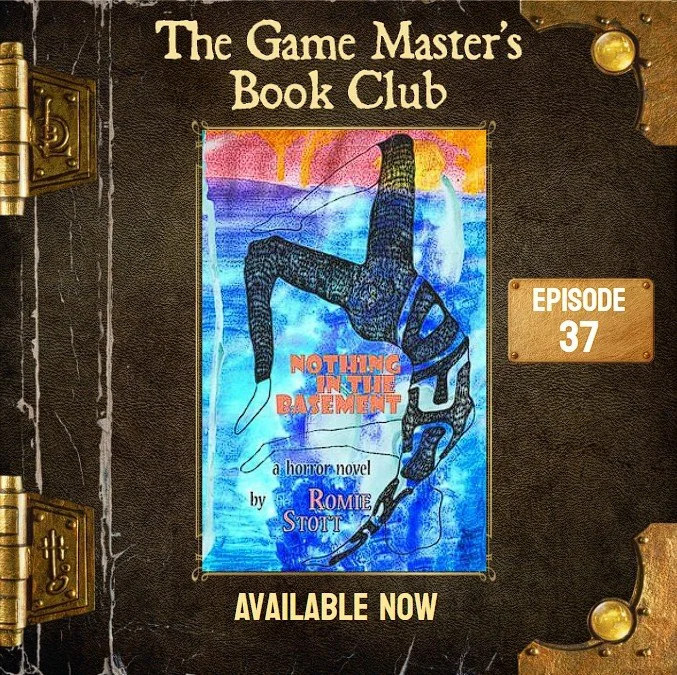
GMBC ep37 - When the Mundane Turns Macabre: Nothing in the Basement with author Romie Stott
Romie Stott
Nothing in the Basement
Speaker A
00:00:08.240 - 00:01:29.190
Welcome to the Game Masters Book Club, where great fiction becomes your next great tabletop role playing experience. Richard and Sandra are good people. They have great jobs. They volunteer, they keep up with friends. There's nothing in the Basement.
Sandra nearly drowns in the bathtub. Richard's teeth are falling out. The dogs are in a frenzy. How many things can go wrong before you suspect cosmic forces want you dead?
Nothing in the Basement.
Author and self confessed gaming nerd Romy Scott, along with game masters Chad Banks and Josh Newman, are here to discuss the horror of banality, the oral tradition of storytelling, gaslighting women, and what is the nothing in the basement? Let's get into the creepy conversation. All right. Hey everybody. Welcome to the next episode of the Game Masters Book Club.
This is Eric Jackson and we are here today to talk about a brand new book, Nothing in the Basement by Romy Stott. And hey, she's here.
And we're going to get everybody to talk about themselves today and find out who our Game Masters are because they're all brand new to the show.
And we are going to start with Romy, but when we do so, we're going to have her and everybody else and we're going to talk about something that is very deeply present in this story, which is banality.
So our Game Master is going to talk a little bit about their own gaming journey and they're going to tell us how they feel about banality and what's a great example of it. So, Romy, you want to start?
Speaker B
00:01:29.190 - 00:03:23.940
Hi, I'm Romy Stott. I'm the author of Nothing in the Basement, but I'm also a big tabletop gaming nerd and have been for pretty much my whole life.
I've actually written several short stories that are about board games or about people who play a lot of games.
That's not very present in this book, but it is always a little bit present in the way I think about things to such an extent that I have an economics degree. I've been playing.
Well, I guess my start with role playing games was fairly informal, was just as a kid pretending a lot in groups and then you'd have to kind of come up with ways to negotiate in the larp, how things go. Like you're playing Robin Hood and we've gotten into a point where there's a fight on a log. How are we deciding who wins?
You know, if I say I shot you and you say no, I dodged, how do we decide how that goes? And that kind of led to working in theater a lot, which I still do.
And I really like theater that's highly interactive, so that includes not just improv, but kind of art happenings. Like, I've done work at museums and stuff that are sort of acting exercises, but sort of as an end in themselves.
Not to learn how to be a better actor, but as a way of kind of exploring getting to be a different version of yourself. But then I've also kind of, I guess since I was a teenager, done more of the kind of classic tabletop RPGs, usually as a game master.
I think I really started out with the D6 Star Wars RPG that was around in, like, the 90s is probably the first thing that I started. Game mastering. And then probably my favorite system to game master is the D10 version of 7th Sea. I just think it's perfect.
It's swashbuckling, but I really like the mechanics of it.
Speaker A
00:03:24.200 - 00:03:25.640
And banality.
Speaker B
00:03:25.800 - 00:04:05.980
Right. So in terms of my most horrible, banal thing about myself, I have sort of chronic gum disease.
And it doesn't have anything to do with how well or how badly I take care of my teeth because I'm actually extremely thorough about that.
And I see the dentist about twice as often as most people, but more of an autoimmune thing where my gums are trying to eat my jaw at any given time, and I just sort of have to convince them not to do that.
So that does mean I periodically have to have surgeries to replace bits of my gums with bits of the roof of my mouth and part of my jawbone is a corpse jawbone.
Speaker A
00:04:06.380 - 00:04:23.940
Okay. Wow. Yeah. Oh, that was not creepy at all. Okay. Fantastic. And absolutely on. Absolutely on point.
All right, before we go on, gentlemen, I have to ask, you said that where did the economics degree come in? I got confused there for a second. Well, why does economics equal rpg?
Speaker B
00:04:24.500 - 00:04:37.220
Oh, economics. I mean, game theory is a subset of economics. Oh, yeah, it's very much. It's a study of choice. Why do people make the choices that they make?
If you change a rule, how is that likely to change behavior or not?
Speaker A
00:04:37.380 - 00:04:41.620
Game theory completely slipped my mind. Josh. Joshua, do you want to go forward?
Speaker C
00:04:42.180 - 00:06:11.570
Sure. I am Joshua C. Newman. I am a game designer and fiction writer, and, well, let's call it fiction illustrator and fiction inventor.
I find things that I wish were true, and I imagine them as hard as I can, which usually spills over into other people imagining them with me.
I'm the designer and publisher of a role playing game called Shock Social Science Fiction, which we use to build sort of socially aware Science fiction in the Ursul Le Guin kind of model. And I started doing that kind of thing in 1980 when I had a cool big cousin who played Dungeons and Dragons.
And I got the old red box and mostly didn't understand why when we didn't do the stuff that it said to do in the book, we had a lot of fun anyway. And I kept doing that between then and, well, now, I guess.
But the big thing was when I became a teenager and we just started furiously making up role playing systems. We had a crew that was based in our local game store and it was just sort of wildly imaginative. And that. That became.
The part that was always really important to me is that everything is vivid and means something to the people who are there, even if it's just something that is. That only means something to the people who are there at that very moment.
Something that's social or something that's aesthetic, you know, you did something beautiful for and with each other. That's. That. That wound up becoming the. The heart of role playing games for me.
Speaker A
00:06:11.570 - 00:06:14.930
That's. Aw. And your banality.
Speaker C
00:06:15.410 - 00:06:57.320
I was actually. I was thinking I was gonna say something else, but today I had this sort of horrifying thought.
I was hanging out with a friend outside as the sun went down at a cafe.
You know, we're all sort of on the tail end of this worldwide pandemic, and I'm just sitting there talking to him and the sun went behind a building and started getting cold and I started putting my gloves on and things, and I'm thinking, like, I'm having a nice time, but, you know, it's uncomfortable, but I'm having a nice time with my friend. And when we parted ways, I was going past homeless people begging who are experiencing exactly the same thing and only it's life threatening to me.
It's just an inconvenience and any one of those people might die tonight if things go badly.
Speaker A
00:06:58.520 - 00:07:12.840
Okay, we're keeping it pretty dark here. This is good. No, we're really setting the tone for the book here. Yeah, we're doing it.
All right, Chad, do you want to move forward and give us your gaming journey and your banality?
Speaker D
00:07:13.020 - 00:08:35.400
Yeah.
So as far as my gaming journey is concerned, I started dabbling in tabletop role playing games, I want to say, in the early 90s when I was at an LGS and some people were playing one of the early editions of Shadowrun. I don't remember if it was third or second, but it was, you know, by today's terms, quite an early edition.
I joined the group for a while and had some fun being, you know, like a cybered up mercenary and found a D and D group in high school, which I played with for years. And then I spent a fairly large amount of time in a role playing group with Romy playing actually quite a lot of seventh Sea.
I both understand the devotion and the fandom to that system because it is pretty unique and wonderful as far as the banality is concerned.
Today I had a thematically appropriate adventure with a clogged drain and you know, so I went to the grocery store and got some white vinegar and baking soda and dumped all that down there. But unlike the last time I used that trick, this time it just resulted in a like 3 inch thick pool at the bottom of my sink.
And I thought, okay, well something more heavy duty is required here. So I had to go back to the grocery store and get some Drano, which was just one of those fun.
I have to deal with this adventures that we run into on an everyday basis. Really.
Speaker A
00:08:35.480 - 00:09:58.020
That is the core of banality is the everyday.
So my name is Eric Jackson and I have been playing role playing games since the place the scene early as I since 1970 when my dad, who was a high school teacher gave some kid 50 bucks to pay for his new car when he sold off all of his D and D stuff. My dad, who was a math teacher and this is where the banality comes in.
My dad was a math teacher and always wanted to find a way to push math on me in a way that was his solution was because he had seen the game and oh well, look at all this graph paper and all of these geometric solids. Boy, I bet this would be a ton of fun.
Which I think is the most banal way that anyone has ever entered into Dungeons and Dragons because it's like, ooh, the math math. Obviously I've enjoyed playing it creatively and all those other things, but I'm not a math person. It did not.
My father's evil scheme, or banal scheme in this case did not succeed. But that was why I ended up in D and D because of graph paper and geometric solids.
Eventually also because he saw the Dungeon Master's Guide and in the first edition Dungeon Master's Guide there is a that used to roll three D6s and there is a bell curve of the statistics of like what your average should be. There's an actual picture of a bell curve.
And my father was like, yes, my son will play this game forever because I will drive him to various People's houses so he can play the math game. So that is my banality here.
Speaker D
00:09:58.020 - 00:10:07.260
Well, it's actually been found that D and D fosters numeracy skills in children. So, I mean, that's a perfectly valid reason to get into it.
Speaker A
00:10:07.260 - 00:10:28.600
Absolutely. So that's everyone's banality.
And it is through that banality and the horror that it creates that we're going to move into our book Nothing in the Basement. And since I have the author here, I thought I'd ask her to give us a quick explanation of the book.
And then, gentlemen, we can throw in any additional themes that we want to add in after we hear from Romy. So go ahead, Romy, and tell us about your book.
Speaker B
00:10:28.600 - 00:11:17.610
I'm going to cheat, and I'm going to just read the back of the book, which you better believe that my publisher and I, like, went over and back and forth on again and again a bunch of times. So it's been vetted. Richard and Sandra Brown are good people. Comfortably overweight, generally honest.
They live in a nice house in a safe neighborhood. There's nothing in the basement. They have great jobs. They volunteer at community theaters. They keep up with college friends.
There's nothing in the basement. They have adorable dogs and favorite television shows. Sandra nearly drowns in the bathtub. The sewage backs up. Richard's teeth fall out.
The dogs are in a frenzy. How many things can go wrong before you suspect that cosmic forces want to kill you? There's nothing in the basement.
Speaker A
00:11:17.930 - 00:11:31.770
That is still very creepy. That is still I. Because I did read it when I. When I. Obviously when we picked up the book, and I was like, ooh, that sounds very. It's still chilling.
All right, what do you feel are some of the themes of the books? Or at least what's your favorite theme of the book?
Speaker D
00:11:31.770 - 00:12:47.720
So my favorite theme of the book is. Well, actually, it's like, can I really pick a favorite here? I think it's really just about horror and dread.
That's to be derived from the ordinary experience of life and how many ways that human beings failing each other can lead to heartache or grief or, you know, even, like, danger and things like that. And it taps into these fears and a lot of very real, dreadfully relatable ways.
Aside from that, it also does a really, really excellent job of relating the common female experience of being.
I mean, it's easy to say gaslit because it's the correct term, but it's also just being sort of not taken seriously by men when it comes to your Anxieties and your fears about the various things that women have to deal with in our society and our civilization.
And it taps into those things in a way that not only is very creepifying, but also very eye opening for someone like me who doesn't have to deal with those pressures on a daily basis. It's just like kind of startling how relatable she makes those experiences that I wouldn't otherwise have any reference for Joshua.
Speaker C
00:12:47.720 - 00:14:15.830
The thing that struck me hardest in the book, aside from the things that we're already talking about, this is a normal life.
And the difference between normal life and horror is, you know, a hair's breadth, is that the nothing seems to a great degree to be something that undoes meaning and intention. It doesn't want something. That's not how it is. It's not an antagonist. It's a natural force. But even like a hurricane has a pattern.
And this is just sort of turning up the probability of entropy from moment to moment. Like any one of these things can happen. Suddenly find that you have a life altering illness or there's some dumb thing wrong with your house.
And I mean, that's part of what is so creepy about this story, is like nothing in this is impossible or even really supernatural. The only thing that approaches that is that it's happening at once and seems to be there just to take the air out of every tire it can it.
Until all of the ideas of a comfortable suburban married life with cute dogs, all those things that are calm and pleasant, just sort of dissolve, not because somebody else wanted them, but because they all just rolled down the hill of entropy. You know, that just the. It just let off all the steam, the pressure of which was actually maintaining the life. Yeah.
Speaker A
00:14:16.550 - 00:14:55.600
So to be fair, I've mentioned this to Romy before, and I think to you gentlemen as well. I'm not a general horror person. I found the whole thing to be very discomforting.
And I do agree that one of the things that was the most discomforting was the lack of an antagonist and the overall feeling that the thing that was out there, whatever it was, if it did exist. And that's gonna be. I don't know how Rovi's gonna answer this. I'll see how this goes. But that whatever it was seemed inevitable.
Like it never felt like there was an. I don't know if I felt like there was an out, but if there was. Romy, is it entropy? Is that what it is back there?
Speaker B
00:14:55.760 - 00:16:23.520
Well, I mean, when Joshua says entropy, he's.
I mean, he's certainly got his finger on something in terms of that is something that I've always found to be kind of the ultimate antagonist, is the sense that order creation has to be deliberate. It doesn't really happen by accident. Energy will tend to drain out of things. Things will tend to fall apart unless you're making an effort.
So I would say a lot of my horror, both this book, but also, like, horror short films that I've made and stuff I normally describe as being existentialist horror, because a lot of what, you know, what is the most likely to keep me up at night is these sorts of questions of, like, is anything that I'm doing, does it matter? But in general, I came to telling horror stories very much through an oral tradition, through telling ghost stories to people at sleepovers.
And I think that's still very present in the way that this book is set up. Because both.
I'm actually trying to horrify you about what I'm guessing is your actual surroundings, because that's what I would be doing if you were right in front of me. I would be trying to creep you out about things that are in the room that we're both in.
But I'm also going to be telling you jokes a lot, especially early on. I'm going to be making you laugh a lot because otherwise, why are you listening to me?
So the book is, you know, dedicated to my sister, and she's always said that my stories are very good because they're funny and funny and funny until suddenly they're very much not.
Speaker A
00:16:23.680 - 00:17:01.040
As soon as you said, oh, this is like an oral tradition, like ghost stories, I was like, yes, yes, there it is. And that's what we're doing to a certain extent. We're trying to create this oral storytelling. That's what we're doing in roleplaying.
We're continuing that tradition of rolling with it, literally and figuratively there. But let's talk about that.
Let's talk about how we are going to use a mechanical system, an order like we have here, and we're going to try and use that to bring about these themes that we've been talking about, these themes of banality, these themes of horror. Chad, do you want to lead us off there and talk about the mechanics?
Speaker D
00:17:01.040 - 00:17:57.320
Well, there isn't a one that the book maps onto as far as mechanics are concerned, that pops to my mind.
But when it comes to themes, it does remind me a lot of the Worm from Werewolf, specifically, because you have this sort of diffuse, unidentifiable, unassailable force as an antagonist. As you've talked, the antagonist feels absent and present at the same time because it's a non embodied evil or antagonism or figure or energy.
And the worm in Werewolf has that same sort of feel to me where it's like, well, yeah, how do you fight it? Well, you just have to do the best you can, you know, which nothing in the basement actually does kind of tap into that solution.
It's like you can't go at it directly. And so you simply have to do the best you can with what you've got.
Speaker A
00:17:57.480 - 00:18:00.360
Romy, do you want to take us through a mechanic?
Speaker B
00:18:00.360 - 00:19:19.460
Sure. In terms of mechanics, I love when you can have a game now nested inside a game.
You know, as I've mentioned, I do tend to write games into my stories and that's also even true. In the middle of Nothing in the basement there's a chess game that happens.
So for this book, I'm very attracted to the idea of using Dread as a system which, you know, is. Is built on. On kind of doing one shots rather than campaigns, which I don't think is a problem for this.
I think it is very natural to kind of keep it contained and kind of do a bottle episode with it. But then I like the fact that you are using the Jenga Tower because you are literally making gaps in the bottom of a building.
And so that's to me like just the irony of that. For Nothing in the basement, I like that you are actually creating a basement of nothing that will be your undoing as you're playing Dread.
I also think about the idea of just incorporating basically running Mafia or diplomacy inside another role playing game so that you have a mechanic where your players are sometimes hiding their actions from the other players or to where in the table talk, you're saying one thing, but the moves that you're actually turning in to the game master are different.
Speaker A
00:19:20.100 - 00:19:30.400
Diplomacy, the great ruiner of friendships. No, I have a standing rule where I don't play diplomacy with anybody.
I know I'll go to cons and play with people who I don't know, but I won't play with my friends.
Speaker C
00:19:32.000 - 00:19:35.680
That's a common rule of thumb. Like you don't want to ruin those friendships just so you can win.
Speaker A
00:19:35.760 - 00:19:39.680
Joshua, I believe you are going to give us a mechanic now.
Speaker C
00:19:39.760 - 00:24:38.570
Sure. So the obvious first thing, as Romy said, is Dread, which, I mean the aesthetic feature, you're right, there's a fantastic overlap.
But there's an interesting thing which is that most of the time in Dread, when You're pulling. What's happening is the tension is increasing and something isn't happening. So you pull in normal dread. You pull out a Jenga block.
When you're trying to do something dangerous versus something. Yeah, usually it's where something dangerous. In this case, you're going to be doing it.
When you're doing things like having a girl's night out, and each time something normal happens, you don't know if. If the girl's night out is going to result in somebody falling down the stairs and breaking their neck, that might be what happens. But instead it's.
Everybody's talking about, you know, wine they like and somebody's cheating on somebody's boyfriend and just sort of these regular things. And if you're.
If while you're describing our book club or I'm, you know, getting together with friends over beer or I'm taking dog for a walk in the park, if the tower falls down, that's when you reassert that there's nothing in the basement, I think. And each time, and this is not a part of the regular game of Thread, but each time you might be escalating the scale of what can happen.
So that's my, you know, the. The obvious first thing. Now.
Now the thing is that I'm a game designer, which means that when my friends and I get together, like, we'll watch a movie or something, we'll say, like, how do we turn this into a game? And it's not, you know, how do we do this with Gurps? Because that's not going to. That will give us the Gurps experience. Right.
It's not going to give us the. The feeling of Annihilation, which is the movie that most reminds me of. Of Nothing in the Basement.
Because in Annihilation, there's no way that the characters or their relationships or the sense of meaning that you went in with will survive. That's the movie wouldn't work if then they punched the bad guy and they blew the place up and got away with the girl. Like, that's not.
That's the wrong kind of. Wrong kind of environment. So I would say that what you would want to have happen. I tend to write games that don't have a static GM just because.
Well, I mean, I guess it's because I was the GM so much that I wanted to play everybody else too. So, you know, I wanted to play somebody who really wants things and can do what they can to get what they want.
And, you know, I'm privy to the same Dramatic ironies and everything, as everybody else. So what I would say is that a system that you would use to play this, you would have things that your character wants and can do.
And these might be moves, like Apocalypse World kind of moves, but you have them in a hand. Once you've played them, you can't do that anymore.
And what's going to happen is you get these cards now and again that are things like, there is a terrible danger to your health, or there's a terrible danger to somebody else's health, or just like. Like these cards would be really specific to the situation, like there's something wrong with one of the dogs.
You got a bill that doesn't make sense in the mail, and, you know, just this kind of thing. And you don't want to. You want the rules to tell you play these only when you have to. You don't want to be holding back because it'll be fun later.
You want to be horrified when about when it happens, and you want to look down at your hand and say, oh, shit, something's wrong with one of the dogs. That's my best and only move right now. I was trying to avoid this, but now something's wrong with one of the dogs.
So I would say that this would be a card game where you don't want to reveal your hand to anybody. And all the everybody who's playing, which might be. I tend to like, three player dynamics.
So it might be one of you is one protagonist, another one's another protagonist, and somebody else is all of their friends or something like that, but not that one player is the nothing or anything. Or if they are.
If one player is the nothing and all the friends and everything, what they're trying to do the whole time, whether, you know, their points or whatever they can.
Whatever they can do, whatever the forces that they're pulling and pushing against, those should be things where you're not looking for every opportunity to, you know, play this card that you think is going to be dramatic. You want everybody to be forced into this situation where something horrible is about to happen despite the fact that you didn't want it to happen.
Like, you don't want to feel like reading that book. I don't want to feel like Romy wants to hurt the fact that I kind of identify with this woman.
I want Romy to want to hurt this woman, but I want Romy to not want this woman to be hurt along with me. And so I feel like the rules would have to have to sort of reflect that.
Speaker B
00:24:38.650 - 00:25:44.910
Yeah, I mean something that you're bringing up that I think that I've thought about in terms of designing a bespoke system for this is, as you say, kind of. I don't. I don't really feel like you want a game master or a player to be playing the nothing because it's. It's nothing. It doesn't want anything.
So to some extent, like, the nothing is just the setting, it's just the precondition.
And something that I see going on for both of the characters and therefore for any of the players is kind of competing desires to get away from this house and to get away from this relationship and to want to recommit to this relationship and to want to be allowed to stay home in your own house. So I could imagine a mechanic where sometimes you are your motivation, your win condition is flipping to.
Where sometimes you are trying to be the one who is preventing people from leaving this situation. You're trying to draw everyone back into it. And at other times, you're definitely the one who's trying to pull away and trying to escape it.
Speaker C
00:25:45.310 - 00:27:05.560
There's a rule in my game, the Bloody Handed Name of Bronze, which is that you're only allowed to tell the other players what your character does, says and looks like and where they are that kind of thing. You're not allowed to tell them anything about the internal state of the character except in ways that a person, that a character could.
You can do it with, you know, a raised eyebrow. You can just say what you feel, but there's every reason to doubt that.
And the rule is actually that you may not reveal a character's heart except to lie, which means that you naturally, by the rules, have to suspect anything that anybody tells you. Now, you can tell a lie. That's the truth, because people expect it to lie.
It's the assume that just like in the real world, you don't know what's going on in somebody else's heart. That I think can go a really long way.
If the deal is, as in my example, is a card deck, or in some other way, like, I'm like, you know, I'm playing this character. I'm like, I really got to divorce my husband. Something's gone horribly wrong here. I got to get out of this. That has to be a valid thing to play.
And then nothing is going to keep sucking. Like, all of my motivation and desire to do something that makes sense in that case, that's still going to be under attack.
But that has to be a strategy that my character is going to try to employ.
Speaker A
00:27:05.720 - 00:29:08.940
So when you guys are talking about this bespoke system that you'd like to do with this, I would like to say that you should be writing a hack of ten candles. I think ten candles is exactly what you guys are looking for. The characters come in, they have four characteristics which they make up.
So it can be very bespoke. They are written on index cards and stacked in front of each player. There is a virtue of vice, a moment, and a brink.
The players create the virtue and the vice for their character. They also create a moment, which is this kind of condition that would give the character hope.
And they have the brink, which is a secret trait that like, pushes them over the edge. Right.
And so the whole part of this is the characters are all kind of moving around and in this game, which is not scenically the same, because this is about living in a world where monsters are literal. Monsters have taken over the world and people are trying to avoid them. And this is their last moment before the light goes out of civilization.
Like, that's the basis of this. But I think this mechanic of as you try and do things, you roll dice. And if you roll any ones on these are six sided dice.
If you roll any ones when you're making the attempt, that means you have to burn, hence the candle part. You have to burn one of these. One of these traits. And so they. So they disappear and they're no longer available as that goes on.
So that degeneration, as things went on that you were getting to the end of your rope was. I've seen this. They actually, in some versions of this, they like, like, like the. Because it's 10 candles and there are literally 10 candles.
And as things disappear, people are like putting out candles. And it's very creepy. It's very awesome to watch on Live Play.
But I think this idea of things slowly being burned away and used to try and get to the end and then reach reaching an eventual point, which is what happens at the end of this book. Something happens. The brink has been passed. And here we go.
And so I think if you guys wanted to, like, work with a base system on this, I think 10 candles would be the way to go.
Speaker C
00:29:08.940 - 00:30:01.810
Yeah, it's certainly a strong one. Now, Romeo, I have a question for you about that. Do you feel like the ending is inevitable there? Do you feel like if we were. If.
When you're writing this, you're. Are you thinking, what if one of the dogs gets away?
Or what if our protagonist gets away and just has this, you know, scarring experience, but they've gotten far away enough from the basement that they've actually pulled it off. Like, is there something that you would want people to. Would you want players to be holding on to hope that, that they can actually pull this off?
Because in Ten Candles, you, You can't. You, you sit down, you get told the, the premise of the game. You look at the 10 candles there and you blow one out. You say, okay, I get it.
This is, this is literally hopeless. This is what happens when we have no hope. Do you want a player or a reader to have hope of it?
Speaker B
00:30:01.810 - 00:30:57.610
Yeah, I think, I mean, I, I really follow what you're saying in terms of if it's a kind of inevitable everybody dies situation, that's a disaster film to me. Like, that's just a catastrophe. Whereas the horror, again, that kind of sits with me. Is that kind of.
Well, what if, though, it's that kind of time traveling you do after you get out of like, oh, but maybe I should have been able to save everybody. Maybe I should have been able to do something different like, oh, why is it that that happened to that person?
I do think that that's actually, I think there's a reason for the final girl in a lot of horror that isn't just about giving you a happy ending, because you don't necessarily. It's not necessarily a happy ending. This is usually somebody who's pretty traumatized and who may have to face further horrors later.
It's kind of the knife in the gut is the like, oh, but, but if this person could make it out, then maybe the other people failed.
Speaker C
00:30:58.570 - 00:31:01.290
Zinn, Rocklin. Who? Romy, I think you know too.
Speaker B
00:31:01.530 - 00:31:02.010
Yeah.
Speaker C
00:31:02.090 - 00:33:07.950
So I at one point went to her and said, I don't understand horror. It's. It's just not a genre that spoke to me at a critical moment in my artistic development.
And, you know, 80s horror was frankly pretty awful and stupid. And it's. The moral universes that it was portraying were really abhorrent to me.
Even as a teenager, I was like, this, you know, this, this is just mean. We sat down and watched a bunch of horror shorts and stuff. I was like, oh, I get it.
It, you know, it uses fear the way that science fiction uses curiosity. And then you have whatever your, your novum, your shock is, that is a.
That's something horrifying and maybe supernatural or somehow emotionally rending. And then you get to shine a light on what does this mean to society and so forth. And then when you read her books like Flowers for The sea.
The question is not really is she going to survive bodily. The question is as this society is collapsing and the main antagonist in the story is everybody's opinion about somebody who's had a baby.
Which is, as you might imagine, this is coming from a pretty personal place in that book. The question of whether or not she survives is just sort of a fact of the matter. That's not really the question.
The question is really kind of like, is she going to be able to self determine regarding her child? And the child's not old enough to have self determination. But you know, you want the, the question.
I don't know what you want is it's a complex emotional universe in that book. But the question is what happens to her? What is she able to do given this sort of claustrophobic social situation?
And I, I think that's, you know, that's, that's kind of the question here. I don't really care if the character lives because the character is not a real person. I care if the, the ideas of the character that I value survive.
Speaker B
00:33:07.950 - 00:33:38.160
I think that's a good way of putting it and tying it back to the Ten Candles question. Yeah, it's. Everybody dies. I mean eventually, like given a long enough timeline, we're all dying. This isn't a vampire story.
This isn't a story where some people get to be immortal. So the question is kind of did you get to the end of things with your integrity, whatever that end is?
And so I think that could be incorporated into 10 candles. I will also co sign that Zyn Rocklin is an incredible horror writer and I fully recommend reading any of her stuff.
Speaker A
00:33:38.160 - 00:33:58.750
We've talked about the mechanics. Now I'd like to talk to you folks as role players and game masters.
Stuff that is portable from Romy's book that you just want to drop into your own world.
Chad, what is something portable that you want to just completely just rip off from Romy right now and drop into a horror game that you're going to be running later?
Speaker D
00:33:58.830 - 00:35:18.080
Well, the moment that just lives in my head rent free from nothing in the basement.
And there are a number of them that are up there, but the one that always gets me is the first instance of the title appearing within the text when the main character says to the dogs, there's nothing in the basement. And the dogs respond, we know, let us fight it.
And it's such a beautifully well done bit of dramatic irony where she just does not understand that the dogs understand something serious is going on and she's not Taking their anxiety and their aggression seriously. And they're just trying to protect the family.
And, you know, just having animals, like, it's so common in speculative fiction and also in horror, specifically for us to draw upon this idea that animals have extra sensory abilities that humans can't tap into. And, like, that's drawing from the fact that, you know, animals can hear things that we can't.
They see in different spectrums of light, sometimes depending on the species.
So drawing on this sort of natural wisdom that we attribute to animals to create a sense of dread and anxiety for the reader or the player, for that matter, is just a wonderful, well done element. And I'm always referencing it in my head.
Speaker A
00:35:18.080 - 00:35:22.720
I agree. That is a. It's a great thing to play with. Joshua, do you want to go next?
Speaker C
00:35:22.800 - 00:36:40.460
Sure. Yeah. I mean, weirdly, the thing that strikes me the most is already, you know, that things are going seriously sideways.
And these moments when our protagonist is just kind of irritated with her friends is the. It just feels so. Man, I just. I know that feeling like, I shouldn't be thinking about this, but I'm really annoyed with my friend.
And at the same time, like. Like, you're just, like, thinking about it on the wrong scale. It's a. It's a little bit. It's a little bit like. So I think Call of Cthulhu is a.
A game that really misses his own point very often. And because you. You're. You know, the things that are happening here are cosmic scale. And you're like, well, we have to go get the cult.
And the cult doesn't fucking matter. The cult's a bunch of humans. And that feels like this, like her buddies who are kind of annoying and crass.
The annoying crassness is sort of just the tiniest bit of the nothing coming to just drag them all down. I really love just how trivial it was as. But incisive as a sort of the tip of the iceberg of what was really going on.
The tip of the tentacle, if you will.
Speaker A
00:36:41.250 - 00:37:09.250
Yes. And I would also note that there's a lot of times where insanely trivial things will take the place of the storyline.
While I am trying to write, I'm trying to help the players along towards whatever goal. Even if it's a goal. They've told me. They're like, yes, we really want to go do this. Okay, yes.
But now we're going to spend 20 minutes with this Kobold character who you mentioned shouting in the Squirrel. Yeah. He's like, okay, now we have to spend 20 minutes talking to the Kobold. I'm like, all right, we could spend 20 minutes talkative.
Speaker C
00:37:09.330 - 00:37:10.370
Cobalt. It's great.
Speaker A
00:37:10.450 - 00:38:16.090
I'm gonna throw mine in because I want to have Romy go last because obviously she's going to tell us all the cool things that everything else that she did. Yes. I'm totally gonna just ditch out of this. But my favorite part of this was the is. And I. This is something I like in all of my role playing games.
I like a good transformation scene, and I really like the haircut scene. It really is a moment where I. That is, I think, the moment where I feel like I finally figured out who the protagonist was.
I. I know we discussed previously that we were like, Romy had mentioned, like, she didn't know who was going to be the person who was going to survive. And I felt like that was the moment where, like, okay, all right, this is the person who. She's going to make it out. It's going to be okay.
Like, she's figuring out the. There's some sort of secret wisdom in this moment that's making this work. And I really. That was.
I would love to have something like that happen in every game in every session. So that was the. That was the most role play sort of thing. And it was. And it was just in this really cool transformation scene. And I really liked it.
So I want to steal that. Romy, you want to tell us about stuff you want to take out of your own book?
Speaker B
00:38:16.090 - 00:43:49.160
Okay. There are three things that I'd recommend stealing.
One of them is, so in the book, there is a descent into a sinkhole that turns out to be probably not a good idea that I would summarize kind of as the memento. Like, I'm chasing him. No, he's chasing me.
I think an encounter that starts as one thing and then becomes a different thing is always very, very fun when you're playing that.
It's, for instance, when you're fighting a character that is intentionally way over leveled for you that you cannot defeat, but that you thought that you could, and then it turns into, okay, we're trying to get away. Chad's already mentioned Shadowrun as a system that loves this kind of reversal.
But the other two things that I think are really easy to grab are a lot of systems. D and D famously have the notion of a critical failure.
But I think a lot of times game masters tend to default to the critical failure, not really telling you anything about the character. It's like, oh, your gun malfunctions. And like, oh, You.
You lose a turn because you're fiddling with your having to fix this, or like, oh, you took a wrong turn. It tends to be about the physical environment and something going wrong in it. Like, oh, you've stubbed your toe, you take some extra damage.
But I think it would be more interesting to kind of throw critical failures onto the players to where it is. A critical failure of something that would normally be your strength is a weakness in that moment.
Because something that's certainly true of the characters in the book is that the same things that make them resilient are the things that put them in danger.
You know, you have Robert, and he's very, very sure of himself, and he's very confident and he's very immobile in a lot of ways, but in a lot of ways that are good, that kind of allow him to get through really difficult situations. He's. He's able to say, like, oh, that's a one off. That doesn't really affect my ideas about things. I'm gonna stay true to myself.
But then that same stubbornness and unwillingness to move can make him make very dangerous decisions for himself. And similarly, you have Sandra, who is very compassionate. Like, she's very interested in being kind, in figuring out the nice way.
She's constantly telling herself off for being irritated with people and being like, no, I need to be more forgiving. No, I need to have a heart and care about life and care about love and all of this kind of stuff.
But that's also then what leads her to make some of her most dangerous choices, where it's like, no, no, no, this was not a time to think the best of somebody.
And so if you have your players have that sense of what their flaw is, but their flaw being the same thing as their strength just being the other side of that coin. And then when there's a critical failure in the game, throw it to that flaw. What is it that they start doubting?
What is it that they start activating in themselves that causes the problem? It's not a mechanical failure.
And then the final thing, and this is pretty dark, is that, okay, so in reality, you're really the most likely to get murdered by somebody you're really close to somebody in your family. We tend to think about that from the perspective of the murderer, from this sort of idea of like, who could make you angry enough?
Who could make you have big enough feelings to kill? But I don't think it's that. I think it's who don't you run away from you don't run away from your family.
You don't run away from somebody you love, somebody being really, really scary, who's a stranger. You back away. You say, I'm not going to deal with this yelling person. I'm not going to deal with this obviously belligerent person.
But if it is your brother or your son or your wife, it's like, well, I've got to comfort this person. I've got to figure out what's wrong with them. Like, we're a unit, we're together. Like, I have a responsibility to care for them.
And obviously something's going wrong for them. And I think that's pretty portable into a campaign, not into a one off event. But you can figure out, I mean, you sort of.
Eric, you mentioned earlier how players will just fixate on like I'm going to have a 20 minute conversation with the Kobold. It tends to be an emergent player behavior that they will kind of fixate on some random NPC that you didn't intend to be important.
And so probably not for your ultimate boss in your campaign.
But if you have a character who as players in previous adventures in the campaign you have rescued before, or characters who have kind of redeemed themselves before, characters who have betrayed the villain to be on the side of the. Of your heroes, if they turn into one of the bigger villains at the end of the game, that's gonna be.
That's interesting for players basically to have to wrestle with that because they're still gonna kind of be pulling their punches because they're gonna be thinking, oh, just like before, we're gonna be able to. Our goal is to help this person is not to take them out, but that. That means that. That they're going to be very dangerous.
Speaker C
00:43:50.190 - 00:43:50.790
That's brutal.
Speaker A
00:43:50.790 - 00:44:19.040
Yeah, that is. And that's definitely got that same feeling of. That same feeling of the book there. That's where we're going to go next though.
Josh, we'll start with you first.
You've mentioned a bunch of different media already, but if we're going to be running this game, whether we're going to be running a specific nothing in the basement game or a game that is like nothing in the basement. What other media do you think has similar vibes that would help, like either put you in the mood or be also inspiring in the same sort of vein?
Speaker C
00:44:19.040 - 00:45:24.070
Well, aside from Annihilation, which I think is a. It's such a. It maps in a lot of ways emotionally and, and has a similar sense of like dismantling Your understanding of.
Of what you thought you were here for. There are. Oh boy. I feel like David Lynch's movies, maybe where you're not.
Where what is going on is aesthetically coherent, but the meaning of the connected ideas isn't apparent. Like, no. Geez, I don't know. I mean, like Eraserhead is the first one that comes to mind because it's. It's increasingly horrifying because.
Not because something's going to get you, but because you don't know what's going on and something's happening. And he's famously quiet about what the fuck he was talking about. So I would say something like that.
David lynch, when he's off the leash, is probably a good example.
Speaker A
00:45:24.150 - 00:45:28.710
Romy, do you wanna talk about what you think your book is like, what sort of vibes it has?
Speaker B
00:45:28.710 - 00:46:09.230
I'm not intentionally drawing on anything outside the book, although I will say I do love Annihilation, which I had not encountered before writing the book. And I of course love David Lynch. But books that I would say are in the same sort of psychological horror space.
The Haunting of Hill House is the obvious one, and Rebecca is also really up there. I'd also say in general, the works of J.G. Ballard. There's a lot of.
I think a lot of the same people who would like this book also would like a lot of JG Ballard. It's a little bit hard to pick a starting place. Probably the most similar one would be High Rise.
Speaker A
00:46:09.310 - 00:46:15.950
Chad, what sort of vibes? What sort of vibes? What sort of media do you think would go well, would pair well?
Speaker D
00:46:16.030 - 00:47:27.650
I think I'd give an honorable mention to the Only Good Indians by Stephen Graham Jones.
I think the source of antagonism in that book is a little different than Nothing in the Basement, but they both have that sort of low patina of horror throughout that where part of what's generating your anxiety and your reader is just a constant feeling of discomfort from any number of inputs.
But more close to Nothing in the basement, the 2022 film watcher with Maika Monroe, which is a thriller, has a very similar vibe when it comes to the forces and trials that are arrayed against the female protagonist. Specifically, it does a very good job of evoking the same sort of horrors that Romy touches on from time to time.
In Nothing in the Basement and then throughout reading Romy's book, I had similar sort of emotional responses to the experience of reading Cackle by Rachel Harrison. So those would be titles that I would recommend for people who liked Nothing.
Speaker A
00:47:27.650 - 00:48:39.610
In the basement I'll wrap up. Which I think is actually probably the worst choice because. Because I have the least horror experience here.
As I've said before, what Romy said about people's strengths being their weakness. I always think of the John Carpenter film Prince of Darkness. There's a lot of that where people's. What people are curious about.
If people are curious or people are passionate or future. Those end up being the things that destroy them in that movie. Being staying with people who are in your family.
And that's what makes them very dangerous. I felt like Mexican Gothic. That's Sylvia Moreno Garcia. And I think that has a lot of that.
It's in the family and I need to stay, but I mean, but that's keeping me in danger. So there's that feeling, if you want to get that sort of feeling.
And then the whole, like, the system is inevitable and maybe we can escape and maybe we can't. I would say Lois Lowry's the Giver has that same sort of feeling.
And it also has that thing where you're not sure who's gonna escape and if they will. And so that's where I would put those. Those are my three best possible choices in my limited pool.
Speaker B
00:48:39.690 - 00:49:01.370
Yeah.
I'd also say a book, I forgot to mention that I think has some tonal overlap, although the plot doesn't really is Jonathan Lethem's Girl in Landscapes. He also has a short story that I think is called the Happy Man. It's whatever the first story is in his first short story collection.
And I think it has some overlap as well.
Speaker A
00:49:01.370 - 00:49:01.970
Fantastic.
Speaker C
00:49:01.970 - 00:49:02.290
Good.
Speaker A
00:49:02.290 - 00:49:23.970
A much better thing to end on. All right. We discussed the book, we discussed mechanics, we've talked about portable materials and we've talked about media.
Now it's time to cut back to our game masters here and talk about stuff that they want to promote and tell us about that they really important. Josh, do you want to lead us off with, Is there anything you want to tell the folks that they should totally be looking into?
Speaker C
00:49:24.130 - 00:50:23.430
Yeah.
I wrote a role playing game called the Bloody Handed Name of Bronze, which I'm terribly proud of and had the poor taste to release on February, I believe, 28th, 2020. And yeah, yeah, that was not a well populated Pax east. That sort of swept the leg of my publishing company.
But I'm finding myself back enthusiastic about it because every so often I get a chance to play and I go, God, I really. This is the best game I've ever designed. And it's a Bronze Age sword. And sorcery that is sort of about.
Implicitly about the dawn of humanism in a world where the gods are just super real. There's the way that you do magic is you. You cut deals with the demons that live inside things with names.
And ironically, those are the people who have the most human moral choices to make. So it's, you know, a little bit Conan, a little bit Torah, a little bit Gilgamesh, a little bit like Red Sonja sword and sorcery magazine stories.
Speaker A
00:50:25.670 - 00:50:33.750
I'm gonna throw this at you super quick, and I probably should wait until after, but I can't because it's one of my favorite books. Have you read Iron dawn by Matthew Woodring Stover?
Speaker C
00:50:33.910 - 00:50:36.630
No. I know the name. I'm putting in my notes right now.
Speaker A
00:50:36.950 - 00:50:56.110
They've written quite a bit of stuff. There's. They're all over the place. But that one in particular is a aftermath of Trojan War, army of undead. Kind of like.
Like as soon as you said, like Bronze Age and gods and things like that, I was like, oh, you have to read Iron Dawn. It would be so good. Okay, sorry.
Speaker C
00:50:56.990 - 00:51:20.520
Excellent. Excellent. Yeah, yeah. I mean, yeah, yeah. The. The Iliad is another one of the. One of the big, big influences.
And I'm sort of generally staying away from European influences. It's. It's all very Middle Eastern, North African and, you know, sort of Central Asian. At the.
On the outside, the center of the world is, you know, Uranuruk. Not by name, because it's a. It's a fantasy world. There's, you know, dinosaurs to the north and stuff, but.
Speaker A
00:51:20.520 - 00:51:22.120
Oh, there you go. Fantastic.
Speaker C
00:51:22.600 - 00:51:25.720
The Iliad is definitely an influence on this. Yeah. So that, that's awesome.
Speaker A
00:51:25.720 - 00:51:36.300
Okay, Romy, you're. It's your book who brought us here, and I assume you had. And you've mentioned that you have many other stories.
So tell us about where we can find those and if there's anything else you want to promote.
Speaker B
00:51:36.300 - 00:51:48.980
Well, I mean, mostly, yes. I would like for people to buy the book that we're talking about. Nothing in the Basement.
I'm pretty proud of it and I. I think you should buy multiple copies. I think that you should have one for every room in your house, because why not?
Speaker C
00:51:49.379 - 00:51:50.380
I've got a couple of my.
Speaker B
00:51:50.380 - 00:51:51.300
How else are you going to keep.
Speaker A
00:51:51.380 - 00:51:58.660
Again, as a non horror reader, I enjoyed this book. So that's. For what that's worth. You know, there's my promotion for it,.
Speaker B
00:51:58.660 - 00:52:36.430
But outside of that, I mean, if you Google my name, you'll pretty quickly come across websites and things that will. That will give you links to all of the various short stories of mine that are online.
I'm also very continuously in love with my electro pop band, Stopwalk. We haven't put out anything super recently because I've been busy with the book and such, but I still, I still love our band.
We've still got good singles.
And then finally, I am the senior poetry editor at Strange Horizons, so I would always encourage people at any time of year to make a donation or buy some merch from Strange Horizons. It's a good magazine.
Speaker A
00:52:36.430 - 00:52:43.430
Awesome. That sounds fantastic. Anyone have anything else that I didn't get a chance to mention before we wrap this up?
Speaker C
00:52:44.070 - 00:52:49.070
Yeah, actually let me go back and pitch my Patreon for a moment.
Speaker A
00:52:49.070 - 00:52:49.750
Oh yeah, go ahead.
Speaker C
00:52:51.030 - 00:53:04.430
You can also find my work, which is, as I said, sometimes inventions, sometimes drawings of aliens, sometimes. Sometimes role playing games and that kind of nerdery. It's just patreon.com Joshua and that's where I make all sorts of stuff.
Speaker A
00:53:04.430 - 00:53:28.770
All right, everyone should go and support that. That'll be fantastic. Thank you for your first official Game Masters Book Club. I hope we get a chance to get you back here sometime soon.
I had a blast with this. This was really good and you're all just such well spoken and well, just, just well accomplished Game Masters this is.
And very thoughtful in what you're saying here. So, so thank you for coming on the podcast and making it sound great. So thank you.
Speaker C
00:53:28.770 - 00:53:29.330
Yeah, thank you.
Speaker D
00:53:29.330 - 00:53:30.290
Oh, thanks for having me.
Speaker C
00:53:30.290 - 00:53:30.770
Thank you.
Speaker A
00:53:31.250 - 00:54:46.480
And that was nothing in the Basement by Romy Stock, who was one of our awesome Game Masters along with Josh Newman and Chad Banks. Thank you all for your gloriously creepy commentary.
Join us next time when another nerdy author who plays tabletop role playing game graces our show, Lev Grossman. He, along with his son Ross o' Donnell and veteran of the show Eric Trixon, discuss the Arthurian epic the Bright Sword.
You can find a complete transcript of today's discussion as well as links to all of our podcasts@k-square productions.com GMBC.
You can learn about upcoming episodes on our social media, on bluesky, at gmbookclub, bluesky social, on Facebook, at gamemastersbookclub, on Mastodon Game Masters Book Club and on Instagram gamemastersbookclub.
If you've enjoyed the show, please like subscribe and comment on our episodes in your chosen podcasting space and be sure to share those episodes with your gaming community. You've been listening to the Game Masters Book Club brought to you by me, Eric Jackson and K Square Productions.
Continued praise and thanks to John Corbett for the podcast artwork and Otis Galloway for our music. Later, gamers and to paraphrase the great Terry Pratchett, always try to be the place where the falling angel meets the rising ape.