GMBC ep47 - The Superpowered Book Club: Unpacking the Complexities of Black Hammer
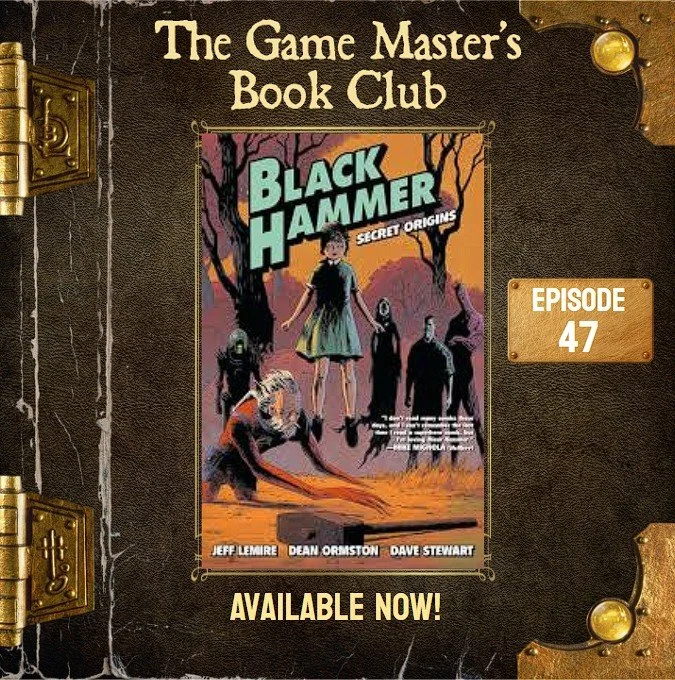
Black Hammer
Jeff Lemire
Speaker A
00:00:07.200 - 00:01:45.830
Welcome to the Game Masters Book Club where great graphic novels become your next great tabletop role playing experience.
And welcome to the small town of Rockwood by way of the mysterious Parazone, where our pastiche superheroes are trapped, defeated and living ordinary lives.
Jeff Lemire's Black Hammer combines dark fantasy with superheroes and creates a moody interpersonal set of stories.
Sean Murphy, John Mazer and John Corbett are the secret identities of our superpowered Game Master trio.
For this discussion of soap operas, pulp fiction and meta analysis of this grim graphic novel, let's get into the conversation.
And here we are on the Game Masters Book Club one more time to talk about some fantastic books that are going to make some great tabletop roleplaying experiences.
I'm here with Jonathan, John and Sean and we're going to be talking about Blackhammer, a great graphic novel of, I believe we just said was superhero meta fiction.
So I'm very excited to hear what that is.
Maybe we'll figure that out.
But even if we don't, we're going to have our Game Masters talk to you a little bit about their gaming journey as well as their favorite original superhero, because that's one of the things that's happening here.
Although we may argue about how original the superheroes are here, but they are not superheroes from the big two, DC or Marvel.
So we're going to have everybody talk about the.
Their favorite original superhero that they've seen or played in a tabletop role playing session.
Sean, do you want to start us off and tell us about your original superhero experience in Tabletop?
Speaker B
00:01:45.830 - 00:02:23.350
Yeah.
So I don't have any direct superhero experience.
I'm going to have to fall back on the second option, which is picking your favorite non big two superhero.
I'm going to go with Miracle man, actually, because it was the first Alan Moore I read.
It was a stray copy of issue 7 wandering around and I was like, what is going on here in this whole sort of.
It opened up my ideas to what superheroes could be and I think it's sufficiently meta that it qualifies as being, you know, know, certainly a precursor to what we're going to talk about tonight.
Speaker A
00:02:23.590 - 00:02:28.790
Jonathan, I know you do have a lot of superhero experience.
So what do you have for us tonight?
Speaker C
00:02:29.030 - 00:02:45.910
That it was a tough decision and I was also trying to come up with something that was not a cutout or, you know, an obvious copy of something else being me.
I. I have a.
A tie for first place.
Speaker A
00:02:46.800 - 00:02:47.200
Yep.
Speaker C
00:02:47.280 - 00:03:07.360
Either my vote would go for a character that my friend Amy played In my long running and mentioned before superhero game named Templar who is actually based on a character that George Krebsky came up with.
If I can reference a different working group of your podcast.
Speaker A
00:03:07.680 - 00:03:08.080
Sure.
Speaker C
00:03:09.040 - 00:03:37.750
But Templar is sort of a legacy hero.
He.
In George's game it was he and in my game it was she.
But the Templar that was in the game was actually the third hero to bear that name.
The grandfather and the father had been Templar before that.
And I believe the thumbnail sketch was, if you can imagine, Spider man.
Speaker D
00:03:39.730 - 00:03:39.930
Or.
Speaker C
00:03:39.930 - 00:05:05.890
Spider man sort of a Spider Man y power set.
But if he were raised, trained by Captain America and Batman, that was just a lot going on.
I really, really enjoyed both the concept of the character and Amy's take on it.
And my second tie.
Second first place was actually a character I, I guess technically played.
I came up for it in sort of a spontaneous game I was invited to in Mutants and Masterminds Foreshadow.
Oh, good name is the character's name.
And he is both precognitive and has darkness manipulation.
So sort of a dark lantern, if you will.
I came up with the concept and the power set, but my dear friend Jim Oliver, actually I said, I need a help with this background.
And he wrote like, I don't know, five pages of background.
And it all made sense.
It was, it was like, how do you, you know, tie these desperate things together?
And it, it was just a really clever concept about, you know, a.
A pair of married physicists that were working on wildly different projects.
And there was an accident.
Speaker A
00:05:06.390 - 00:05:11.350
John Corbett, time for you to talk super unique superheroes.
What you got?
Speaker E
00:05:11.430 - 00:05:57.610
There was a game that Scott Nichols ran Marvel heroic role playing game from Cortex.
And we slapped together, I think four characters for that.
Just grabbed the powers, like two powers and put them together.
And I think I got this weird combo which was I think teleportation and like blasting or something like that.
And I wasn't sure how to do it.
So I was like, okay, what if the guy just had this, this tattered cloak and he was like, like some kind of hobo.
But whenever he like unfurled them, he could either teleport or shoot light.
And you know, I didn't really.
I wasn't sure if he was going to be like a broody loner guy or whatnot.
And then as I started to play him, he started to morph into that guy from what's the movie with Janine Garofalo and Ben Stiller where the guy talks the sphinx and he talks in like Riddles.
Speaker C
00:05:58.330 - 00:05:59.210
Mystery Man.
Speaker E
00:06:00.170 - 00:06:28.200
Mystery Man.
That's it, yeah.
So you ended up turning into like kind of a zen guy like that.
I called him the Outsider and I just put him in the chat.
The drawing that I did for him, he was kind of a Moon knight ripoff I guess for his look.
But he was a lot of fun to play because I got to be like, you know, oh, those who fear training train only in fear.
And people would constantly be turning and saying stop that, stop that.
Speaker C
00:06:28.520 - 00:06:31.240
Sort of fortune cookie wisdom, as it were.
Speaker E
00:06:31.960 - 00:06:33.000
Yes, there you go.
Speaker A
00:06:33.880 - 00:07:08.080
Hi, I'm Eric Jackson and here we go.
I'm going to tell you about my favorite superhero which I played with John only once.
Jonathan was running a superhero game and I came in to guest and I was playing a sound based character.
I think I called him like the musician or I don't even remember his name.
But my favorite part of his power set was that I determined that because I had sound powers I got to control the ambient music that was taking place in the game like in real life.
So I got to control the radio.
That was really the whole point of that character was like I just wanted to be able to control what music was playing.
Speaker E
00:07:08.320 - 00:07:09.680
You were Radio Rebel.
Speaker A
00:07:10.000 - 00:08:49.589
So we've come up with some really interesting characters here that we've talked about that are original superheroes.
But I think we're pretty close to original superheroes here in the Black Hammer universe.
So if you were going to come in and take a look at this particular series, we only read the first two volumes.
I think officially as a group there are many more but I would say if you're going to read it.
Welcome to Blackhammer Farm in the sleepy town of Rockwood where six archetypical superheroes are trapped after they saved Spiral City from the anti God.
The first 13 issues in volume one do drips with depression and defeat as the heroes have mostly given up trying to escape this small small town farm.
Here is where the art of Dean Ormstad really well what's the opposite of shine glooms?
The mystery of why they are so stuck.
What riddles the strange curl weird or the creepy Madame Dragonfly play in the heroes force enforced capture?
And what role Black Hammer's daughter Lucy will play in the future of this comic?
Hint, if you do read on to volume two a lot.
It's a moody interpersonal soap opera of a comic with dark mystery at the middle with superheroes as the with.
With supers as the stars of that soap soap opera.
Sign me up for the next six volumes.
I'm ready to go.
What did you guys think about this one?
What was your.
What did you get from it?
John Corbett, when you read through this, what themes or how did you feel about the book?
Speaker E
00:08:50.069 - 00:09:24.770
It was interesting.
It was definitely a love letter, I thought, I mean, very much something that the author and the artist were like, gosh, I want to feature these characters that I grew up with and love so much from the Silver Age and the Gold Age.
So that was the primary takeaway I took from it.
And also that it was not your traditional.
Even though it featured traditional superheroes, it wasn't traditional superheroics.
The story is much dramatic, much more suspenseful.
So between that and the very moody artwork, I just thought it was a great, great read.
Speaker A
00:09:25.010 - 00:09:26.530
So, Sean, what do you think?
Speaker B
00:09:26.530 - 00:09:49.850
Yeah, no, I agree.
I think it's an interesting read.
It's an author that, though I've heard a lot about him, I don't think I've read anything by him before.
So that was interesting.
It feels like.
And we'll talk a little bit more.
It feels like more of a mystery than anything else right now.
And a sort of human interest story, which was interesting.
And I agree that the, the artwork was perfectly suited for what we were reading.
Speaker A
00:09:50.330 - 00:09:51.450
Jonathan, your comments.
Speaker C
00:09:51.770 - 00:10:14.690
Yeah, well, you guys already touched on the archetypical nature of the, of the main characters.
If I can just do a callback.
I was going to say, in a sense, not entirely dissimilar from Astro City, which we covered in our first episode.
Speaker A
00:10:14.690 - 00:10:15.850
Yep, episode 16.
Speaker C
00:10:16.650 - 00:11:14.150
Yeah.
I also, a lot of people made mention of the sort of small town folksiness of the, I guess of the supporting cast of the environment.
I think I made a note that in a very real sense the, the environment that they're in is sort of a character unto itself.
That's a great observation and I will be in the minority.
I actually was not super enamored of the art, but I'm not saying that I don't agree that it sort of fits with the, the nature of the, the world.
But I, I was just kind of like, ah, it wasn't so off putting that I was like, I can't read this.
Which has happened, but not in this case.
But it didn't scream comic book Y to me.
It, it screamed, oh, it's very indie.
Okay, I get it.
Speaker A
00:11:14.230 - 00:11:34.670
I think I've said before on the show that most of the horror I read is very.
Is.
Is graphic novel horror.
That's.
I don't generally go for a whole book.
I can usually only handle about a Graphic novel's worth of horror at a time.
So I felt like this looked a lot like some of the horror comics that I've read previously, so I could see where it did not feel superhero.
Speaker C
00:11:34.670 - 00:12:08.030
Yeah, yeah, yeah.
And the other thing I was going to toss in is apparently meta fiction is a form of fiction that emphasizes its own narrative structure in a way that inherently reminds the audience that they are reading or viewing a fictional work.
So, you know, in other words, I guess we're talking about comic book superheroes in a way in which they are emphasizing that they are comic book superheroes.
Speaker A
00:12:08.110 - 00:12:14.030
This is the deepest cut I can come up with.
Very Da Vinci's Notebook title of the song.
Speaker C
00:12:14.750 - 00:12:17.790
Yeah, sort of.
I mean, that's not a bad example.
Speaker E
00:12:17.790 - 00:12:19.110
Cut so deep it went over my head.
Speaker C
00:12:19.110 - 00:12:20.910
Check it out.
You won't be sorry.
Speaker A
00:12:21.230 - 00:12:54.820
So we have this moody mystery, maybe kind of hard, but definitely involving superheroes sort of world with strange characters and no real antagonist that's up front and standing there above the heroes and saying, my plan will defeat you.
So this is a different kind of superhero game that we've got here.
So how are we going to run this game?
What is the best mechanic that we can possibly put in here?
Jonathan, I'm going to let you go first on this one.
What is the mechanic that you think would best serve this story?
Speaker C
00:12:55.140 - 00:14:04.420
Well, you can let me go first, but I think I'll probably have the least convincing answer.
You know, I.
You're right.
I looked at it and I'm like, well, this is not a game where you have.
You would have to necessarily go, okay, I've done the math.
And he can definitely lift this full tanker truck over his head, you know, and throw.
You don't need to do that level of detail.
So I think if I were going to use a sort of a rule system that was aimed at doing comic book superheroes, I probably pick something lighter, like icons.
But I think my first instinct was to go with something sort of generic that you could use for a variety of types of games.
So I was leaning towards fate, with my backup idea possibly being the gumshoe system, just because of the sort of overarching mystery theme of the.
At least the part of the story that we read.
Speaker A
00:14:04.820 - 00:14:13.140
Sounds good.
All right, Sean, do you want to take it a step further and tell us your suggestion for the mechanic for Black Hammer?
Speaker B
00:14:13.140 - 00:15:01.100
Yeah, no, I.
It's a hard one because they're not really.
They have powers.
They don't really use them very much because they're not supposed to.
And there's no super villains.
And that's actually, I've read the entire series now.
No, supervillains is kind of a thing that sort of gets them in the other books, but no supervillains in the book themselves is sort of a thing.
And so I was just thinking what would be one that you could have people work, you know, where the bonds between people are and the connections are important.
I came up with Worlds in Peril and it's powered by Apocalypse.
And it does have that sort of mechanic where you know who you're connected to and how you feel about them has some.
Some bearing on sort of how the game goes.
Speaker A
00:15:01.340 - 00:15:06.540
John Corbitt, what do you think?
How would you make this happen on the tabletop?
Speaker E
00:15:06.860 - 00:15:51.230
I think I would throw out the idea this is a superhero game.
I wouldn't try to grab an existing superhero system.
I would do something that emphasized the, the drama, the.
The sort of uncertainty of things.
And I would tell the players that this is going to be like a one night.
You know, these are like bubble games.
I don't think they're meant to run in campaigns.
I mean, I'm sure you could.
But what I would be inclined to do is take something like Dread.
I would put that Jenga tower right in the center.
And then as the players attack the problem or figure it out through all their interpersonal role playing and with the environment around them, watch it get down lower and lower and see who gets knocked out as a result of trying to figure out the mystery.
Speaker C
00:15:51.230 - 00:15:51.710
Cool.
Speaker A
00:15:51.710 - 00:17:40.850
That sounds awesome.
I'm going to buck tradition here.
Everybody here is like not a superhero game.
I think it is.
I think it's a superhero game, but a very specific one.
I think it's the Smallville role playing game that was put out by Margaret Weiss Productions, which is.
It's often touted as the superhero soap opera simulator.
So very excited about that.
It does value.
It puts values and relationships over stats.
There's a big part of the game is creating a relationship map.
And my personal favorite, which I've used when I've run other cortex system based games, is you can do this sort of bidding war thing where you're like, I have this many plot points up because this is what's happening.
And then somebody else can throw some in and then you can throw some more in.
So there's this like little bidding war that's happening.
And I felt like a lot of the characters in the game were bidding against each other.
It was almost like a PvP to see who would win the argument.
Now granted, those arguments were over whether somebody was going to school that day or not.
So maybe not as dramatic as we're going to knock down a building, but I think that the Smallville Cortex would work really well.
The one place that it doesn't work very well, as I did some more research on this, is that the Smallville game really puts a high visuality on villains and making them part of the structure.
So given that there are no villains in this one, maybe that's where my idea of using the Smallville falls apart and I'd have to fall back on something else.
But I still think it's a great.
I think it'd be a good place to start.
So that's my mechanics for this one.
Anybody have any other mechanics before we move into the portable section?
Speaker C
00:17:41.490 - 00:18:04.640
The only other thing I'm looking at, the notes I wrote down.
There are at least four different dimensions, for lack of a better way of putting.
I put it in air quotes if you couldn't hear that because they.
They had the spiral city universe that they came from.
They have the place they are now.
Speaker B
00:18:04.880 - 00:18:05.280
The.
Speaker C
00:18:05.360 - 00:18:43.190
I just wrote down the farm, there's the Power Zone.
And then I put the cabin and then I put a question mark because I'm like, well, I don't know, it kind of moved with them.
So like.
But the.
The impression that is suggested is that it is maybe its own dimension as well.
So depending on what you were trying to replicate from this story, I was like, well maybe you'd need to.
To have some sort of a rule set that could do something with that.
Speaker A
00:18:43.270 - 00:18:56.750
And that's a great place to launch us off into the portable section.
So.
Because we're talking about parts of that that we might want to steal and if I recall from the pre game, that was something that you were interested in was the Parazone, Jonathan?
Speaker C
00:18:56.750 - 00:19:00.630
Yeah, yeah, the cabin.
Yeah.
I thought that was interesting.
Speaker A
00:19:00.630 - 00:19:05.590
Is there anything else from that would be portable that you'd want to drop right into your own game?
Speaker C
00:19:05.970 - 00:19:36.040
If you don't mind it being a minor point.
One of the things I did write in my notes was steal this.
And that was in relation to.
I think it's in the second volume when Blackhammer's daughter.
I'm sorry, I don't remember the character's name off the top of my head, but the journalist character goes to the.
The library in town and all of the local history books are blank inside.
Speaker E
00:19:36.040 - 00:19:37.040
It was a nice touch.
Speaker C
00:19:37.040 - 00:19:47.080
And that doesn't bother anybody.
Oh, that's weird.
Is all you kind of get I'm like, oh, yeah, I don't know how, but I've got to use that someplace sometime.
Speaker A
00:19:47.240 - 00:19:47.600
It's.
Speaker C
00:19:47.600 - 00:19:52.120
It's a minor thing, but it really.
I was like, oh, that's very clever.
I like that.
Speaker A
00:19:52.520 - 00:19:57.960
John Corbett, what would you want to take from this and drop into your.
Into your next game?
Speaker E
00:19:58.200 - 00:20:18.220
I definitely want to grab a cranky sidekick, like, Talkie Walkie.
I just loved their indignance at having to work hard and then have to go hide in the barn when regular folk come around.
So I would definitely want to drop something like that in my game.
I would also love to do something with the Pastiche characters.
Speaker A
00:20:19.260 - 00:20:19.980
You know, the way.
Speaker E
00:20:19.980 - 00:20:59.440
I would love to see, like, the players at the table pattern themselves after a recognizable character from.
From another.
Some other form of media, the way that the characters are in Black Hammer.
I would even encourage maybe a mechanic where maybe at the start of the game session, each person, after their character's introduced, writes down who they think the other character is, and if they're confident at some point, they can unveil what it is to get an automatic success on some test or something like that.
I just like the Pastiche characters.
I just love the way that they were recognizable, like, oh, that's supposed to be Thor, or that's supposed to be some other character that's been around in the Silver and Golden Age, but.
But it's subtle, you know, I really like that.
Speaker A
00:20:59.720 - 00:21:05.960
That was fantastic.
Sean, what in this series did you really want.
Did you want to really take and drop into your games?
Speaker B
00:21:06.520 - 00:21:57.080
Similarly, I really liked filing off the serial numbers for some of the golden and Silver Age characters and updating them.
Well, you know, it's clear who they're supposed to be, but you still sort of walk away feeling they're new and they're interesting in a way that you often don't see when someone's lifting from a previous character.
And then I. I liked the mystery element.
I'm.
I'm starting up a superhero game in a couple of weeks, and I. I like the idea that there's things going on that they're not sure about and not sure how.
How to resolve them or what to do about them.
And some want to sort of start punching at the walls, metaphorically speaking, and some are like, no, no, no, we need to.
We need to sort of not do that.
So I. I think that's.
If we can find a way of sort of bringing that into the game, that would be fun.
Speaker A
00:21:57.480 - 00:22:51.710
I'm going to say something that I probably should have even said in our previous episode when we talked about Astro City.
And one of the things that I really like about this is the lore building.
I think there's a decent amount of deep lore that's hiding underneath the surface here.
It feels like a well structured world, which is always a great thing to have.
But the thing that I would immediately see just drop absolutely directly in is the idea of the never aging hero, but aging secret identity for Golden Gale.
I love this idea that your secret identity continues to live their life as they do, but not the superhero part.
You never age up and you stay the same.
That just seems so fraught.
It's the kind of thing that it's just like when you think about it, you're like, oh, oh, no, that's really bad.
Speaker E
00:22:51.870 - 00:22:55.150
Yeah, there's a lot of roleplay opportunity there for somebody to sink their teeth into.
Speaker C
00:22:55.470 - 00:23:01.630
Yeah, I was gonna say.
Can I, can I toss out the fact that we did that in, in the superhero game I referenced?
Speaker A
00:23:02.030 - 00:23:02.670
Yeah, sure.
Speaker C
00:23:03.070 - 00:23:22.840
My dear and sadly late friend Paul Edson played a character called Kid Thunder, who was a sort of a Shazam Thor kind of character.
He was an avatar of the Celtic God of thunder, Tyrannos.
Speaker B
00:23:22.840 - 00:23:23.240
Nice.
Speaker C
00:23:23.560 - 00:24:04.300
When he got these powers, the game, it was like supposed to be in the late 1980s, I think, and he was an archaeological student and he later became a professor.
And there was a note in sort of the background that his civilian identity.
Dave Danvers may not have even realized it consciously, but he was actually transforming back to his civilian identity less and less because his superhero identity was obviously immortal and didn't age.
Speaker B
00:24:04.620 - 00:24:04.940
So.
Speaker C
00:24:04.940 - 00:24:45.860
Yeah, that, that, that dichotomy was.
Was very, very interesting.
And we, you know, played around with some of the.
I don't even know if I would have thought of them as tropes, but at some point he lost his avatar hood.
Somebody else got the power, so he, he became the avatar of a different pantheon.
I think it was an Aztec God of some sort.
I remember there was a.
There was like a spectral hummingbird that went around that.
That was how the transformation occurred instead of a.
A thunderbolt.
Yeah, I, I think there's a wealth of potential role playing opportunities in that idea.
Speaker A
00:24:45.860 - 00:24:52.700
Eric wanting to stay immortal or.
Or in the case of Golden Gale, not.
Which I thought was really cool too.
Speaker C
00:24:53.100 - 00:25:28.700
One thing that I don't.
I didn't hear anybody comment on, but I, I did write a note about is maybe too deep as a minor point, but specifically a lot of the.
The Colonel weird stuff made me write down the note.
Is there A human need for time to occur or time to be linear.
It seemed to be the shuffled order of the way he was perceiving time in the parazone that possibly made him, you know, the way he was.
Speaker A
00:25:28.780 - 00:25:38.690
A good question that.
Does the human brain require a linear timeline in order to function appropriately?
And I would say that Jeff Lemire.
Or is it Lemire?
Speaker B
00:25:38.690 - 00:25:39.690
I think it's Lemire.
Speaker A
00:25:39.770 - 00:25:40.330
Lemire.
Speaker D
00:25:40.330 - 00:25:40.570
Yeah.
Speaker C
00:25:40.570 - 00:25:40.850
Okay.
Speaker A
00:25:40.850 - 00:26:16.990
I would say Jeff Lemire signing on the no time, go crazy part of the.
Part of the equation.
So that is our portable section, which means that it's time to talk about, unsurprisingly, what other things vibe with this book.
Now, we've already said that this is not your.
Not your regular superhero book.
So I'm looking to see what people have picked that's going to look like this or at least remind them or rhymes with.
So we'll see how this turns out.
Sean, do you want to lead us off with your media picks?
Speaker B
00:26:17.549 - 00:26:57.550
Sure.
So I thought the Umbrella Academy, both the comic and the television show did a good job of capturing sort of the emotional weight of the past, which is.
Runs through all these with the flashbacks to things and the things have gone on before and their sort of life histories and such.
I thought the weird sci fi vibe is reminiscent for me anyway for Planetary and then just sort of the.
Some of the goofiness just reminded me of Doom Patrol.
Both the Grant Morrison comic and the television show did a pretty good job of being a Grant Morrison comic, but also bringing in some new elements like Cyborg as well.
Speaker A
00:26:58.030 - 00:27:03.250
And those are fantastic picks, just as regular comics.
They're amazing.
And TV shows.
Speaker E
00:27:03.250 - 00:27:04.090
Yeah, that was a good choice.
Speaker A
00:27:04.650 - 00:27:08.970
John Corbett, you ready to take up the mantle and tell us your media?
Speaker E
00:27:09.130 - 00:28:06.730
Yeah, I kept thinking about this 1968 book called Life for Sale by Yukio Mishima when I was reading it, when I was reading Black Hammer in the book, this guy, I think his name's Yamada, he tries to.
He fails to commit suicide and he realizes he thinks his life is meaningless, so he puts an ad in the paper saying his is for sale and he'll do whatever anyone asks, even if it means his death.
But no matter what shenanigans he gets up to, he never dies.
He just keeps running into weirder and weirder situations.
And I.
It just reminded me of a lot of what was going on with, you know, Madame Dragonfly out there thinking she's going to take care of problems in this little prison, or Colonel Weird talking about how he Met walkie talkie out there in the, in the depths of space.
It all just had the same kind of odd mashup vibe to it.
Speaker A
00:28:06.810 - 00:28:12.170
Cool.
Jonathan, you want to tell us your media picks for Blackhammer or.
Speaker C
00:28:12.970 - 00:30:29.560
It was probably largely coincidental, but right around when I finished the the two volumes that we read, I watched a movie on HBO called Normal.
The title coming from the locale that the movie takes place in.
It's Normal, Minnesota.
And then I watched within a few days of that, the premiere of the new DC Universe show, also on HBO Lanterns.
And without going into any sort of spoilerific details on either of those, though, I, I would endorse them both as things you should watch.
They have this small town USA kind of vibe to them.
You know, I, you could maybe say Midwestern.
I, I don't know.
I, I grew up in a, a small town, you know, that was transplanted to the northern New Jersey woods.
So I'm like, I, I sort of know what they mean.
Even though I was not in the Midwest, but.
And just sort of the very ordinary ness of aspects of the story coupled with in one case hyper intense violence and in, in another case, you know, cosmic alien shenanigan type stuff, you know, there just seemed to be this sort of curious through line that was running through all of those things.
But I will throw in this other one since you've mentioned a couple times, Eric, that the soap operatic nature of the comic.
Yes, there was a comic I read, oh, I don't know, probably a decade or two ago.
It was an image comic and it really was much more of a superhero soap opera kind of thing called Noble Causes.
It was a comic book series done by James Barber Ferber, I think is how you pronounce it.
And that, that was very much more of a, you know, oh, so and so sleeping with so and so's husband and you know, like soap operatic in the way that I think of soap operas.
Speaker A
00:30:29.720 - 00:30:59.890
I'm going to wrap up the media by saying first off, we've Already mentioned episode 16, Astro City, which I think has a lot with this, although it is a much more bright and shiny thing as opposed to Black Hammer episode 28.
We did a Total Con episode.
Sean was there as well.
We talked about Origins of Adela Superhero by Jim Berheimer.
I would recommend that as something that's a little darker and crunchier and more soap operatic.
There's still plenty of punchy people stuff in that one.
So if we're gonna go, that's a.
Speaker C
00:30:59.890 - 00:31:02.250
Novel like yes, you know, a pro.
Speaker A
00:31:02.330 - 00:31:42.990
Like a prose novel.
Yes.
So far.
So far I'm doing all novels.
There is going to be my exception, which is I think the Incredibles.
Both movies are great at talking about how to be a superhero and doing that meta fiction thing, but I think the best possible version of that is the Refrigerator Monologues by Catherine M. Valente.
She talks a lot about female heroes, female sidekicks, female superheroes, how they're treated in comic books.
And it's very metafictiony and very dark and gritty and unco.
And like this.
And so I think it has a lot of the attitude that that has just the.
Speaker C
00:31:42.990 - 00:31:52.590
The choice of title there.
Is that in any way related to the Women in Refrigerators thing that Gail Simone did back before she wrote comics?
Speaker A
00:31:52.590 - 00:32:16.920
Yep, that is absolutely what it refers to.
That's the very.
The very first.
The very first story is about that character or about a similar character.
A character like that with the serial numbers filed off.
And the conceit of this is that all these heroes, heroines, sidekicks are in an afterlife and they're waiting for their chance to return because it's superhero stuff.
Speaker C
00:32:17.000 - 00:32:17.840
Oh, yeah.
Speaker A
00:32:17.840 - 00:32:57.730
Okay.
And so some of.
And some of them are like, I'm going to go at any point in time.
And then other ones are like, oh, yeah, she's here, but she'll be gone.
She'll be gone in a couple days.
And so then really talking about themselves being dead, but how they lived and how they might get back and how they're going to get back.
And so it's really.
They're also, quote, unquote, trapped in this space.
So it's another reason why I really thought it matched up with Black Hammer.
So, okay, so now we've come to the time where we return to our game masters and have them tell us cool stuff that's going to be happening.
Jonathan, do you want to lead us off with our promo section?
Speaker C
00:32:57.810 - 00:33:05.170
September 25th through 27th is Baltimore comic Con.
I mean, it might be go now.
Speaker A
00:33:05.570 - 00:33:22.510
Nice.
You could be at Baltimore Comic Con right now listening to this episode while you're walking through the halls.
That could be awesome.
So the only other thing that I'm going to promote is I'm going to say that everybody should come back and listen to you guys talk again about all kinds of.
Of wonderful graphic novels, because this has.
Speaker E
00:33:22.510 - 00:33:23.150
Been a lot of fun.
Speaker A
00:33:23.150 - 00:34:08.820
We've been having a great time finding graphic novels together, and I love that this team is sort of focused on that.
But in any case, it's always good to have you guys on the show and you come up with great stuff.
So thank you so much for being here and let's do it again.
And that was Blackhammer with story by Jeff Lemire and art by Dean Ornstrom.
To our friendly neighborhood Game Masters John Queen Corbett, Sean Murphy and Jonathan Mazur, I say Excelsior.
Look for their return in 2027 with more amazing graphic novel discussions.
Also, stay tuned for our next episode when we explore a classic fantasy young adult setting.
Red Wall by Brian Jacques with three brand new Game Masters, Tanya Dreet, Lindsey Grove and Megan Rodriguez.
See you there.
Speaker D
00:34:08.820 - 00:35:00.920
You can find a complete transcript of today's discussion as well as links to to all of our podcasts@k-square productions.com GMBC.
You can learn about upcoming episodes on our social media on bluesky@gmbookclub, bluesky social on Facebook @gamemastersbookclub, on Mastodon @gamemastersbook club, and on Instagram @gamemasters book club.
If you've enjoyed the show, please like subscribe and comment on on our episodes in your chosen podcasting space and be sure to share those episodes with your gaming community.
You've been listening to the Game Masters Book Club brought to you by me, Eric Jackson and K Square Productions.
Continued praise and thanks to John Corbett for the podcast artwork and Otis Galloway for our music.
Later, gamers, and to paraphrase the great Terry Pratchett, always try to be the place where the falling angel meets the rising AP.