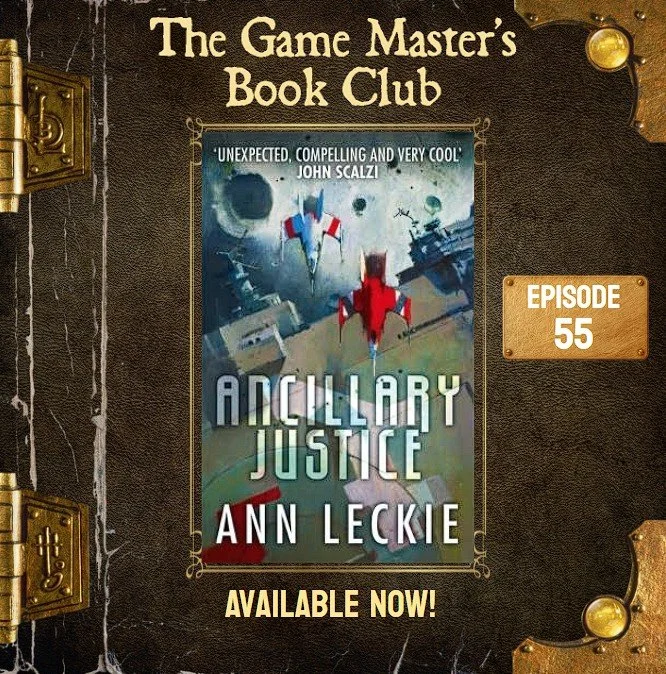
Ancillary Justice
Ann Leckie
Speaker A
00:00:04.880 - 00:01:30.520
Welcome to the Game Masters Book Club, where great fiction becomes your next great tabletop roleplaying experience.
This episode we explore a character who exists as a multiplicity, as a ship and a humanoid, and also exists over hundreds of years.
Ancillary justice by Ann Leckie follows the ship line of the spaceship justice of Tauren and its sole surviving ancillary brec as it plots the death of the Emperor of the Rash.
Game masters Josh, Romy and Lugh discuss.
Discuss drinking games like Negotias Infernalis and Baron Munchausen, gender in gaming and how to keep secrets at your gaming table.
Let's get into the conversation.
Today we are here on the Game Masters Book Club and I am here with three fabulous game masters and we are going to be talking about Ancillary justice by Ann Leckie, which is a fantastic book set in the sci fi future with AI characters and all sorts of deception and wonderful and, and just a wonderful book.
Really interesting things going on.
I can't wait to talk to you guys about it.
But first, let's have everybody meet you folks out in the audience.
I'm going to have the Game Masters introduce themselves.
They're going to say a little bit about their gaming journey and they're going to talk about something that happens frequently in this book, a character hiding what they actually are.
So, Joshua, would you mind introducing yourself to the folks and telling them about a time in your game when a PC or an NPC was hiding what they actually were?
Speaker B
00:01:31.430 - 00:03:28.500
Sure.
I am Joshua A.C. neumann.
My pronouns are he and they.
And there is a game.
I'm not sure it's in print right now, but it might be in its second edition.
Who knows where these things go?
It's called Cold City and it's about a post World War II, sort of hellboyish horror in Berlin as the wall is about to be built.
And you are each playing representatives of the powers that matter there.
So you might be American, you might be German, you might be Soviet, you might be, you know, from.
From some other.
Some other interest.
So it's all, it's all spy stuff.
Plus, of course, you know, you have wisdom that man was not meant to know, uncovered in the, in the catacombs under Berlin or whatever.
What we discovered when we played it was that if you, if the players don't know the other character's secrets, you can't activate them.
You can't find the like.
If you're writing a novel, you know, the big moment to reveal that if you're keeping it from the other players, nobody can play along.
And so you tell the other players, and then you put your characters in positions where it's going to really matter if this turns out to be true.
And the whole time you're sort of cackling with glee about what a mess you are about to make.
So my answer is, when a character is lying, you make sure that the other players know, because otherwise they're never going to get found out.
And remember that in gurps, like, you would lose character points if you're.
If your secret got found out.
So it was sort of a dick move to reveal somebody's secret if you figured it out because you were costing them points.
And I found that most of the time, those are just perverse incentives.
And what you want to do is find moments of irony and tension where it actually matters to reveal it.
And you need all the authors on board to make that, make that feel good.
Speaker C
00:03:29.380 - 00:04:06.270
That's interesting.
I feel like I've actually run into sort of the opposite thing as a problem when I'm playing RPGs, because often I will write pretty extensive backstories from my character just to have a sense of how they're different from other characters I've played, where I'll be like, okay, here.
Here was what their parents were like.
Here's what their first love was.
But I don't intend for any of that to come out in the game.
But if I share it with a game master, inevitably they try to make it an important plot point.
And my whole thing was, this doesn't affect the plot at all.
This is just me figuring out how my character will make decisions about totally other stuff.
Speaker D
00:04:06.990 - 00:04:15.710
Joshua, for you, it's, you're the math teacher.
You want to see the work.
And for Romy, you're the English teacher and you want to hide all of your work and just show the final draft.
Speaker C
00:04:16.070 - 00:04:16.630
Absolutely.
Speaker D
00:04:17.110 - 00:04:34.390
Okay, fantastic.
Lou, what subject are you teaching?
I mean, tell everybody about yourself and tell them about Bromy.
You already told us a little bit about your character background stuff.
Why don't you tell us a little bit something about this hiding what a PC or NPC is and about your gaming journey.
Speaker C
00:04:34.710 - 00:06:37.460
Well, the first time that I ever played Shadowrun, it was a long weekend at college.
And so a bunch of my friends, we were all.
I was friends with a lot of people who weren't going to college, where they were from, like, including me.
But so there was some long weekend where there wasn't really time for people to go to the other side of the country.
And I lived close enough that we just all wound up crashing my parents house.
So there was just a ton of college kids in the house and a friend was like, we should play Shadowrun, which none of us had played before.
Pretty immediately I became the face character, the person who is not really wired for combat but is the negotiator.
And my sister became the muscle, the, like the heavy.
But in one of the encounters we were just like picking up supplies, like we were just gassing up the car essentially.
And then some, some gang tried to knock over the convenience store and we were there at the time and they weren't really out for us.
It was just like a random encounter of some people who were tweaking on some kind of science fiction drugs and wanted to knock over a gas station.
But we didn't want to get robbed because we were carrying some pretty important stuff because we were in the middle of a heist.
And what wound up happening was my character just snuck out the back instead of doing any kind of negotiating because it was like, there's no point talking to these people, they're not sensible.
But my sister's character just picked up a cereal box and started pretending like the cereal box was talking.
And I don't remember whether she rolled particularly well or whether we all just thought that was really fun and were like, no, that should work.
So there became a whole encounter between these gang members and essentially like the Lucky Charms box talking about how their life was turning out.
And that's how we got out of that encounter.
Speaker D
00:06:38.420 - 00:07:02.090
Okay, that's amazing.
That is.
I've never heard anything like that before.
Which is what this show is all about.
It's fantastic.
Lou, we've already had the, as I previously said, we already had the math teacher and the English teacher, so.
So what sort of teacher are you and what sort of.
And tell us about your gaming and tell us a little bit about your.
About someone hiding what they are in your campaign.
Speaker E
00:07:02.250 - 00:11:00.750
Absolutely.
So I'm Lee Wanika of Tabletop Journeys.
I'm the one of the co founders, co hosts.
I'm also a writer and designer for various game products and so many other hats that I'm not going to bore everyone here with all of them.
However, give us a shout sometime.
Callyourboysttj and I'll certainly fill you in on all of that.
As far as what kind of teacher I would be given, despite the fact that I was an English major to become an English teacher in college, given the parameters that we have set just before me, I'm Gonna yes, and.
And say, clearly I'm a history teacher.
Which blends just a little bit of both.
Cause I do sit kind of firmly in between my fellow guests on this score.
I do believe that in tabletop gaming, secrets can be critically fun.
And just one of the times it has been really great in.
The game I played in was a D and D game.
I believe at this stage we were still playing 2e.
We may have just converted to 3,0.
Essentially we are playing a pseudo Ravenloft campaign.
We call it Alanis.
And it's campaign that started back in the 80s and still goes on to this day.
I'm actually on a live stream for that show, Old Ways to Spiro.
You can see it on YouTube.
But the key was characters would occasionally be replaced by doppelgangers or possessed or something like that.
And one of the characters I played for probably four or five sessions was in fact replaced.
My character was actually off doing something and then the game master came to me and said, hey, when you get back in, you're not you.
You're this person.
They know all of this about you, but not everything.
So you do have to occasionally give a tell, but you're actively trying not to get caught.
So even if they question that tell, you now have to roleplay a way around that.
And then they gave me my new mental stats or whatever.
So I thought that was immeasurably fun because I got to play a parody of myself playing my own character and put in all these weird things.
Like I would pronounce certain character names absolutely incorrectly, or I would mix up like Terms of Endearment I had for different characters.
I would get them backwards.
Or at other times where I would not use my character signature weapon, I would use some other weapon which was very unusual.
And people would keep picking up on these things.
And I kept finding ways to play that off.
When that was finally revealed, everybody's like, oh, should have known.
Those kinds of secrets can't work unless the person doing them is aware.
You can't just say, okay, pretend for the last four seasons it wasn't you, and let me know at the moment of reveal.
You can't get that to work.
Similarly, if you told everybody, if we were doing a book or a live play, that works for the audience, but it doesn't necessarily work for the actual game table as a powerful reveal.
So it is about kind of picking and choosing who needs to know what needs to know.
And it's all, of course, based on that session zero style conversation or series of Conversations where you do let players know in advance that these are the kinds of things that can happen, which my GM had actually done many times.
Every time we start a new campaign, in this long history of campaigns that were connected, he would reiterate, not everything is as you seem.
At any point, somebody could be possessed by something else or what have you.
You know, never give the paladin to the succubus was our catchphrase.
Speaker C
00:11:00.750 - 00:11:36.150
Yeah, I guess I'd say as a film and theater director, a bit of advice that one gives commonly to actors is don't act the room that you just came from.
And I think that's essentially what we're getting at with the whole when to have secrets and when not to have secrets.
It's great to know stuff about your character that's backstory.
But play the scene if it doesn't matter to the scene, it doesn't make a lot of sense.
If you're actively trying to conceal something, but you're playing that you want it to be found out, it's not gonna work.
So if you want it to be found out, eventually you do need to tell people.
Speaker B
00:11:36.630 - 00:12:04.730
In some way.
Like, it can be quiet.
Like, I can imagine a system in which you say, like, okay, one of these.
You know, we have two truths and a lie here about our characters or whatever, and you can sort of figure it out over the course of it.
You know, it doesn't need to be just like, okay, I'm really your child time traveling from the future, but you don't know, okay, like, you.
You can have that kind of conspiracy, but that's not necessarily the way to do it.
Speaker D
00:12:04.970 - 00:14:32.070
Well, I'm going to go with being a science teacher because that's what I am, which is that I love the unknown and I love discovering the unknown, which is why.
Oh, and by the way, I'm Eric Jackson.
I'm the guy who's in charge of the podcast, which is fantastic.
And I've been playing since the Pleistocene.
And my current.
I am playing a character who does not know what his origin story is.
This particular character was injured and healed, and he doesn't know how he came back the way that he is.
And I told the game master, I said, here's five possible things.
Pick one of them.
Don't tell me what it is.
I'm just gonna play this character and you will reveal to me as this goes.
Basically, the reason why I say I'm a science person is that I really love discovering the unknown, and I'm also a terrible liar.
So if I had to, if I had to deceive everyone of what I was, I don't think I could hold back, like, wanting to tell that story because I'm.
I'm a storyteller.
I'm normally.
I'm normally a game master and I'm.
That's my main thing.
And I'm like, I want to tell everybody all the lore all the time.
And so this was.
The only way I could play a character with a secret was that I didn't know what my own secret was.
And we're all talking about characters that are not what they seem.
And that, to a certain extent, is what a lot of Ancillary justice is about.
This fantastic sci fi book is based around the idea that the Lord of the Ratch must die.
Bre, an AI that once commanded a starship, the justice of Ton, and thousands of ancillary corpse soldiers is now reduced to a single body.
Severdin, soldier from long ago who served aboard the justice of Torun, is suffering from drug addiction and personal disorder.
Spare when she complicates Brecht's personal quest to assassinate the ruler of the greatest empire in space.
Neither of them know that the Lord of the Ratch herself is an AI that is fighting a covert war against herself.
The whole book is based around the concept.
Can Brecht navigate political corruption, class hierarchies and colonization, and the strange twists of an omnipotent AI's madness?
Ann Lecky explores the boundaries of personhood, the fiction of gender, the cost of civilization upon the individual, and the ultimate futility of war and empire in this really great book that we all read.
And I'd love to hear what you guys felt about this, what themes or things you thought were really cool about this book.
Romy, why don't you start?
Speaker C
00:14:32.150 - 00:16:36.300
Oh, just in terms of themes about the book, what I like about Ancillary justice is that I'm always interested in stories about someone who is a multiplicity.
I've always loved the idea of being able to split into multiple selves or be multiple places at once.
So it's really fun for me, particularly in the early parts of the book when Brek is her full self as the justice of Torhen and getting to bounce around and be all of those places simultaneously.
You're not omnipotent.
She can't be everywhere.
But I love that she's able to see herself from her own eyes.
I love that she's able to sing harmonies with herself and is able to just sort of perfectly coordinate that's very appealing to me.
So I love all of that.
As we get later into the series, something else that I like is that you manage to have a power struggle for this empire that is between one person who is divided against herself.
And that feels very psychologically rich to me as well.
And then there's a sense that what this person is protecting is this sense of purity.
You have that constantly throughout the book.
You have that this society, the Raj, you know, is constantly wearing gloves, is constantly concerned about cleaning, and is even expanding its empire in order to protect its real self.
That it's just basically making a huge buffer so that nothing alien could ever come in contact with it.
Which means you have to constantly expand the border because you're trying to push stuff as far away from you as possible.
And to have that sense of wanting purity, try to exist simultaneously with this sense of wanting a huge amount of expansion and of wanting to be able to split yourself into parts.
Obviously that's gonna fall down, and that's fun to watch.
Speaker D
00:16:36.540 - 00:16:41.980
Luke, do you wanna follow up with that?
Any themes or things in the book you wanna specifically point out?
Speaker E
00:16:42.140 - 00:18:49.730
Yeah, I really did like a lot of what Romy mentioned.
As far as the concept of the Emperor being in being so many places at the same time themselves, specifically, that they're at war with themselves.
I thought it was a nice.
Nice is probably not the word, but it was an intriguing and interesting and actually amazing allegory for the war that each of us will have with ourselves against our better natures or our worser natures or how we want to respond to this situation or that situation.
And I even think it kind of illuminated or shed a little light on the concept of nurture versus nature.
Because they're the same body or different bodies, but they're the same mind.
It's the same individual.
But somehow or another, over all these generations, you have the Emperor having different experiences.
And at some point, those different experiences don't coalesce into one single plan.
They actually divert into two.
Into at least two factions that we know of here at this time and probably many more.
Almost like the Star Trek adage, infinite diversity, infinite combinations.
If this emperor can be an infinite place, as infinite bodies and have infinite experiences, then in theory, there could be infinite factions.
While many may agree there's quite likely to be no end to these covert civil wars that have been in existence for a while that are brought to the fore in the course of this book, I thought that was just a really brilliant way of saying how powerful a mind can be if left unchecked or if someone's not doing their due diligence to regulate themselves.
I thought that was an interesting.
At least that's how I took it and thought it.
It's certainly a discussion for really in depth sociological and psychological reference.
There's a lot there.
Speaker D
00:18:49.730 - 00:18:53.090
Absolutely.
Joshua, any themes you want to point out?
Speaker B
00:18:53.350 - 00:20:33.400
I think one of the things that she does a great job at is considering how cultures might be different from each other.
And this idea that one person has, you know, we know that it's, it's, it's at least two people, but there's a.
And there's an ideal.
And the ideal is that you eat fish, you drink tea, you, you're.
You have modesty, modesty standards about showing your hands or touching somebody else.
And you rise through the ranks, through military service.
Like there are all these values that are established that you, that you don't make distinction.
Actually, it's hilarious.
The, the way that it treats gender is that it's so clumsy that there's grammatical gender in other languages.
And they're sometimes they're kind of dicks about it because they're convinced that they're the only right way to be, because why wouldn't they?
They have this purity ideal that they hold to and they have enormous force of arms to enforce their whims and neuroses.
Of this individual who might have two warring interests hidden is still a very narrow set of human experiences.
You know, this is a person who more or less doesn't die and hasn't died for millennia and still has tastes and preferences and is so powerful that they just impose it on the galaxy and the places where they can't.
They have to come to this detente with the.
Oh, shoot, there's the Ur.
And I forget what the other aliens are.
Speaker C
00:20:33.400 - 00:20:34.120
The Presker.
Speaker B
00:20:34.120 - 00:21:54.450
Yeah, the Presker.
Thank you.
They just have this detente with them where they're like, we're going to lose.
We have proven to you that we're.
I believe the word they use is significant, which is some standard that the Pressker have.
And that just means we're just hands off from each other because we're going to get hosed if we actually tangle in some way and we don't even understand what they want.
But we all seem to be in a place where we can stand back from each other and nobody gets hurt.
And even inside here, inside the Raj, inside human space, we have the proper way to be.
We have our sense of propriety and it's.
Do I Want to use the word contemptuous, I think.
Contemptuous, yeah.
Of the idea that there can be a dominant culture and the small.
I mean, they can dominate, but they are, but everything that they use to dominate makes them weaker in the long run because they have this narrower and narrower idea about what it is to be civilized or a person or, or polite or proper or any of those things.
So they go around destroying everything that is a cultural, that's alien to them.
And, and that sounds familiar.
I think we've seen that a few times.
You know, she's, she's not, she's not, she's not making that up from.
Speaker D
00:21:54.450 - 00:22:00.080
Whole cloth, I think.
Yeah, I think we've, we've seen some examples of that in recent history, you know, that could be happening.
Yeah.
Speaker B
00:22:00.080 - 00:22:00.560
Yeah.
Speaker D
00:22:00.960 - 00:22:34.860
All right.
Okay.
So now that we've outlined this book and talked about it and talked about its themes and we, we've talked about all of this wonderful atmosphere and all of this wonderful setting and all of these wonderful characters, what's the game, what's the tabletop game that makes Ann Lecky's ancillary justice happen?
What is the, what is the system that helps portray all of this in the best possible way?
Lou, do you want to start and give us your, your choice for the tabletop for ancillary Justice?
Speaker E
00:22:34.860 - 00:22:46.740
Yeah.
So I should start with the gimme response, which is.
I'm not sure that there's an existing tabletop that really perfectly captures all of it.
Speaker D
00:22:46.740 - 00:22:47.260
Okay.
Speaker E
00:22:47.500 - 00:28:29.100
But I'm going to start with the mechanical system that I think will get us three quarters of the way there and give you a little nuance for that last quarter that I think does it.
Perfect.
Makes it perfect.
I would go with the game Sentience by Al Spader.
It's a 2D20 game.
It is published by way of Yellow Hand and Modiphius.
It happens to be the first of the world builders, which is basically third party content that Modiphius has ever approved.
They've done a few since the beginning of that program several years ago, but Al's was the first.
He started as a prolific Star Trek Adventures freelance writer, has led at least one of those books and he has a number of role playing games to his credit.
Fantastic human who wrote a game about sentient robots.
And the idea was sentient robots that were not like the Terminator, they were something different.
The reason I think this system works really well is just the narrative nature of the 2D20 system.
Difficulties get set, there's some meta currencies.
More importantly Values is the biggest thing about the game, which is as you're role playing scenarios, your values are a thing that you can use.
I failed a role.
I need to do better at this.
Well, do you have a value that indicates the need to do this more?
Then you have this thing called determination that you can exercise the ability to reroll.
Or perhaps your situation is made more difficult because you have a value against it that is taking off my gloved hand and touching somebody that I don't know.
That's a difficult thing to do.
That makes the tasks involved in that scene more complex.
So these values and the ebb and flow of the various meta currencies really work towards some of those themes that are more narrative than specifically mechanical.
And I think that works really well.
The other major factor for 2d20 and specifically sentience, being the system that I think works best here is that the sentient robots are based on their emotions.
So when you are talking about your stats for the character, we are talking about their emotions.
Anger, fear, joy, love, pride and sadness.
When they talk about their protocols, basically the things that they can do or are good at that would be analyzing communications, moving, observing operations or operating and surviving.
And I think that really encapsulates especially with some of those nilt scenes with Breck and Severdin in the book.
I think those things really show off in those areas.
You know, more of the emotional stuff is in the past scenes, but I think the actual protocols show up in the latter scenes.
So just finding a way to kind of mirror that.
For the non AIs or the non ancillaries, it would be important, but I think that really does 75% of the lift for mechanics of a tabletop game.
For this book that last quarter is about discovering who you are, those difficulties with missing memories, things of that nature.
And for that I would say it's very important to have something like the Discovery system from a Powered by the Apocalypse game known as the Real Thing.
It's based on the Faith no More album from the late 80s early 90s.
It's done by, I'm forgetting the name of the publication company and forgive me the Wards.
Jason Ward and the other Ward are the two writers.
They were on our show when they first did the game.
We did some of the early play tests for it.
It's a brilliant Powered by the Apocalypse game.
They have something known as a Discovery system.
When you fail a role, you now learn something about your past.
And then that thing you learn is a narrative thing that the GM prompt gives You a prompt like tell me about the time when X happened and then you say that thing.
Usually it involves some of the other characters that are involved in the scene or in the game and your interactions with them in the past.
And that will illuminate more of the storyline going forward.
And I think some, it would have to be massaged a bit, but some semblance of that system would help carry the rest of the weight.
One last thing about the 2D20 sentient system that's important here is if you end up doing those rerolls and start using your values to get rerolls and do things like that, you can actually start cutting off your emotional connection and you can get to the point where you revert to a machine.
And I think that very taut line within this book about where you've got characters who are all machine or all about to just deal with the way things are and revert and not care about things emotionally or not make what we consider a moral choice or what have you is something that could also be worked out within those parameters.
Like that thing where if you work too hard or fail too often to honor your values, then at some point then those values stop, lose meaning and you start to revert to this more machine like existence.
Speaker D
00:28:29.500 - 00:28:45.320
That sounds great.
If you're going to be looking for a memory based system as well.
And you said you might want to modify it a little bit.
We talked about a game called Thousand Year Old Vampire, which is a solo journaling game.
It has some really interesting mechanics.
Check that out.
Speaker E
00:28:45.880 - 00:28:46.560
Absolutely.
Speaker D
00:28:46.560 - 00:28:50.520
Romy, do you want to talk about your mechanic choice for Ancillary Justice?
Speaker C
00:28:50.680 - 00:29:56.200
Well, one of the first ones that I thought of was Shock.
But since we have the writer of Shock here, I will let him talk about it.
So I was like, I instead I sort of went on a side quest to go a completely different direction, which is something I realized through this reread of Ancillary justice is they're drinking a drink, an alcoholic drink called Arak.
And I thought that this was just a science fiction alcohol, but I figured out about a month ago that it wasn't.
It's real.
So me and my buddy Chad tracked down a lot of it.
There's two versions.
One of them is from Indonesia and is called Batavia Arak, and it's made from red rice and sugar cane.
And then there's another one called Ceylon Arak, which is from Sri Lanka that is made from the flowers of the coconut palm.
But despite this, they taste fairly similar.
It's this weird alcohol that Kind of tastes like it's halfway between whiskey and rum.
Speaker D
00:29:56.360 - 00:29:56.920
Okay.
Speaker C
00:29:57.080 - 00:34:18.340
So in light of that, and in light of the fact that in the story they're constantly throwing discs in order to do fortune telling about what is or isn't auspicious in the day, like, this is one of the things as an officer that you're expected to do.
So I was like, okay, what's the kind of game that would be good for that?
And so there's two games that I wound up at that are good kind of drinking games that you could combine with this.
One of them is what Chad and I were actually playing while having our Arak festival was the game Negocios Enfornales by Cse Cooney and Carlos Hernandez.
It's a game that has its own internal story, but its setting is that it does take place in an empire that is governed by a powerful empress and that you are playing courtiers underneath her who have powers that have been granted to you, you believe, through sort of demonic deals.
But it's not demonic.
It's that there's this powerful alien species that has contacted you and offered you these boons, but you don't have the mental framework to understand what's going on.
So you must have made a deal with the devil.
And so you also have these beliefs that you are cursed as a result of it.
That, like, there's some way that that evil is going to corrupt you at some point.
But it's all in your head.
It's psychosomatic.
But the way that the game works is not only that you have a set amount of time to accomplish the mission that has been set for you by the Empress.
But also you don't have dice rolls.
You have essentially a tarot deck, but it's a different fortune telling deck that they made up that has like seven suits in it.
And so you're drawing cards to inspire you for to some extent you're seeing whether you succeed or fail, but to some extent you're seeing, okay, what's the, what's the vibe of how this decision turns out?
And I feel like all of that would actually work really, really well for running a mission in this universe.
If you are working for the ruler of the universe, maybe less so if you're going against her.
The other game that I thought of that lends itself very well to being a drinking game is the Extraordinary Adventures of Baron Munchausen, an RPG by James Wallace, which you can get on Itch IO or I don't know whether people say itch IO or itch, IO where again, we have the drinking, we have the chip throwing.
We have the potential for having the.
Who I'm referring to as the Empress Mia Nai as the viewpoint character.
Because it gets at the thing that I like, which is the idea of being kind of one person in multiple bodies.
Because one person is telling the story in Baron Winchouse and one person is being the Baron.
But anybody else can basically throw some poker chips in and challenge you to have to add something to your story to be like, well, but wait a second, this complication happened.
How did you get out of it?
And if you need to pause, you have to pretend that it's like, oh, well, I have to take a sip of my drink.
I'm parched.
Which is the only way to give yourself time to think.
Otherwise, you just have to run with it.
And I like that because so often in the book we're seeing Brek have to react very, very suddenly based on stuff that, like, for instance, say, Varden does.
Because Brech is kind of not used to having to work with people who aren't herself, who aren't justice of Torhen.
And so she's a little bit more comfortable when she can just go into their implants and feel how they're doing and be sort of telepathic to them, even though it's not as good, since she can't control them directly.
But in the first book, she's in hiding a lot of the time and has deliberately, kind of turned off all of her tech that would let her be able to feel these other people the way that she would if she was the ship.
Because as the ship, she has all kinds of sensors.
And so I like that aspect of the feeling of like, whoa, left field.
Suddenly I have to incorporate this thing that I didn't see coming because somebody else came up with it, but I'm having to act like it was my ide.
I feel like that all works very well for the kinds of problems that Brecht encounters throughout the book.
Speaker D
00:34:18.660 - 00:34:29.940
Fantastic.
Absolutely brilliant.
What a great way to approach this.
That's really amazing.
Joshua, you want to tell us what you would like to run ancillary justice in?
Speaker B
00:34:30.020 - 00:41:12.480
Well, after that discussion, I kind of want to use the Adventures of Baron Munchausen.
I think it's a really good idea.
It's fits particularly well.
I think that's a really brilliant way of thinking about it.
Just like Romy decided to leave me my answer, I will leave Romy's answer.
And my answer starts with shock, because shock's first questions are that it asks, as a system, is what are things that you care about in the universe?
You as a player, you as a real person, otherwise you wouldn't be playing this game or telling these stories.
And then we use science fiction stuff.
We use a shock to blow them up, to magnify them.
And by magnifying them, it ironically lets us get a little bit further away from them and then lets us get closer to look closer, to analyze them in ways that we have a hard time doing when we're looking at them, literally.
So there's a bunch of themes in here that are about Empire and how one's morality shifts with one's personal access to power.
So I would say that I would take those basic rules of, you know, what are the things that we care about here?
Like, we might sit down.
If the four of us sit down to play, we're gonna look at things that we care about.
And it's conceivable that we don't care about.
None of us cares about what it means to be polite in society.
That's not what we want to talk about right now.
That's just background stuff that we have tea parties and stuff.
We're like, oh, I guess we should have a tea party to do this, right?
But it's not like.
It's not like that matters.
The structure of that society, those societal niceties matter.
What matters for us, hypothetically, because we've each put down something that we care about is the stuff that I was talking about a moment ago that, you know, we care about.
What happens to your morality as your access to power goes up?
And so that's one question.
And then we have a character who's confronting that and another character who's maybe also Anand or Bianae, addressing that from another direction.
In this case, we can have more than one answer.
We can have more than one character asking those same questions and asking them really directly.
You know, you're asking, I always say that all games are ethical experience experiments.
That, you know, what do you do in this situation with another player?
If it's a competitive game, it's asking about those competitive experiences in life.
If it's a role playing game, you're saying, what do you do in your relationships with other people?
What can one do?
What's proper?
What is the world like?
What do I wish it was like?
What do I think it's going to become?
And science fiction does the same thing.
So when we look at a game like this and we say, like, okay, so Here's a character, this character is a couple thousand years old, used to be a.
Have however many ancillaries, and then other humans that they could talk to, anybody who would be a subordinate or themself is gone.
And they're now reduced to this person.
And they are dealing with the consequences of their own actions, the moral consequences, the eternal moral consequences of their own actions and what they're trying to do to make it right, some of which is very personal.
And it was actually my.
I was ambivalent when I started reading it.
Like, revenge, I always find to be a really shallow motivation.
I don't think it's.
I don't think it's realistic.
I don't think it's moral.
Usually it's, you know, leads to just sort of spirals of despair and, you know, it happens sometimes.
I can understand wanting to shoot somebody back, but dedicating your life to vengeance is kind of in the.
Just in the realm of fiction.
It's just, it's.
It makes it simple to make a character.
So I was reluctant at first to buy in.
And then over the course of it, I was like, oh, this is a big deal.
She's not like, oh, I'm going to get you back for this.
She's like, I'm going to burn this all down.
Not only is this wrong, but you made me do horrible wrong things and this will not stand.
And to herself, her own rationalization.
It's personal, but it's not true.
It's a lie.
It's how she keeps herself going.
I don't know about a lie.
She's underplaying it to herself.
And as she has to make moral decisions, you know, okay, so what do you do in this ethical circumstance?
This person Sivardin has dashed themselves on the shores of their life.
Well, now you've met this person, you're on a personal vendetta.
What do you do now that they need your help that really changes things.
What do you do when it turns out the person you're seeking vengeance on also wants vengeance on themselves?
Not because of a personal vendetta even, you know, is.
It's because they want things to be better instead of worse.
Like, okay, now I have to change that, change my perspective on that.
So shock's good, good at doing that kind of thing.
And if I were to make a focus of shock specifically for this.
We know some things coming out of the gate are shocks.
We know that there are ancillaries.
We know that there are, oh, I don't know, there's ways that star travel works.
There's our political systems that are where our shocks cross, our social issues.
And then I would say in shock, you make your dimensions of moral decision making.
So the one that has become most famous is space battles versus sex.
And your character can be better at one or the other and will resolve their conflicts through one or the other, depending on the circumstances.
That was a particular.
Ridiculous.
Particularly ridiculous.
It was like Buck Rogers.
Oh, you know what it was like?
It was like Flesh Gordon.
That's what it was like.
It was like the burlesque send up of Flash Gordon from the 70s.
And it was actually really good.
It was because we could just come out of some really, really gnarly ones and we wanted some wings on helmets and, and that's, that's where we took it.
It means that you get to say you don't get to have good sexual relationships if you're good at having space battles.
You can.
If, like, if you're a sexy space pirate, you're gonna do it like James Bond, you're gonna lose all the time.
So yeah, so that, that's more or less what I would start with.
And then I would just make sure that in the tradition of my, my groups of friends, we would usually start with some idea about how a role playing game worked well last time and then we'd tweak it for this particular setting.
And sometimes the tweak's really dramatic.
Like, you know, we need to come up with a way to have detailed space battles because that matters to us.
Or we need to have a way to manipulate a parliament because that matters to us.
And we design a game around that and then throw away all the parts that didn't matter.
So that's what I would do.
Speaker D
00:41:12.480 - 00:43:01.200
Awesome.
Fantastic.
Just amazing, amazing ideas, everybody.
This is all really good.
I'm gonna tack on mine on the end.
I don't feel like they're anywhere near as inspired.
I've played the alien RPG a couple of times with folks and I like the way that they handle Android characters.
They have specifically in the book how to play an openly Android character and a hidden Android character.
And that's part of the, part of the process.
So that's a nice little piece that could be very useful for this sort of game.
But the game I think that I think would work the best is Eclipse Phase by Posthuman Studios.
Your character sheet is based around this idea of you have an E ego and you have a morph.
The morph is the body and the ego is the brain.
And they can be separated at any given point in time and you can change your morph at various points.
So it does.
And it does actually deal with effective immortality and like how you handle that in gameplay.
So if we were going to play in the.
In the time period that Romy likes, in that earlier period where you're doing all of these multiplicity things and you're downloading yourself into various bodies all the time and not just trapped in one, then I think Eclipse phase is probably a good place to start.
But that's all I'm going to say about those, because I haven't spent a ton of time playing either of those games and I think all of your ideas are way better than mine.
So we're just going to leave it there.
That's good.
But I'm going to jump back to Romy.
Romy.
We're now going to move on to what I like to call the portable part, but was really the stealing part, the part that all game masters do to a certain extent or another.
What from this particular story.
Basically, you've already hinted that you've read on, so feel free if you want to throw a couple of things in from later books, if there's something lurking down the road that we should know about.
What in Ancillary justice do you think could make an appearance in one of your campaigns?
Speaker C
00:43:01.200 - 00:49:14.380
Well, I'd say part of what appeals to me about stealing things from Ancillary justice is I like some of the visuals.
I think that often when I'm game mastering, I'm thinking a lot about plot and thinking a lot about what do the characters need to achieve, and thinking a lot about the NPCs and how they need to behave.
And where I feel like I kind of wind up running out of juice is the, okay, what does the room look like?
What is the setting?
How, you know, how can I make it not generic?
So one of the first things that I really love for a lot of reasons is at one point in the book, they jump off a bridge.
And it's not an important bridge, and there's not even a particular reason for them to be on that bridge specifically.
It just looks cool.
They're on a pretty icy, inhospitable, wintry planet, and there's a chasm that has what gets referred to as a bridge across it, which is just made out of colored glass and is gorgeous and was clearly developed by some alien civilization that's not around anymore.
And it's a tourist destination.
But it's also a way that Brec just Decides to get from one place to another, because why not?
Even though it's pretty dangerous to walk across a chasm on a beautiful glass bridge, and Sye Varden is following her and winds up misstepping and falling off the bridge.
Brek immediately jumps, grabs SE Varden, like, extends a personal shield, tells Sae Varden to extend a personal shield, but save Arden.
Already sold theirs.
So essentially, there's a huge fall that happens off of this gorgeous glass bridge down a chasm that has, again, these very artful glass tubes at the bottom that nobody knows what their purpose is.
But a lot of decisions have to get made quickly while falling through the air.
And a lot of calculations have to be done about, essentially, Brecht kind of trying to figure out how much damage can I take in order to make sure that we both stay alive versus how much damage could I offload to this other person?
And that feels a lot like the kinds of calculations that get made in, like, DD encounters where it's, you know, oh, we gotta protect the wizard.
So you jump in there in front of them.
But I find that.
And this may just reflect the sort of person I tend to play with.
Combat often feels very slow in the parties that I tend to play with because everybody gets really obsessed with doing the right, most perfect thing.
And, you know, so even though a round is in game time taking, like six seconds, everybody's taking, like 20 minutes to decide what they're going to do.
So as a game master, I love anything that has to be like, no, you have to decide now.
Okay, you have to decide now.
Now you're falling further.
You're losing time to actually be able to make a decision and react.
And you can't do that all the time with your players.
But sometimes it's nice to actually put people under a sort of a literal time trigger.
You know, maybe you have an hourglass or something like just a little sand egg timer where it's like, you know, you have until you hit the ground to decide what you're going to do.
And then we do the damage calculations.
The other two pieces that I thought of as potentially interesting to steal happen in the second book.
And this is not going to be too spoilery, but there's a point where there's, you know, again, in terms of beautiful settings, there is this.
Most of it's set on this space station.
And the space station has an enormous, very beautiful botanical garden with a lake in it.
And, you know, Brech, our protagonist, is both like, oh, this is really impressive and gorgeous, but it's also a huge, absolutely nuts safety hazard because right outside of there is vacuum and there's no way that you could evacuate this room really quickly.
And a fight does indeed wind up taking place in that, you know, which again, I'm saying is not a spoiler because it's very Chekhov's gun.
You don't create a setting like that and not have the big battle wind up happening there.
Something's gonna happen there.
And there is.
There's a breach in the lake.
Breck is like, is, of course, speaking with the AI that is the space station and is like, you've gotta evacuate all the decks underneath here because it's gonna flood.
And then the ship that is the space station AI instead doesn't do that, chooses not to do that, instead just turns off gravity.
And it's like, oh, I love that.
Like, that's so beautiful.
As the solution that I wouldn't think about because I live in a world where you can't turn off gravity.
But suddenly all of the physics of the encounter change.
And there's not a flood because nothing's being pulled down, but also the entire battle changes.
And I love the idea of having a setting in an RPG that changes midway through the fight, not because the characters have moved to a different location, but because something significantly different happens, like there's a flood, like suddenly a parade comes through and, you know, just any number of reasons that could suddenly interrupt the fight that's still going on.
It's very cinematic, but it's also an interesting thing to think about as a game master.
And then a final thing that I really like, again, in the second book, I mentioned that there's a space station.
The space station is above a planet that is full of tea plantations.
There's basically a space elevator that goes in between them.
To some extent, you have to have approval for whether you can go up or down.
And I like that.
I like having this very agrarian setting right next to this very high tech setting.
Kind of the idea that the wealthy kind of treat both of them as a playground, but then the majority of the people are in one place or another and don't really travel back and forth.
Speaker D
00:49:14.860 - 00:49:31.020
That's really cool.
There's a very similar concept in Matt Deniman's new book, Operation Bounce House.
So if you really like that, that's another option there.
Lou, do you want to go and tell us what you want to take from the Ancillary justice and drop into your campaign?
Speaker E
00:49:31.100 - 00:51:47.430
Yeah.
It's not necessarily a specific scene or mechanic, but it's more.
More about.
More of a methodology.
I really like the way setting is described and handled specifically as it relates to cultures and factions within this book.
And I think as a GM, certainly as a writer, but as a GM who GMs for home groups at my local shop.
I do professional GMing as well.
Learning new techniques for description never ever hurts.
I mean, there's whole companies that do this with real people.
There are probably a billion companies that do it with AI, no pun intended.
But I like the way that there's a show don't tell mentality with this.
So it's about.
Don't sit there and exposit on a culture or on a way people handle things or the way people talk.
Just have it be part of the flow of the situation or the scene.
Talk about the stratification of society by having multiple people within the setting from different parts of the society.
Showing who pours drinks, showing who wears what kind of uniforms.
The simple discussion of accents and language and the use of pronouns were really instructive.
D and D has long ago moved away from language being a differentiator.
It's a big differentiator in the games I play and run in because I think it's cool.
I think it's cool to have the difficulty be I don't understand what so and so saying.
So I need to find another way to communicate, whether that be with skills, insight or what have you.
There's something important about that.
And this book does a great job of showing that through the scenes and through the actual actions of its characters.
And I think as a GM, having your NPCs do that reduces the need for box text and increases the ability for players to really feel like this is an immersive game world.
Speaker D
00:51:48.390 - 00:52:50.740
For some reason we haven't talked about it yet, or we only talked about it a very tiny bit at the beginning.
And that is the discussion of gender in this book.
And that was one of the things when I originally read this book when I was looking at.
Because I.
This is my reread.
But when I originally looked at it, it was like, oh, this is.
They're doing lots of interesting things with gender in this book.
And I was like, oh, that'd be really cool.
And I'd really like to be able to show how different cultures really treat gender.
And I thought that would be a great.
This is a great example of doing that.
You are mostly looking at it from this.
From this giant empire that is busily enforcing its own attitudes on people.
Which is good, you know, which is, again, a very interesting part of gender studies in that regard as well.
But I thought the idea of.
Of talking about gender and gender pronouns, that it would be different or would be used in different cases when you're taught, when you're in game.
I thought that would be a really great.
A really fantastic piece to add in.
Anybody got thoughts on that?
Speaker B
00:52:50.740 - 00:53:10.340
Sure.
I mean, I think it's.
I mean, I think it's just.
It's just fruitful because it's something that for.
For so many players, it just comes from the gut shock.
Shock is all written with neopronouns.
The game came out in 2006, and at the time, I had to explain to people what that's about, and now I don't.
Speaker D
00:53:10.740 - 00:53:11.540
Yay.
Progress.
Speaker B
00:53:12.900 - 00:53:30.370
Yeah.
And it was like, at the time, I was like, here's a thing that you can experience in your normal, everyday life.
That is what a shock is.
Like, you like, oh, that's not a boy.
That's interesting.
Like, if you treat it as like that, that's interesting.
All of a sudden, the universe is interesting.
Speaker D
00:53:30.370 - 00:53:30.810
Yeah.
Speaker B
00:53:31.450 - 00:54:06.500
And there's every reason to do that.
Oh, Murderbot, is it?
Right?
It's hard for me to refer to Murderbot as it because to me, it means not a person.
I think that's actually kind of an important feature of English that we have a gender that's not a person.
But despite Murderbot's protestations, obviously a person, like, by any standards, anybody cares about, definitely a person.
So that's how Murderbot handles it.
And I think that's fun.
And obviously that's a stand in, to some degree for gender, because we consider that to be a part of personhood in our culture.
Speaker C
00:54:06.980 - 00:56:04.450
One of the things that I find pretty fun about the way that the book handles gender is that we wind up talking about it very much as a book that is about gender, because our narrator, you know, it's not Brech aggressively, does not want to think about gender aggressively as, like, everybody's a she.
I don't want to have to deal with it.
Everybody is a she, and not everybody feels that way.
And it's pretty clear in a lot of conversations that Breck is having that Breck even is like, oh, I have to be anxious because this is a person who does pronouns.
And I'm gonna have to remember the pronouns that they're using to refer to the other people, even though to me they're all she's, and I'm a she, and everybody's a she.
And then for me, as A reader.
I'm not picturing all of these characters and female presenting bodies based on the way that they're behaving.
I'm reading gender into it as I read.
So they're being called she's by our narrator, who calls everybody a she.
But some of them, I'm like, that's a dude.
And so that's kind of fun to, like, look at how I impute gender to things.
But it's actually not something that stood out to me hugely about the book.
Like, I thought it was fun, but, I mean, I tend to use sort of gender defaults myself, where it's like.
Like, it actually annoys me a bit when I get asked for my pronouns, because it's like, I really just want you to use whatever you're defaulting to.
It's not actually a thing that is important to me.
Whereas if I have to insist upon it, suddenly I'm having to pretend an importance.
So I really sympathize with Brech on this one.
You know, it's kind of like I do sort of assume everybody is bisexual until, like, I've found out that a few people aggressively aren't.
And it's like, for you, I'll try to remember that you're not.
Otherwise I'm just assuming everyone is.
Speaker D
00:56:05.410 - 00:58:51.050
Start talking about media.
And I'm gonna go first, mostly because Joshua already mentioned my.
The book that I was gonna mention, which is Murderbot.
And so I wanna get it while Strike while the iron is hot, as it were.
If we were looking for books that are similar to this particular series, and this is a really great series, it has three other novels, Ancillary Sword and Ansel Lee Mercy.
There's also two short stories.
And also, just because I want to sing the bonafides of this particular thing, it's the only book ever to win the Hugo, the Nebula, and the Arthur C. Clarke Award in the same year.
So kind of.
So obviously, lots of people who make decisions about what they think books are think it's cool.
But if you're going to find something that isn't an Ann Leckie book in this world that she's built, what would you pick and why?
And my first choice was Murderbot.
I. Murderbot is also an AI that really doesn't want to be human.
And I think that's a very.
That's an older trope that's kind of gone by the wayside.
But I.
When I first started reading about AIs, it was always like, you know, the Data character who's going to wants to be human and all that stuff.
And I, I remember when I read Murderbot I was like, oh, this is very different.
And I, I also feel that Brecht does not.
Brecht has no desire to be a human.
Like that's just not.
They have their own rich life that they're doing and they're not terribly interested in.
They have to deal with humanity, but they don't want to be humanity.
The other book that I wanted to recommend for this one is Queen of Roses, which is a little more off the beaten path.
It's by Elizabeth McCoy and it is an AI that is trying to grow beyond their programming, which I think to a certain extent is the opposite of what's happening with Breck.
Breck is used to being this giant character and, and now they're having to shrink down to remember they're only in one body.
Whereas this one is an AI program that's used to basically being like a billing and customer service piece.
And then it gets hired in a job to run a space cruise ship.
And during that time they also end up working with another AI character and they both have to solve a murder mystery that takes place on that ship during her maiden voyage as the ship.
And so there's a lot of really interesting AI and thought and multiplicity and experiencing new senses and which I felt a lot of that happened in this book justice and also happened in Queen of roses by Elizabeth McCoy.
So those are my two picks.
I will pass it on to Lou and say, hey Lou, what books?
If you wanted to get books or media or anything that you thought felt a lot like ancillary justice, what would it be and why?
Speaker E
00:58:51.840 - 01:01:18.040
I don't know if I've read a book like this before, to be honest with you, which was, which was completely refreshing.
I've certainly read books that have had themes like this, but nothing with those themes, these types of settings, this sci fi out or what have you like, that is unique to me and I have not seen a lot within that really handles it.
I, I, I, I, you know, I hate to do the cop out, but.
But honestly, this is my first foray into this style of story and I really liked it.
It was different.
I read a fair amount of fiction or I used to.
I tend to be more of a classical literature.
Like the amount of times I've reread Robert Louis Stevenson or Jules Verne is immeasurable.
I'm a big fan of Edgar Rice Burroughs and a lot of the, and Dumas and that type of thing.
I don't tend to read a lot of modern fiction.
I read a lot more current nonfiction than fiction, which is why I love this show.
And I love the fact that you've asked me to come back because this has prompted me to read more current fiction and exercise some of those muscles that quite honestly may have been atrophying.
You know, the brain muscles, the important ones, not the tongue wagging.
But it is definitely something that I want to do more of.
So at some point in the future, I'd love to be able to come back and give you a list of things that I think are similar as far as media in general.
I think there's any number of shows that have some form of AI involved.
The thing that I think comes closest to it is the modern reboot of Battlestar Galactica and the Cylons and in specific the Cylons with their resurrection ships and the way that work with Six and some of the others.
I really got a sense of those Cylon characters feeling very much like the emperor and I got a real sense of menace from that concept.
Very similar to Dean Stockwell's character.
Especially in the latter seasons when he was confronted by Six and several of the other Cylons and they ended up allowing the robot likes in Cylons.
Spoiler for a show that's 20 some odd years.
Oh my.
Speaker B
01:01:18.040 - 01:01:18.280
God.
Speaker E
01:01:19.160 - 01:01:19.960
Oh no.
Speaker D
01:01:20.520 - 01:01:21.160
Oh no.
Speaker E
01:01:21.480 - 01:01:23.760
Yeah, right.
I ruined it for you.
My.
Speaker D
01:01:23.760 - 01:01:29.480
Bad.
We're spoiling an entire series here.
I think.
I think the 20 year old show can.
Can handle it.
It's fine.
Speaker B
01:01:30.680 - 01:01:36.120
I'm appalled that it's.
That it's that old.
But you're right, that is what numbers do.
Doesn't it?
Isn't it?
Holy crap.
Speaker E
01:01:36.360 - 01:02:48.640
I. I only know that because they.
They literally this month had like an anniversary thing and replayed the scene I was just talking about where they took out Dean Stockwell's character and I remember the whole wow.
And they had the very similar thing like all the different models, like all the six models, if one died, they went to the resurrection ship.
That allowed all of that individual models experiences to be downloaded into the group.
And therefore any Six that was re resurrected would now have the combined knowledge of.
Of that one that just returned to the.
To the central.
So the resurrection ship.
So it's like that was really powerful.
And then when they took the resurrection ship offline and one of the models was going to be killed, he's like wait a minute.
But if I die, all my experiences are gone.
No other of my model will ever have these experiences again.
And they were trying to use that as leverage to get him to, to bend to their will.
He didn't.
They took him out and that was the turning point that got other ones to pay attention.
So I think that's probably in media, the closest to this in concept, a really great series for a lot of those same reasons.
Speaker D
01:02:48.800 - 01:02:53.160
Awesome.
Joshua, you want to tag in and tell us about your media picks?
Speaker B
01:02:53.160 - 01:04:32.540
The one that is closest to me, Lou, if you're, if you're curious in reading other things that are along these lines.
E and M Banks culture novels also do this, like big moving societies, secrets and fantastical technologies and things.
And it's very thoughtful.
I can tell that she had read his novels.
The scene with the glass bridge, I was like, oh, she's writing this.
Like Banks would have, like, including the description of what it's like to be hurt that badly.
Because in the culture, people within the culture are fairly immortal.
That doesn't mean that they can't get themselves into garishly horrible pickles.
He's got a fantastic, very Scottish sense of humor in those novels.
So particularly Player of Games, which is about these, you know, somebody who's sort of decided that they're going to try to change the course of history of a society in terms of ways for an AI to be.
My favorite has stopped being Blade Runner, which is a long time.
I've got a lot of Blade Runner reference T shirts, but I don't think it gets at the same point as this book.
But Automatic Noodle does.
By Annalee Newitz.
It is a much kinder, more compassionate book.
In fact, they tend to be a kinder, more compassionate author.
It's about a bunch of AIs finding meaning in life.
Speaker D
01:04:32.700 - 01:04:34.780
Great book.
Robots in particular.
Speaker B
01:04:35.180 - 01:06:50.260
Yeah, it's very sweet.
And then the other thing about this that we didn't really talk about very much, but it's hard to do in role playing games without some really serious thought is the flashbacks and the things that I think about that for media are.
I mean, I don't think this is going to surprise anybody, but I was thinking about Rashomon.
When you're reflecting on traumatic events in the past, different characters are describing it differently and you don't know if they remember it differently and you don't know what happened.
All you know is the story is that somebody is telling later on.
It's a powerful sort of upsetting movie.
That is just some hardcore human condition stuff.
Ocean's Eleven is like the way that heist movies work is all we're like, oh, this is actually gonna work because we did this setup, but you thought this setup was gonna get.
Make this work, but it made something else happen.
So, like, I think that's.
That.
That could be really good for saying, like, you're gonna play, you know, two character sheets.
However your system deals with that.
Here's you 20 years ago, here's you 1,000 years ago, and here's you today.
And if you want a power today, then we're going to go back in time to 20 years ago or back to a thousand years ago, and we're going to give you the abilities or set up your pickles.
We're going to find you resentments and errors that have come home to roost and all that stuff when we go back in the past.
So that's how heist movies like Ocean's Eleven do that.
And Memento just tells this whole story backwards, which is a really neat way of doing it, where you have a scene and then you have the scene that led to that scene, and then you have the scene that led to that scene.
And I think you could do this that way.
You'd have to design it pretty carefully, I think, as a role playing game, to make it work.
And I think Ocean's Eleven is probably going to be a better model for a role playing game to do that kind of flashback thing where you're saying, here's the causal relationship.
I didn't know how I was going to resolve this when we started playing this scene, and I don't have the resources, but the character does.
I need to find out what the character's resources are by going back 20 years and learning about that, you know, whatever that causal relationship is.
So those are my recommendations.
Speaker D
01:06:50.660 - 01:06:54.980
That's great.
That's fantastic.
Romy, you want to wrap up our media for us?
Speaker C
01:06:56.420 - 01:11:02.090
Sure.
One of the things that occurred to me is the movie Gattaca.
It's not on the surface, about the same things.
It's not really about a huge empire.
It's not really about artificial intelligence.
But there's something about the science Fiction society that it presents that for me resonates a lot with Ancillary justice and the world of the Raj, just in terms of sort of how buttoned down and concerned about propriety it is and the degree to which there are concerns about being able to pass aptitude tests and that you may be institutionalized and reprogrammed if you mess up and the job doesn't turn out to be a good fit for you.
But how much that's not something that the characters are striving to break down, it's just something they have ambition within.
Felt like it had some things in common with these books.
I also think very much about the nine book series, the Expanse by James S.A. corey, which is wonderful.
But the last three books in particular I think are hitting on a lot of the same themes and uneasiness that's in the ancillary series because this is the part that was not adapted at all for the television shows.
But when you start in book one, essentially you're dealing with this terrifying virus fungus thing that's taking over a, an asteroid.
But as you kind of follow the plot of the books, this thing winds up being a bit of alien technology that builds essentially Stargates.
So you have kind of a second trilogy that's basically taking you from.
You know, the first trilogy has been about kind of the struggles between different populations of people who originated on Earth within the solar system.
But you know, it's now like Earth versus Mars versus the Belters.
But then suddenly you have these space gates that are this, this alien tech and suddenly we can expand to the rest of the universe.
So suddenly humans jump to being multi system, riding on the back of these highways that were clearly built by aliens that are kind of not around and that are maybe dangerous to us.
But it's still about okay, how are humans going to deal with their own political.
Because we still haven't actually encountered any aliens, we've just sort of encountered evidence of them.
And then by the time you get to the final three books, another society has shown up that is much more technologically advanced than us that does take over, that is fighting the aliens that we still haven't met yet.
And a lot of it feels very similar to some of the obsessive control mixed with paranoia that describes sort of the ranch and the way that it's viewing the Presker in the background of the book, which is driving a lot of the paranoia and a lot of the psychological stress that is causing the fracturing of the, of the empire.
And then finally I'm going to say straight up, I don't know if I'm pronouncing this name correctly because this is somebody who I've been reading for decades and have corresponded with for decades, but it's been in text.
So the author, Bogi Takash B O G I T A K A C S is really, really wonderful writing about both sort of mechanical intelligences, writing about very interesting sci fi takes on gender or being Agender or being intersex again, kind of merging with.
With being a cyborg, merging with anything you can think of in space, like Bojji's.
Amazing.
I would in particular recommend, I believe, your first poetry book, which is called Algorithmic Shape Shifting.
You can tell from the title this is very much the kind of thing that you would like if you like ancillary justice.
They've also recently released a book called Song of Spores, which I haven't had a chance to read yet, but which looks awesome.
Speaker D
01:11:03.130 - 01:11:31.760
Well, anything called Song of Spores is definitely going to be great.
I think we covered a great deal of really interesting stuff.
We've done a really great job.
But now it's time to go back to you folks and have you tell everyone about stuff that you think is important that maybe isn't.
It can be about.
It can be about role playing games.
It cannot be about role playing games.
It'd be just about you.
It can be whatever you think is important because what do you think the folks need to know?
Lou, we'll start with you.
What do the folks need to know?
What sort of.
What do you want to promo here?
Speaker E
01:11:32.000 - 01:13:35.320
So I'm just going to talk about my podcasting life for a little bit and some of the works that we do here at Tabletop Journeys.
We have been doing a podcast since 2020, as 4 million other podcasts probably started that same year.
That said, my co host Josh and I, we've been friends for many, many years and as he coined the phrase, we have the conversations on air that we used to have when we'd go over to other friends houses at parties, sitting on various couches, annoying everybody with game talk.
We just do that on air for even more people.
We love talking about gaming.
We love talking about the games we run, the games we've been a part of.
We love writing stories.
You have a person who's been creative writing most of his life.
I also sing a little bit.
And you have Josh, who is a music theory major and a composer in addition to being a computer engineer, retired for a number of years.
So we have a lot of strange and eclectic perspectives that we bring to the game table and to the podcast world.
We drop episodes two or three times a week, depending on the week.
We have a live show with our co host, Michael Ross, formerly of the RPG Academy that we do on Wednesdays.
We do an actual play of Star Trek Adventures RPG on Tuesdays.
And then we have our general TTRPG discussions that we air on Fridays.
And we write game books, the Chronicles of Bridgewell and the Traveler's Guide to Factions are our most recent two game supplements and adventures irrespectively.
And we're writing more most of today.
I have been working on one of our next set of adventures, the Secrets of Bridgewell where there's a number of different adventures in that series of modules that we're putting together.
Speaker D
01:13:35.960 - 01:13:44.440
A plethora of fantastic things from Lou here.
So everybody check that out.
It's gonna be on the website.
Joshua, do you have anything you want to tell the folks?
Speaker B
01:13:44.840 - 01:14:46.680
Yeah.
So I am getting my bookstore back online.
A lot of podcasts started in the pandemic and a lot of companies like mine really struggled and I am just getting my stuff back for sale now.
So there's Shock and the Bloody Handed Name of Bronze, which I'm not sure if this is tooting my horn or the opposite, but it's actually a better role playing game than Shock is.
It's had about 15 more years of role playing game design behind it and it's Bronze Age sword and sorcery and is the best game I've ever designed.
And actually you can find all of my things.
The easiest place to find me is on my patreon.
Joshua.
I make a lot of stuff.
I make games, I make music, I make electronics, I write.
I'm publishing a zine right now.
So if you like cool things that I make cool things and I have a discord that's full of hand picked cool people who are really interesting and we talk about the coolest stuff and you can get there just by supporting the Patreon.
Speaker D
01:14:46.920 - 01:14:55.480
Fantastic.
Everybody should go do cool things with Joshua.
That's the next thing on the list there.
Romy, why don't you wrap it up for us?
What do you want to tell the folks?
Speaker C
01:14:56.760 - 01:15:13.390
Well, I think that everybody should buy a copy of my book Nothing in the Basement.
It's a horror novel.
If you don't like reading horror, that's okay.
You don't have to read it.
You can just own it and have it and know that it's a beautiful object to keep in your house.
You could have a whole shelf of it.
It's lovely.
Speaker B
01:15:13.390 - 01:15:15.110
That book hits hard, Romy.
Speaker D
01:15:15.350 - 01:15:39.600
I would put it in a pitch that Romy and I and Joshua and a couple and some other folks talked about her book.
So if you don't want to read the book, but you want to know how to play the book, Nothing in the basement.
You could listen to episode 37 of the game Masters Book Club.
You can go to K squareproductions.com GMBC or follow the links on this podcast.
But anyway, Romy, you probably had something else to say besides your book.
Or did you not?
Speaker C
01:15:39.990 - 01:17:25.640
I always want people to support Strange Horizons, where among other things, I'm basically the accounts payable department.
Because if you are running a magazine and you need someone who is very passionate about SF stories who will also obsess over finding the lowest fees and the best exchange rates, you need to find a tabletop RPG nerd.
Just find one.
They will do it.
And then finally I have a YouTube channel that I started a couple of months ago.
You can just find it it at I'm on YouTube as Romy says.
R O M I E S A Y S and of particular interest to people listening to this podcast, you might enjoy a video I recently posted about why you should go to worldcon Montreal.
It's very funny.
And another video I posted that is an old reader con talk of mine called Old Democracies and the Cycle of Forgetting, which is essentially about how did the Roman Republic collapse into the Roman Empire?
And then also what are some other historic democracies that you might want to use in your RPGs?
It's something that I.
It's a talk I put together specifically because I got annoyed at the number of people when I would be playing kind of medieval RPGs who would be like, no, you wouldn't know about democracy.
And it's like, what are you talking about?
Of course I would know about democracy.
Here's all these historical democracies.
So it's telling you about them about like the ancient Indian republics, I mean in India, or about the Mandan Charter in Africa.
Really, really wonderful little bits of inspiration if you're wanting to come up with a historically based fantasy society that isn't just like brutal strongman feudalism,.
Speaker D
01:17:25.960 - 01:17:46.020
Man, we are just killing it here.
This is great, great.
There's all sorts of great stuff in this episode and the best thing of course is you folks.
You guys are the best gms and you have so much, so much rich experience and you brought it to here and we have this great book to work off of and this is just an amazing episode.
So thank you so much for being here.
That was so awesome.
Thank you,.
Speaker B
01:17:46.020 - 01:17:47.300
Thank you, thank you.
It.
Speaker C
01:17:47.300 - 01:17:48.020
Was a pleasure.
Speaker D
01:17:49.300 - 01:18:09.310
And that was Ancillary justice by Ann Leckie.
A multiplicity of thanks to Rich, Romy, Lou and Josh for their wide ranging conversation that stretch from cultural studies to flesh Gordon.
Thank you so much for this episode.
Stay tuned for our next episode.
When we discuss the strange sci fi thriller Romance Murmurations by TJ Klum.
Speaker A
01:18:09.310 - 01:18:20.040
You can find a complete transcript of today's discussion as well as links to all of our podcasts@k-square productions.com GMBC.
You can learn about.
Speaker D
01:18:20.040 - 01:19:01.410
Upcoming episodes on our social media on bluesky, at gmbookclub, bluesky Social on Facebook, at gamemasters Book Club, on Mastodon Amasters Book Club, and on Instagram gamemastersbookclub.
If you've enjoyed the show, please like subscribe and comment on our episodes in your chosen podcasting space and be sure to share those episodes with your gaming community.
You've been listening to the Game Masters Book Club brought to you by me, Eric Jackson and K Square Productions.
Continued praise and thanks to John Corbett for the podcast artwork and Otis Galloway for our music.
Later, gamers, and to paraphrase the great Terry Pratchett, always try to be the place where the Falling angel meets the rising game.